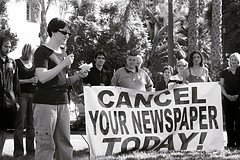
Investigative journalism 2.0

newspaper_journalismSelf-described new media whore Paul Carr has an interesting take on the future of investigative journalism and publishing – the problem:

Talk to a random sample of journalists and they’ll tell you the same thing – no one commissions investigative journalism any more.

Talk to any editor and they’ll tell you why; it costs a fortune to produce and rarely adds anything in terms of circulation or bottom line.

In an era of plummeting circulation and competition from free online news sources, as far as a cost-benefits analysis of newspaper investigations goes, it’s all cost and no benefit.

Basically another example of the problem of monetizing content that costs a lot to produce but little to reproduce. After dismissing one Web 2.0 business that attempts to address the problems of investigative journalism called Spot Us Mr Carr proffers his own solution:

I’d kill it. Take it out to the shed and put a bullet through its brain. Its been sick since the mid-80s and watching it try to struggle for twenty more years is embarrassing at best and cruel at worst.

Walk in to any bookshop and go to the politics, culture, biography or current affairs section. Now tell me investigative reporting is dead.

Of course these are the big stories – what of the smaller, more immediate ones? TV news. It’s there first, it has money and access and it has a 24 hour cycle to fill, meaning that every lead gets followed and reported no matter how apparently inconsequential.

Online news sources have their part to play too, although, frankly, they can be divided into two camps – brand extension for established media companies or total horseshit. Blogs have a role – but it’s confined to fact checking and uninformed gadflyery.

This gadfly likes Carr’s idea of idea of a cheap, subscription book-service, slightly more in-depth than a typical article in The Economist but less heavy than (for example) the 464 pages of Blackwater: The Rise of the World’s Most Powerful Mercenary Army and you would also get a tighter, more focused, and original piece of reporting:

I’d approach an established publishing house with a business plan – a new imprint that publishes short (40,000 words maybe), low cover price (£4.99 tops) books, each written by a recognised investigative reporter and each dealing with a single investigative subject.

Also recommended is Paul Carr’s recently published book Bringing Nothing to the Party: True Confessions of a New Media Whore. It combines hilarious gonzo journalism with genuine insight from Paul Carr’s experience as a wannabe Web 2.0 entrepreneur.
[story from Paul Carr’s blog][image from dsearls on flickr]

Cybercrime isn’t all that bad…

…or at least as bowel-voidingly terrifying as people might think.

Prof David S. Wall from the University of Leeds has published a paper – Cybercrime and the Culture of Fear: Social science fiction(s) and the production of knowledge about cybercrime – which has been profiled on IO9 that claims that:

Cyberpunk effectively defined cybercrime as a harmful activity that takes place in virtual environments and made the ‘hi-tech low-life’ hacker narrative a norm in the entertainment industry. It is interesting to note at this point, that whilst social theorists were adopting the Barlovian model of cyberspace, it was the Gibsonian model that shaped the public imagination through the visual media.

Of “the Barlovian model of cyberspace,” to save you the trouble of Googling, after the IO9 article there is an extract from a lecture on Media and Cyberculture, which says that Barlovian refers to John Perry Barlow, the Grateful Dead lyricist, and one of the founders of the EFF. He declares in A Declaration on the Independence of Cyberspace :

“We are creating a world that all may enter without privilege or prejudice accorded by race, economic power, military force, or station of birth, We are creating a world where anyone, anywhere may express his or her beliefs, no matter how singular, without fear of being coerced into silence of conformity. In our world, whatever human mind may create can be reproduced and distributed infinitely at no cost. We must declare our virtual selves immune to your sovereignty, even as we continue to consent to your rule over our bodies. We will spread ourselves across the Planet so that no one can arrest our thoughts. We will create a civilization of the Mind in cyberspace. May it be more humane and fair than the world your governments have made before”

Which is interesting, to say the least. Check out Professor Wall’s paper in full here (I doubt I could write a better profile than the one at IO9).

And if that was not enough, you too can immerse yourself in the reality of being a successful cyberpunk novelist and Zeitgeist-definer by listening to William Gibson’s playlist.

[story via Beyond the Beyond, William Gibson’s playlist via Boing Boing]

NEW FICTION: THE PLASTIC ELF OF EXTRUSION VALLEY by David McGillveray

This month David McGillveray returns to Futurismic with a new story, “The Plastic Elf of Extrusion Valley”. Strange things are afoot in the computer-controlled fabrication farms of Germany’s Altes Land

The Plastic Elf of Extrusion Valley

by David McGillveray

A cold October breeze came down from the North Sea, but no leaves rustled in the plastic forest. Instead, an eerie, fluting music played in the valley as the wind moved over the tall cylinders like a kid blowing over bottle tops.

My midnight walks were one of the few pleasures I took from working in the extrusion fields. Despite the approaching winter, the soil was warm against the soles of my feet. I imagined with equal measures of fascination and disquiet the seething activity below, the billions of nanoconstructors setting molecule upon molecule, endlessly building. These fields never lay fallow: four harvests per year, as kilometres of commercial piping grew fresh from the magic soil, regular as quarterly budgets. Continue reading NEW FICTION: THE PLASTIC ELF OF EXTRUSION VALLEY by David McGillveray

The Gulf Of Mexico becomes Hurricane Alley

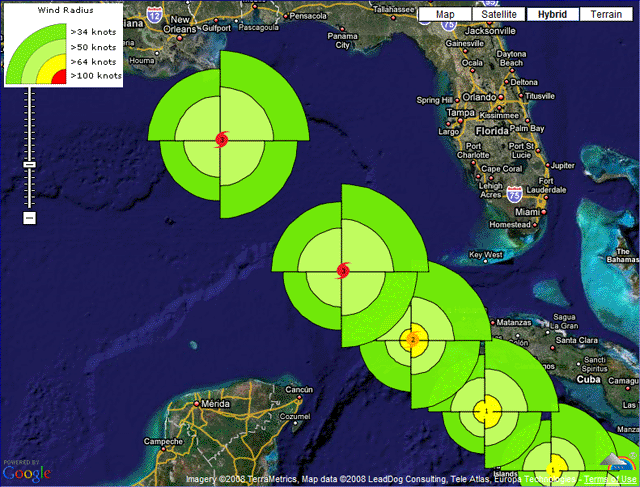
Gustav and Hanna are both predicted to be 'big ones'In the sixties, Roger Zelazny wrote ‘Damnation Alley’, in which Hell Tanner drives from Los Angeles to Boston in a land ravaged by near constant hurricanes and tornadoes in an attempt to deliver a life-saving plague vaccine. While we’re nowhere near that doomsday scenario, this year’s hurricane season is certainly hotting up.

Hurricane Gustav is crossing Cuba into the centre of the Gulf of Mexico today, with many of the simulations projecting it to land as a strength three hurricane somewhere in Louisiana on Tuesday night. Meanwhile, a few days further out in the Atlantic tropical storm Hanna (the eighth named storm of the year) is growing steadily and is also projected to land as a hurricane next weekend anywhere from Florida to Mexico. It may or may not enter the Gulf.

Further out than that a number of other weather systems are beginning to form in the infamous ‘hurricane alley’, creating a conveyor belt of large storms. High ocean temperatures of 28-32 degrees in the Gulf of Mexico in particular are increasing the size of intensity of these systems. When the sea temperatures are above 26 degrees, a tropical storm or hurricane above it will intensify. Below that level the cyclone begins to unravel. With Ocean temperatures high and a number of storms forming, the Southeast coast of the US and the caribbean are in for a pounding over the next few weeks. Oil experts are already beginning to predict problems for oil production, with large percentages of US oil production and refining taking place in the Gulf of Mexico. While it would be inaccurate to link a single hurricane to climate change, if tropical ocean temperatures remain high, the residents at the end of hurricane rally will have to expect more storms.

[via The Oil Drum, Gustav weather picture via Weather Underground]

Presenting the fact and fiction of tomorrow since 2001