
Evolution observed in laboratory bacteria

Image of E Coli in the labFor the first time, a major evolutionary change has been observed in laboratory conditions, giving even greater weighting to evolutionary theory. The bacteria used, a strain of E. Coli, was first introduced into the Michigan State University lab twenty years ago by evolutionary biologist Richard Lenski. Some 44,000 generations later, the bacteria are still reproducing.

Somewhere around the 31,500th generation, the E. Coli developed a trait not present in the original strain: they began to be able to metabolise citrate, the inability of which is one of the main ways scientists distinguish E. Coli from other bacteria. Importantly, the paper says that evolution occurs as a sum of the previous steps of mutation and that as this history varies between groups of creatures, evolution is a random and unpredictable act.

“It’s the most profound change we have seen during the experiment. This was clearly something quite different for them, and it’s outside what was normally considered the bounds of E. coli as a species, which makes it especially interesting,” says Lenski.

One of the main criticisms of evolutionary theory has been that it is a theory that hasn’t been observed in the real world. Creationists are going to have a hard time explaining this result away, one suspects.
[via Daily Kos, image by scaliber001]

Innocence-Sensitive Spy Cams

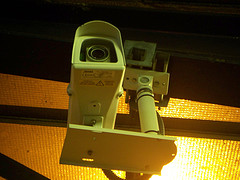
security cameraSince 9/11, the government’s use of video surveillance on the public has increased dramatically (this opens a new window with a .pdf). While the vast majority of this surveillance has been implemented to “protect the country from another 9/11-style attack”, it has been used in other arenas as well, namely in attempts to catch wanted criminals. It’s effectiveness in such a capacity is questionable at times, and the effects of such surveillance on society is noteworthy [photo courtesy of kafka4prez].

However, companies like 3VR – one of the largest surveillance software and video-analysis producers in the world – have begun development of increased-privacy software that would seek to protect innocent people from being falsely targeted by authorities. Their software is hoping to visible blur every face in video surveillance unless an investigation requires that the people in the video be identified. It seems like a small step in the right direction to counter the immense violations by the NSA not too long ago, but at least it’s something.

Robotic Dragonflies

Fans of one of Terry Pratchett’s early comic science-fiction novels The Dark Side of the Sun, will be familiar with the idea of robotic versions of insects being used as “bugs” to spy on people.

This is an idea that is being enthusiastically embraced by the US military, with many small UAVs in development for surveillance purposes.

And there is even more insect-themed biomimicry on it’s way from the labs: the dragonfly is of particular interest, according to researchers:

Dragonflies are one of few creatures that utilize four independently controlled wings to fly,dragonfly allowing them to hover, dart, glide, move backward, and change directions rapidly. Looking to understand such abilities, scientists at the Royal Veterinary College, in England, and the University of Ulm, in Germany, have developed a robotic dragonfly to measure the current flows over and under the wings at different flap cycles. While most of the dragonfly hovering scenarios were not efficient, the team found that if the lower wings are beating slightly ahead of the top wings, the double set of wings proves more efficient at generating lift, employing 22 percent less power to lift the same weight as a single pair.

Well good luck to them. Fortunately for privacy-lovers/paranoids it seems that practical fabrication of these insect spies is still some way in the future.

[story from Technology Review][image by Lori Greig]

Second Life, 3D dildos and the intellectual property mindset inversion

Sven Johnson reports on intellectual property wranglings in Second Life for the latest instalment of Future Imperfect.

Future Imperfect - Sven Johnson

Second Life’s unique content creation tools have been its strongest unique selling point, resulting in a vigorous virtual economy. But there, just as in real life, intellectual property rights are a thorny issue – and there are signs that the social media masses are starting to change their attitude to content theft.
Continue reading Second Life, 3D dildos and the intellectual property mindset inversion

William Gibson interviewed at io9

William GibsonJust in case you hadn’t noticed, the good folks at io9 have an interview with the nigh-legendary William Gibson, who I’m sure needs no introduction to Futurismic readers. Here he is explaining why he thinks people describe his work as dystopian:

“None of us ever live in dystopia. That’s an imaginary extreme. They just live in shitty cultures. And these societies [in my books] seem dystopian to middle class white people in North America. They don’t seem dystopian if you live in Rio or anywhere in Africa. Most people in Africa would happily immigrate to the Sprawl.

Click on over; plenty of brain food in exchange for five minutes of your time. [image by fugin]

Presenting the fact and fiction of tomorrow since 2001