Eat it, Crichton

pieeyedemuPaleontologist Jack Horner has a better way to resurrect dinosaurs than all that tedious mucking about with mosquitoes and blood and amber. Far easier to start with a bird and work backwards. Avian DNA already contains instructions to make tailbones, teeth, scales, and claws. In “Dinosaurs: Return to Life?”, a Discovery Channel documentary, Horner says he would start with an emu, which looks halfway like a velociraptor anyway. A chicken would do in a pinch. (Unfortunately, the show does not seem to be scheduled for rerun anytime soon.)

Has Michael Swanwick written this story yet?

[Image by Ryan Ladbrook]

Friday Free Fiction for 6th June

Chipped from the granite of regular internet content, we present to you the fictional gems prised out from the unyielding seam. Or something like that, anyway!

***

Here’s a handful from ManyBooks.net:

  • The Night Of The Long Knives” by Fritz Reuter Leiber Jr.
  • Heist Job on Thizar” by Gordon Randall Garrett – (“In the future, we may discover new planets; our ships may rocket to new worlds; robots may be smarter than people. But we’ll still have slick characters willing and able to turn a fast buck–even though they have to be smarter than Einstein to do it.”)
  • A World Called Crimson” by John Darius Granger – (“There was a boy and a girl and a strange new planet; the planet was alive with hideous dangers. But the boy and girl were very young and all Robin wanted to know was: “Who stole my doll?”” Well, there’s your human angle, right there.)
  • The Great White Queen by William le Queux – A “Lost Race” tale, apparently, from 1897 – all 90k+ words of it!

***

It’s a veritable Richard Kadrey-fest at FeedBooks:

***

The latest Clarkesworld is in the wild, as reported by Nick Mamatas:

“Regular readers may remember that I “got Lishy” with Paul Jessup‘s “The Secret in the House of Smiles“, which is our fiction feature this month.

Also, get those fingers ready to write cranky letters about our non-fiction feature Cheer Up Emo Kid! Being Depressed (or Gay) is Not All in Your Genes.”

***

You can download Pantechnicon #7, or just read it all online – the choice, dear reader, is yours!

***

Via BoingBoing:

Little Fuzzy is [H. Beam] Piper‘s masterpiece, a tight, neat science fiction story that epitomizes the golden age of sf. It concerns a prospector on a distant world who discovers a potentially sentient aboriginal race (the “Fuzzies”), and his ensuing fight – fists, lawyers and even guns – to get them recognized as sentient beings.

Little Fuzzy is in the public domain, so there’s both a free ebook and a free audiobook recording available of the text.”

Never read it myself, but I remember my mother adoring it – and she’s got great taste. She thinks I’m handsome and intelligent, so she must do. 😉

***

Cthulhu be praised! Via Metafilter, Selected Stories of H P Lovecraft! (Nearly fifty or so, by the look of it – can the fabric of reality handle that much terror?)

***

A morsel of fiction from Peter Watts – “Family Values“:

“Screw this. I’m sick of being outnumbered by morons. I’m calling in reinforcements.”

We all know that feeling, AMIRITE?

***

Jayme Lynn Blaschke is up to instalment 14 of Memory:

“You bastard.” Flavius’ voice was a low growl. “You let them kill me twenty-seven times?

***

A last-minute submission from Jake Freivald:

“The new issue of Flash Fiction Online is up with two new stories (one sci fi, one horror), a classic flash (literary), an essay by SFWA member Dave Hoing (call it literary, I guess), and, for the writers out there, the first installment of a new column by award-winning author Bruce Holland Rogers about writing the short-short form.”

Cheers, Jake!

***

And finally, speaking of flash fiction, it’s those fine and fulsome Friday Flash Fictioneers:

***

And that’s everything pre-deadline for this week, ladies and gents. Keep those tips and plugs coming in – and have a great weekend!

Plastic Fantastic: Developing Fluid Intelligence

A recent topic of interest in the reputable journals of opinion, including Wired Magazine and The Independent has been the possibility of artificially enhancing human intelligence. Methods suggested include Viagra for your Brain, or nootropics: drugs that are thought to enhance intelligence and cognitive ability.

Examples include ritalin, a drug used primarily to help ADHD sufferers which is also claimed to promote alertness and concentration in healthy people, and modafinil, a drug designed to combat sleep disorders but which is also being used to extend the period for which people can stay awake and active.

Fortunately there are also options for squares like myself who don’t have the guts to pop pills bought on the Net: algorithmic approaches to learning, and most recently the possibility of boosting IQ by enhancing fluid intelligence:

Most IQ tests attempt to measure two types of intelligence–crystallized and fluid intelligence. pillsCrystallized intelligence draws on existing skills, knowledge and experiences to solve problems by accessing information from long-term memory.

Fluid intelligence, on the other hand, draws on the ability to understand relationships between various concepts, independent of any previous knowledge or skills, to solve new problems.

The research by brain boffins Susanne M. Jaeggi and Martin Buschkuehl appears to occupy the class of scientific experiments entitled confirming the bleedin’ obvious (facetiousness aside, this is of course as necessary and laudable as any scientific endeavour :-)) :

Researchers gathered four groups of volunteers and trained their working memories using a complex training task called “dual n-back training,” which presented both auditory and visual cues that participants had to temporarily store and recall.

Participants received the training during a half hour session held once a day for either eight, 12, 17 or 19 days. For each of these training periods, researchers tested participants’ gains in fluid intelligence. They compared the results against those of control groups to be sure the volunteers actually improved their fluid intelligence, not merely their test-taking skills.

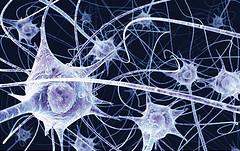
The results were surprising. While the control groups made gains, presumably because they hadneurons practice with the fluid intelligence tests, the trained groups improved considerably more than the control groups. Further, the longer the participants trained, the larger were their intelligence gains.

“Our findings clearly show that training on certain memory tasks transfer to fluid intelligence,” says Jaeggi. “We also find that individuals with lower fluid intelligence scores at pre-test could profit from the training.”

So practice makes you better, if not perfect. As I’ve mentioned before, combining a better understanding of learning methods with drugs that have a direct affect on cognitive ability will have a huge impact on life over the course of the next century, even changing what it means to be human.

[main story via PhysOrg][other stories from The Independent and Wired][images by e-magic and LoreleiRanveig]

Science: It Really Is Everybody’s Business

T-Rex of Dinosaur ComixA museum public-relations coordinator for a Texas museum was the first to discover a fossil of a duck-billed dinosaur while touring a dino dig in Montana. A paleontologist says he would have missed it:

I knew enough never to go to a ridge top because you don’t find specimens there. But I forgot to tell that to Steven, so he did exactly that and proved me wrong.

[Dinosaur Comics, Ryan North]

Time is A One Way Street…

TimeThe June 2008 issue of Scientific American sets out to answer a very perplexing question:

Why does time only move forward?

To find the answer, according to Sci-Am and Mr. Sean M. Carroll, we have to start looking at a very unlikely place:

To account for it, we have to delve into the prehistory of the universe, to a time before the big bang. Our universe may be part of a much larger multiverse, which as a whole is time-symmetric. Time may run backward in other universes.

The article is filled with high-end physics and a bit of science jargon, but Mr. Caroll puts uses neat little analogies to explain difficult concepts:

The asymmetry of time, the arrow that points from past to future, plays an unmistakable role in our everyday lives: it accounts for why we cannot turn an omelet into an egg, why ice cubes never spontaneously unmelt in a glass of water, and why we remember the past but not the future. And the origin of the asymmetry we experience can be traced…back to the orderliness of the universe near the big bang. Every time you break an egg, you are doing observational cosmology.

All in all, it’s a very interesting article and well worth a read. Some of the concepts used in the article are highly science fictional and are prime idea fodder for stories about multiverses and time travel. In fact, for those who’ve read River of Gods, may recognize the inspiration for ideas in that novel presented in this article. [image by gadl]

Presenting the fact and fiction of tomorrow since 2001