So those cancer-causing nanotubes that people are raving about (wait, are they?) might be combined with the vast supply of dust and debris on the moon to make a new kind of concrete for structures on the moon. It seems like a workable idea, though, and the cost of structures would be very minimal. NASA’s idea is to build telescopes, satellite arrays, and other equipment on the moon and utilize this new “concrete” for those purposes. Considering all the material is readily available, it doesn’t really take much to conceive of a science station up there. Or a moon colony – oh, now that’s exciting.
Low-Tech Solutions For Rural India
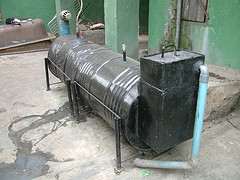 Ever since I read Ian McDonald’s River of Gods, I’ve looked at India from a futuristic, economically oriented perspective to understand how the lives of millions of Indians are being changed by technology. While the cosmopolitan metropolisis of Dehli and Bombay have undergone enormous growth in the last centry, the more interesting changes have happenned among the rural populations. Now, with natural gas prices at an all time high, India is turning to Nature, and the sacred cow for a wholly low-tech solution to their problem. The biogas generator looks set to be the tipping point for cheap, renewable energy for India’s villages. [image by 1village]
Quite simply, a biogas generator is a system that utlizes the gas byproduct of the anaerobic digestion of organic materials for heat and/or flame. These generators, like the one featured in the picture above use manure and organic waste materials to produce methane, which is piped from a central tank via pipes, and can be used by an entire village.
Visible Magnetic Fields
Magnetic fields are weird, something that’s invisible in and of itself, but nevertheless acts on the other objects. By way of visualising magnetic fields, some boffins from Semiconductor working at NASA Space Laboratory as “artists in residence” – Ruth Jarman and Joe Gerhardt – have created this incredible movie depicting magnetic fields:
There isn’t much explanation as to what this is – how abstract is the representation? From Semiconductor Films:
In Magnetic Movie, Semiconductor have taken the magnificent scientific visualisations of the sun and solar winds conducted at the Space Sciences Laboratory and Semiconducted them. Ruth Jarman and Joe Gerhardt of Semiconductor were artists-in-residence at SSL. Combining their in-house lab culture experience with formidable artistic instincts in sound, animation and programming, they have created a magnetic magnum opus in nuce, a tour de force of a massive invisible force brought down to human scale, and a “very most beautiful thing.”
Well it sure is pretty, but it would be nice if there were some details as to how the effect was created. It reminds me of the “fields” of the drones from Iain M Bank’s billiant Culture series, which use coloured “fields” to convey emotion and also as manipulators.
[story via technovelgy]
Open-source self-replicating machine, er, self-replicates
Self-replicating machines, as a concept, have been around since mathematician John von Neumann thought them up. But there has never been a working non-organic machine that has been able to construct a fully-functional working clone of itself … until now. [story via pretty much everywhere; image from the RepRap homepage]
“RepRap achieved self-replication at 14:00 hours UTC on 29 May 2008 at Bath University in the UK.”

I’ve linked to the RepRap Project before when I first started blogging here at Futurismic, and so I’m immensely pleased to see they’ve reached this major milestone. And the head-twistingly awesome bit about it is that, as RepRap is 100% open-source, you can just download a parts list and make your own, then set it to make copies of itself to give to your friends.
“The machine that [self-replicated] – RepRap Version 1.0 “Darwin” – can be built now – see the Make RepRap Darwin link, and for ways to get the bits and pieces you need, see the Obtaining Parts link.”
OK, so it looks clunky, and it lacks the conceptual elegance of Drexler’s engines of creation, but think of it as a proof of concept. Imagine that RepRap could build a functional replica of itself at half the size, and that then the replica could replicate to half the size again, and so on. Unless you’re worried about the largely improbable “grey goo” scenario, it’s possible that we’ll look back on RepRap as the dawn of a new age for the means of production …
… or the root cause of global unemployment, maybe. 😉
Got Change for an Electron?
 Israeli scientists have sliced electrons into “quasiparticles,” each with a quarter charge of the electron.
Although electrons are indivisible, if they are confined to a two-dimensional layer inside a semiconductor, chilled down to a fraction of a degree above absolute zero and exposed to a strong magnetic field that is perpendicular to the layer, they effectively behave as independent particles, called quasiparticles, with charges smaller than that of an electron.
Quasis have been known for 20 years, but they were “odd fractionally charged” — one third of an electron, one fifth, etc. The quarter-charges behave differently and may be useful for computing.
Those of us who have trouble wrapping our heads around quantum stuff might sympathize with astronomers, who, the New York Times tells us, are finding cosmology just as puzzling.
As far as astronomers can tell, there is no relation between dark matter, the particles, and dark energy other than the name, but you never know.
Nevertheless, string theorist Brian Greene, promoting the World Science Festival, reminds us of something most readers of this site would probably find a truism, but is probably a new idea to a lot of people:
We must embark on a cultural shift that places science in its rightful place alongside music, art and literature as an indispensable part of what makes life worth living.
[Ella Delivers Her Lecture on String Theory by Phillip C]