
What Is It to Be a Human?

Wired.com had this article on the World Science Festival in New York City. I think all of us – at some point in our lives – questions who we are, what makes us different, or even why we’re “here”. But have you ever sat and thought to yourself, “what makes me human?”. Here’s my answer. I’m curious to know about yours.

We are unique in our ability of self-recognition. We know ourselves; we recognize ourselves as being unique; and we know that others around us are unique, too. We build upon that and communicate in a way that is different from every other creature. We look at the world in concepts and abstractions, rather than concrete “things”.

That is my answer. What’s yours?

Open Source SF

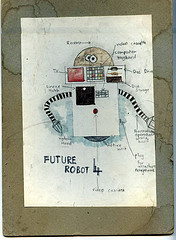
Open Source RobotOver at SF Signal, several writers and editors were asked the following question:

Which medium is driving [SF] … books or Film/TV?

There were interesting responses all around I thought, but the most thought proving answer, IMHO, came from io9 editor Charlie Jane Anders, who said:

“The future of science fiction is probably online, in a blend of written material, video and other media. The best science fiction of the future will be open source and collaborative, blurring the distinction between “creators” and “fans” to an increasing degree… there will be obvious advantages in opening things up to collaboration. One major difference between [SF] and most other genres is worldbuilding. And the more people you have involved in your worldbuilding, the bigger and more realistic your world can be. So the most compelling science fictional worlds online will be ones that are, at least to some extent, open-source…”

I can’t point to any examples of open source SF in online print and video venues directly yet, but consider what video games like Neverwinter Nights, Starcraft, et al. are/were doing for RP-style games with level builders or what Second Life is doing for massive online communities, and we may see what Ms. Anders is getting at. [image by Salim]

The Wire

Personally, I won’t believe it till I hear some guy on cable screaming about it at the top of his lungs. But how about a nanowire-mesh “paper towel” that can clean up 20 times its weight in oil, and recycle the gunk for future use? It might filter and purify water, too.

The new material appears to be completely impervious to water. “Our material can be left in water a month or two, and when you take it out it’s still dry,” [MIT materials scientist Francesco] Stellacci said. “But at the same time, if that water contains some hydrophobic contaminants, they will get absorbed.”

[Photos: Francesco Stellacci, MIT, and Nature Nanotechnology] [story via Gregory Frost]

Contemplating immortality, contemplating death

ninjaThere’s a lengthy (but well worth the read) article at COSMOS Magazine about the prospect of functional human immortality, which – thanks to fairly recent scientific advances – now looks plausible as opposed to impossible. Unlike many articles of its kind, it looks at the psychosocial implications of such a change:

“Our relatively brief lives and our routine proximity to the deaths of ourselves and others are the foundations of everything we have ever thought or believed. Neither religion nor philosophy necessarily promises immortality, but each offers ways of coming to terms with or giving meaning to death and, therefore, life. If death is to be postponed indefinitely, then both religion and philosophy face fundamental crises.”

Well, at least we’ll have the leisure time to talk it all out! [image by brunkfordbraun]

On the flip-side, an article at Wired takes a look at a new computer game wherein the bodies of your slain opponents don’t disappear:

“Over the years, I’ve noticed that most of the seriously violent games I love deal with the corpses by simply whisking them away. […] After I’d killed my way through about seven battles, I experimentally backtracked all the way to the beginning, and sure enough – every body was still lying there, every blood fleck on the ceiling intact.

Now, did this change the emotional, or even moral, timbre of the game?

In some ways, yes. You really do get a better sense that you’re a sociopath when the evidence of your crimes is stacked around you.”

Perhaps, rather than being the training grounds for murderers that some might claim them as, violent games could actually encourage their players to think harder about the consequences of their actions in the real world? That could come in handy – especially if we ever find we can live forever.

Making Our Future as Better Ancestors

StonehengeIt seems to be the custom for new Futurismic posters to introduce themselves. I don’t see race, sex, age, residence, politics, or preferences. But people tell me I’m a 53-year-old white guy who lives in Arizona, leans to the left, and likes fiction, history, journalism, science, The Loud Family and The New Pornographers, and I believe them.

The birth of yet another niece puts me in mind of Samantha Powers’ recent commencement advice: “Be a good ancestor.” One way to do that might be to start treating the environment as part of the economy, by putting a dollar value on it. A report to the U.N. Commission on Biodiversity estimates that humans do at least $78 billion worth of damage each year, “eating away at our nature capital” through deforestation and pollution. Sobering to consider that about 40% of the world economy is still based on biological products and processes.

In light of the likely first contact with an uncontacted seminomadic Amazon tribe on the borderlands of Brazil and Peru, we probably need to factor cultural diversity into the equation, too. There’s something poignant and human about that AP photo of tribespeople firing arrows at an aircraft.

Think about all our ancestors have done for us. The origin and purpose of Stonehenge is no longer a total mystery, according to recent investigations: it served as a cemetary for at least 500 years beginning 5,000 years ago. It may have functioned for 20 or 30 generations as the resting place of a ruling dynasty. At least 300 surrounding homes made it one of the largest villages in northwestern Europe.

Ancestor-worship as big business? If that’s not old enough for you, consider a 375-million-year-old ancestor called the placoderm fish, with a fossil embryo attached with an umbilical cord. It’s the oldest known instance of live birth. Now think what our moms put up with, bringing us into the world. [Image by Danny Sullivan]
Presenting the fact and fiction of tomorrow since 2001