Algorithms to reveal secrets of East Germany

In Spring 2006, I spent a week in Berlin with some friends from university. As part of a city tour highlighting the Berlin’s Cold War heritage, the guide made a passing reference to plans for the digital reconstruction of files shredded by East German secret police.

As this project entered its pilot stage in May 2007, Germany’s Spiegel Online reported on the finer details;

[W]ith the looming collapse of the Communist regime becoming increasingly evident [in 1989], agents of the East German Staatssicherheitsdienstfeverishly plowed millions of active files through paper shredders, or just tore them up by hand.

Rights activists interrupted the project and rescued a total of 16,250 garbage bags full of scraps. But rescuing the history on those sheets of paper amounted to an absurdly difficult jigsaw puzzle. By 2000, no more than 323 sacks were legible again — reconstructed by a team of 15 people working in Nuremburg — leaving 15,927 to go. So the German government promised money to any group that could plausibly deal with the remaining tons of paper.

The Fraunhofer Institute won the contract in 2003 … Four hundred sacks of scraps will be scanned, front and back, and newly-refined software will try to arrange the digitized fragments according to shape, texture, ink color, handwriting style and recognizable official stamps.

This week, as the pilot phase of the project reached completion, the BBC’s radio programme Digital Planet picked up on the story;

“It will be a long job – but that’s the interesting part,” said the Fraunhofer’s Jan Schneider.

“First we have to digitise all the pieces from the bags. This is done by a special high-speed scanning device.

“The next step is to segment the image itself from the raw scan – we need the outline of the pieces, pixel-wise, to perform the reconstruction process after that.

“Then all digitised pieces of paper are stored in the database. After that we reconstruct a lot of the descriptive features of the pieces.”

However, at the former Stasi prison Hohenschonhausen, the main place political prisoners were held and subjected to torture, there are criticisms that the process has already taken too long.

“I think it comes a little bit late,” said Hubertus Knabe, director of the memorial at the site, which is also a museum.

“Nearly 20 years after the fall of the Wall we start to reconstruct these Stasi files, which are really important: the most important files were the ones they destroyed.

“I am happy that now it is going forward, but it is late.”

[2nd story via the BBC]
Frikkin’ LASERs

Another wonderful development in the world of LIDAR – LIght Detection And Ranging – has lead to the possibility of mapping the surface and geophysical properties of other planets with with “differences [in height] down to one centimeter“. Pixel resolution has also greatly increased, “from kilometers square to a few feet by a few feet.

LIDAR works on a similar principle to radar, but through the use of lasers rather than radio waves. The laser is shot at an object, and the time delay between the pulse and the reflection is measured in order to accurately gauge the distance. The advantages of LIDAR over radar are twofold: LIDAR can be used to measure smaller objects, and it works on a greater variety of materials.

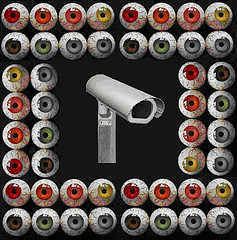
Of course project leader Professor Donald Figer is keen to promote his system’s anti-terrorism credentials:cctv

“Imagine,” he says, “that you have this 3-D, 180-degree fish-eye system . . . in every city scanning continuously for biohazards.”

I know it’s meant to be scanning for biohazards, but presumably the system could also be used to create real-time, centimetre-resolution maps of cities, including the relative positions of every individual. Combine this with currently existing surveillance systems and we could have ourselves a nice panopticon by the middle of the century.

[original story from Technology Review][image by Mike Licht]

Singularity season – nerd rapture or inconvenient truth?

array of computer screensNothing divides opinion like the future – it’s human nature, we all love to take a stab at predicting what will come. But it’s also human nature to disagree over what cannot yet be proven (which is something we can be sure of by looking at the past).


So, Vernor Vinge – the computer scientist and sf novelist who coined the term ‘Technological Singularity’ as used in this context during a presentation back in the eighties, and has talked about it ever since in his fiction and elsewhere – provides the capstone article to a special Singularity edition of IEEE Spectrum, defending the concept against the criticisms levelled at it by various scientists, economists and philosophers.

“The best answer to the question, “Will computers ever be as smart as humans?” is probably “Yes, but only briefly.””

For some odd reason IEEE neglected to solicit Warren Ellis‘s opinion, so he supplied it himself:

“When you read these essays and interviews, every time you see the word “Singularity,” I want you to replace it in your head with the term “Flying Spaghetti Monster.”

As always, if you want the apogee of cynicism, Ellis is your man; he’s the bucket of cold water thrown over the mating dogs of enthusiasm.

But other opinions are available, as the adverts say – George Dvorsky’s response to Ellis, for example:

“The day is coming, my friends, when Singularity denial will seem as outrageous and irresponsible as the denial of anthropogenic global warming. And I think the comparison is fair; environmentalists are often chastised for their “religious-like” convictions and concern. It’s easy to mock the Chicken Littles of the world.”

What do Futurismic‘s readership think about the Singularity – awesome sf-nal literary metaphor, or looming technological likelihood? [image by binary koala]

Hi

Hi, My name is Arun Jiwa. I’m Futurismic‘s newest blogger, and I’ll briefly introduce myself. I’m 19, and I grew up in India. I moved to Edmonton, Alberta in Canada when I was 8 and I’ve been living there since. Right now, I’m spending five weeks in the South of India. I’ve been a fan of the written word since a very young age, and I’ve been reading SF, Fantasy, and Horror for most of that time.

Offhand, a list of my favorite authors in SF include (but are not limited to) William Gibson, Ian McDonald, Alastair Reynolds, Charles Stross, Benjamin Rosenbaum, Neal Asher, Gene Wolfe and Tobias Buckell.

In Fantasy I’ll read anything by Robin Hobb, George R.R. Martin, Patrick Rothfuss, Neil Gaiman, Gene Wolfe, and Lynn Flewelling.

My own blog is The Middle Way

I look forward to blogging with Futurismic.

The Internet is Not Democratising

New ideas are always interesting, and they are the bread and butter of good science fiction.

Here’s one: suppose the Internet is not the democratic, equalising, freedom-enhancing system it has been portrayed as? This network of computer networks has supposedly had the greatest democratising influence on freedom of speech and expression since the invention of the printing press.

But wars are still fought, prisoners are still tortured, dictators still grinding their people into the ground, and the oil price is rocketing. We have the Internet now: why hasn’t all that bad stuff stopped yet?

If you only read one lengthy article this month let it be this essay called The Liberizing Ideology of the Internet by a poet called Jesper Bernes.

Bernes’ basic argument is that the idea that the Internet is democratising and liberalising is wrong. A few controlphrases stand out:

The internet is a screen, a series of screens. It’s true: everyone can have their own blog, can publish their poems online so that the whole world can not read them, can peruse and produce the contents of the internet freely (in all senses of this word). But below this level of freedom, this level of leveling and equalization, the old exclusions and inequalities still obtain—differences in literacy and knowledge, differences in access to free time, differences in positionality with regard to social networks and cultural capital.

The essay is full of high-brow ideological arguments, which are interesting in their own right, but the basic idea is remarkable for the fact that it is not one that is often read or heard. It is that the Internet is just another system of control:

Essentially, with the internet, capitalism gifts the masses with a false commons where people webcan work, off the clock, creating information and relationships that the ruling class can enclose, appropriate, commodify, and sell back to us at a later date.

This isn’t a luddite argument: the Internet is a valuable and necessary tool, and there’s a lot of stuff in Bernes’ article I don’t entirely understand, and of what I do understand there’s some I don’t agree with. I’ve never felt comfortable talking about politics in terms of ideologies like socialism or capitalism, or of economics in terms of class. I prefer to discuss politics in terms of policy and pragmatism.

I’m aware of the irony of suggesting the Internet isn’t a force for freedom of speech in a blog: but it’s always worth bearing contrarian opinions in mind.

What is the reality of the Internet? Is it genuinely revolutionary, or does it “virtualise and disembody resistance” as Bernes suggests? These are perfect questions for science fiction to explore.

[via Jon Taplin’s Blog][link to Little Red’s Recovery Room][images by MR+G and renatotarga]

Presenting the fact and fiction of tomorrow since 2001