
The Earth can take care of itself

Hungry African kidsDid you enjoy Earth Day?

Well, not everyone did. In fact, people in some equatorial countries are rioting over food shortages – a situation that even the slow-poke UN is worrying about.

One of the causes of spiralling food costs is the corn ethanol boondoggle. While it’s a good thing that we’re turning away from our dependence on oil derivatives, all the ethanol cars in the world will be of little comfort to hungry people … so we should probably be getting right behind the cellulosic ethanol researchers. And while we’re on the subject of cutting down on our oil diet, we could be making plastics from pig piss.

Perhaps you think I’m being a tree-hugger. If so, you’re missing the point. As happens so often, Jamais Cascio sums it up in the intro to an essay you should go and read:

The grand myth of environmentalism is that it’s all about saving the Earth.

It’s not. The Earth will be just fine. Environmentalism is all about saving ourselves.

[Supplementary links sourced from MetaFilter, Slashdot, BoingBoing and more; image by Felipe Moreira]

One wandering planet can ruin your whole day

Mars striking Earth This blog is called Futurismic, but mostly we just talk about the near future. Let’s take a look at the far future…say, a few tens of millions of years down the road.

New studies suggest that after 40 million years or so, there’s a small but not insignificant chance–one or two percent–that the solar system will lose its stability, and, Velikovsky-like, start throwing whole planets off on wandering courses through the rest of the system, where they just might crash into ours. (Via NewScientistSpace.)

Although no one can say for sure what will happen beyond that, new calculations are now providing a rough guide to the more distant future. These suggest that there is a 1 to 2% chance that Mercury’s orbit will get seriously out of whack within the next 5 billion years.

This would tend to destabilise the whole inner solar system and could lead to a catastrophic collision between Earth and either Mercury or Mars, wiping out any life still present at that time.

In the case of a smash-up with Mars, for example, “all life gets extinguished immediately, and Earth glows at the temperature of a red giant star for about 1000 years”, says Gregory Laughlin, a co-author of one of the studies at the University of California in Santa Cruz, US.

Interestingly enough, it might not be the first time that has happened:

Many scientists think a Mars-sized object bashed into Earth in the early solar system, throwing out debris that eventually formed the Moon.

Earth was heated to thousands of degrees by the impact, with an ocean of lava covering its surface. A future replay of that event would be disastrous, Laughlin says.

That last quote qualifies, I think, for understatement of the year.

(Image: NASA/JPL-Caltech.)

[tags]solar system, astronomy, catastrophes, far future[/tags]

Every month the Earth beats up the Moon with its magnetotail

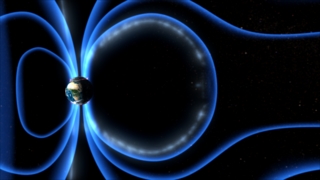
The Earth's magnetotail is a pretty thing to imagineThe Moon seems like a pretty static place. After all, there’s little atmosphere and apart from occasional meteorite impacts, nothing much happens. Or so we thought. NASA’s Lunar Reconnaissance Orbiter mission found that every month when the moon is full, the moon crosses through the Earth’s magnetotail, bathing our satellite in high energy charged particles that may create dust storms and electrical static.

Astronauts have never been on the Moon during this period. Landings have never taken place when the moon is full. But as Roland Piquepaille on ZDNet’s Emerging Tech blog discusses, if astronauts return to the moon to establish a base, they will have to face the challenges of the magnetotail, which could clog up vents and even give astronauts electric shocks!

[via Science Daily, image by NASA/Goddard Space Flight Center Conceptual Image Lab]

Burst Fiction is Futurismic Flash

Writing in a notebookThe longer I work on Futurismic, the more free fiction outlets I discover – I never imagined there could be so many, and I’m sure there are plenty more waiting to be unearthed*. [image by apesara]

I bumped into a guy called Eric Chevalier over at Warren Ellis’s Whitechapel forums, and he told me about his Burst Fiction project. Burst Fiction is:

[a]n active e-zine of one shot short stories, around 1000 characters in length, set in near contemporary times but with scifi tendencies.

Sound familiar? It’s like a combination of Futurismic‘s submission guidelines and the Friday Flash Fiction format! So get yourselves over to Burst Fiction and hoover up some crumbs of story from the metaphorical carpet of the intarwubs. Writer-types, take note – they’re looking for more content, too.

Also recommended, this time by Eric “Saijo City” Rice, is QuillPill.com, which is essentially a Twitter-equivalent for fiction writing (or journal keeping). That’s probably oversimplifying it a little, but I’ve not yet had a chance to test it out for myself – if you have a look (or have used it already), maybe you’d let us know what it’s like?

[ * And you do know that if you find one yourself, you should drop us a line so we can add it to the Sidebar Of Justice, right? ]

Universal translator a possibility?

Rosetta Stone replica Star Trek‘s various starship crews seldom have any trouble talking to aliens, thanks to a nifty device known as a “universal translator.” Although the universal translator was invented, like the transporter, simply because it was the only practical way to tell a story originally sold as “Wagon Train to the stars,” it might actually be possible to build one. (Via KurzweilAI.net.)

So says Terrence Deacon of the University of California, Berkeley, US, who argues that no matter how alien a species might be, its language–even if it communicates via, say, scent–must still describe real objects in the real world, which means there must be an underlying universal code that, given enough knowledge about language and sufficient computing power, could be deciphered.

Deacon presented his idea on April 17 at the 2008 Astrobiology Science Conference in Santa Clara, California.

New Scientist notes:

Testing the theory might be tough because we would have to make contact with aliens advanced enough to engage in abstract thinking and the use of linguistic symbols. But Denise Herzing of Florida Atlantic University in Boca Raton, US, points out that we might be able to test it by studying dolphins.

“Our work suggests that dolphins may be able to communicate using symbols,” Herzing told New Scientist. “The word’s not definitively in yet, but it’s totally possible that we might show universality by understanding dolphin language.”

New Scientist compares the proposed device to Douglas Adams‘s “babelfish,” a fish that translates languages. One hopes that if we do learn to understand dolphin language, the only thing they say to us, before decamping from the planet, isn’t “So long, and thanks for all the fish.”

(Image: Wikimedia Commons.)

[tags]Star Trek,language,extraterrestrial intelligence,aliens[/tags]

Presenting the fact and fiction of tomorrow since 2001