
The future of English

cat price Ooh, this combines two of my favorite things:  languages and the future.  John Scalzi’s grammar bitch of the day (granted, that day was a while ago) touches on one of those small spelling differences, specifically ‘alright’ vs ‘all right’.  While I disagree with Mr. Scalzi on this point (‘alright’ is  usable as that Lichtenstein art he has up, though I’d ask somebody “Are you all right?”), it’s something to think about when discussing the differences between English spellings.  I’ve spent all day today trying to explain to Japanese eight-year-olds why I say “zee” and my co-worker says “zed.”

Garance wonders if the proliferation of an unedited Internet might not bring about a return to the writings of previous centuries, when men wore hose and words were spelled phonetically:

As blogs move us into a less heavily copy-edited world, I sometimes wonder if we’re moving back into a more 16th and 17th century form of writing, where the idea of correct spelling was less important than the communication of meaning — which, in reality, can be accomplished just as well with incorrectly spelled words and homonyms as with a more perfect language. And also: as we move ever deeper into this new world of speech-like writing, will the perfect, formal language of the page one day seem as antique and elaborate as Victorian silverware?

What say you all?  I’m a stickler for spelling and grammar (though I muck it up a fair bit), but I can definitely see a return to a more homonymic age. (funny, lowercase ‘internet’ doesn’t pass my spellchecker, but ‘homonymic’ does just fine)

(image from lolcats, of course)
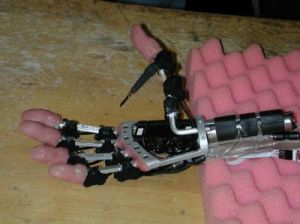
Prosthetic “fluidhand” raises the bar

Fluidhand - prosthesis prototypeVia Warren Ellis’s grinders, I present to you: the Fluidhand!

The flexible drives are located directly in the movable finger joints and operate on the biological principle of the spider leg – to flex the joints, elastic chambers are pumped up by miniature hydraulics. In this way, index finger, middle finger and thumb can be moved independently. The prosthetic hand gives the stump feedback, enabling the amputee to sense the strength of the grip.”

Prosthetics and exoskeletal tech are really making strides (arf!) at the moment. I don’t think it’s science fictional to suggest that we’ll be seeing prosthetic limbs that equal the functionality of the organic originals within a decade. [image borrowed from linked Physorg article]

But there’ll still be a stigma attached to having one, because of the aesthetic issues; it’ll be longer than a decade before there’s a false limb that would pass for a real one.

Maybe they’d become a badge of pride in certain industries or regions – among veterans of ideological conflicts, perhaps? And what about the possibility of elective prosthetics – people choosing to replace limbs that had nothing wrong with them?

Safer, saner cities

city park The more I go through life, the more I find that other people have very different experiences.  But if you’re from middle America, or any major city, much of Nature you’ve seen in your adult life has been through a car window going somewhere else.  And the traditional view of future cities has been a bigger and better version of the concrete jungle, like a bad SimCity where everyone lives in one area, commutes to work in another and goes shopping in a third.

A recent study found that more “walkable” neighborhoods bode well for the elderly, not merely for exercise and physical health, but also for their mental wellbeing.  Specifically,

Berke speculates that walkable neighborhoods might be so important because they promote social connection and reduce isolation, a major predictor of depression. “If people are out walking to destinations, they run into each other”, he says. “And then they talk, or interact, or share ideas”.  He adds that city streets with their shorter blocks, more direct routes, and greater number of intersections—can be more walkable than suburban ones. They also have greater population density, which increases the probability that people meet one another by chance.

This sort of connection between people in a neighborhood is something that has been lost in modern American cities and towns since the rise of the automobile and long-distance commuting became regular.  At least, it’s something that I’ve seen and heard about, but have never actually experienced.  But, with rising gas prices and actual debates going on about changing the way our cities grow, this is something that could impact our perception of futuristic cities.

(via SciTechDaily) (image from Andreas.)

Web wars – white hats versus black in botnet battles

CPU chip pinsThey may be off the news radar at the moment, but botnets are still a serious bugbear for computer security professionals – it’s hard work trying to defeat something that fights back, after all. [image by Rodrigo Senna]

So here’s a new idea from the University of Washington – why not fight fire with fire, and build a white hat botnet to defend against the DDoS attacks af the black hat botnets?

“Their system, called Phalanx, uses its own large network of computers to shield the protected server. Instead of the server being accessed directly, all information must pass through the swarm of “mailbox” computers.

The many mailboxes do not simply relay information to the server like a funnel – they only pass on information when the server requests it. That allows the server to work at its own pace, without being swamped.”

Sounds like a good plan. It’s beyond my knowledge levels, but the guys at Techdirt seem to think it’s a creative approach.

As a recent convert to Linux, this is the part where I smugly remind everyone that if certain commercially ubiquitous operating systems weren’t so riddled with security flaws, botnets wouldn’t be a problem anyway

The Future of Book Recommendations

Welcome to Blasphemous Geometries, a cross-media criticism column where Jonathan McCalmont pokes the foetid corpse of genre to see what oozes out.

Blasphemous Geometries by Jonathan McCalmont

In his introductory column, Jonathan examines new ways in which retailers might decide what to place in our paths next time we’re shopping around for some sf-nal entertainment. Continue reading The Future of Book Recommendations

Presenting the fact and fiction of tomorrow since 2001