Immune system in a jar could speed vaccine development

474px-Human_brain In old science fiction movies, mad scientists and the like always seem to have, somewhere around their lab, a brain in a jar.

I never much saw the point of that. How about something really useful: an immune system in a jar? (Via New Scientist Invention Blog.)

Invented by George Lewis, a virologist at the University of Maryland, this simple replica immune system would allow scientists to test vaccines in the laboratory to make sure they trigger the production of antibodies, without having to take the sometimes dangerous step of actually testing the vaccine in a living human being. This could greatly speed the process of producing new vaccines.

They simply culture white blood cells in the presence of an antigen (which could be a virus, or could be a vaccine designed to stimulate the immune system to produce antibodies against a specific virus). The cultured cells respond by producing new cells that make antibodies against the antigen.

Mad scientists, however, will probably want to stick with the old brain-in-the-jar: cultured white blood cells just don’t have the same visual impact.

(Image: Wikimedia Commons.)

[tags]medicine,vaccine,disease,mad scientists[/tags]
Free ebooks appear to boost sales

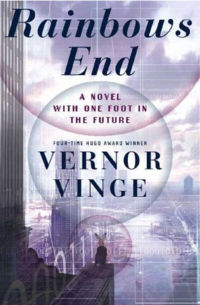
Vernor Vinge made his book ‘Rainbow’s End’ free to read onlineTor author (and sometimes Futurismic blogger) Tobias Buckell has an interesting post talking about the effects of authors giving away their novels. There has been a lot of criticism of the practice by some writers and lots of praise from other corners. But with Neil Gaiman adding his superb bestseller ‘American Gods’ to the list of books you can legally download for free, are people shooting themselves in the foot or will this bring more income in the future through increased readership?

At the moment, it looks like the practice works. Two of John Scalzi’s books are up 20% and 33% in sales since the first one was released as a free ebook by Tor. As Charles Stross has mentioned, the fact that current ebooks are as much as a few hundred grams of chopped down tree, chemical treatment, ink printing, shiny cover embossing, a few thousand miles of transportation, part of the salaries of manufacturers, printers, truck drivers and shop assistants that make up the price of a typical physical book is simply insane. And that’s not even including the price of an ebook reader like the Kindle monstrosity. So until someone comes up with a £50 reader that gives you digital books for £3, £2 of which goes to the author, ebooks aren’t a business model. But they do provide clever authors with the chance to increase their reader base. What do you guys think? Would you purchase a book after you’ve been impressed by the free ebook version?

[image is the cover of Vernor Vinge’s novel ‘Rainbow’s End’, which you can find for free online here.]

In praise of Uxo

Fellow Friday Flash Fictioneer (and good friend) Shaun C Green has been nothing short of effusive about Futurismic’s return to the fiction field. Shaun had this to say about Eliot Fintushel’s “Uxo, Bomb Dog”:

“The tale itself is brilliantly written, with a distinctive voice and a playful approach to its arduous subject matter […] Fintushel’s tongue is planted firmly in his cheek throughout, as evidenced by the dominant, um, pseudo-religious movement of his USA being Naderism (complete with rubber noses, street parades and general amnesties). Fintushel’s characters are endearing and lovable; they’re not whole, many missing digits or limbs or worse, but they’re not broken. Not least of these memorable names is the eponymous Uxo, the last Bomb Dog – a Colonel in the United States Military and the recipient of a Purple Heart, no less. And they’re what gives the story its heart, its love of the living over dead machines and bombs. It comes down to a contest, too, with the living breathing Uxo put up against a cold de-mining machine under the moniker Volkovoy.”

If you’ve not read it yet, “Uxo, Bomb Dog” is waiting for you – bookmark it for later if you’re busy.

And if this seems a little self-congratulatory, well, maybe it is – I’m proud we’re publishing again, and I’m proud we’re publishing such good material. But I think it’s more a case of congratulating Fintushel – and if a webzine can’t big-up its authors, what can it do, eh?

Wired interviews the VanderMeers, gives away chapbook

Cover art: Jeff VanderMeer - The Situation Those VanderMeers are everywhere at the moment – and not just in the traditional venues of genre fiction enthusiasts. Wired‘s GeekDads blog (which strikes me as a slightly sexist masthead – are there no GeekMums?) has an interview with Jeff and Ann VanderMeer that shows them off as candid, interesting and very smart people … and explains why they’re appearing in those unusual venues:

JV – “The main thing is, the internet and the way memes move now, there is no monolithic thing called “genre” or “literary mainstream” any more. There’s all of this fascinating cross-pollinations and collaborations that you never really saw before. […] I think I like to write stuff that can connect with different kinds of readers in different ways. Like, a fantasy reader is going to perceive The Situation one way, whereas somebody who works in front of a computer all day but doesn’t read fantasy is going to take something else out of it, for example.”

Well worth a read. And even though it’s well in advance of Friday Free Fiction, I might as well mention that Wired are giving away a PDF of Jeff VanderMeer’s new PS Publishing chapbook The Situation alongside the article. Bonus!

You can find out more about PS Publishing (an excellent UK-based bespoke small press) at their website – why not order something while you’re there? [Cover art image lifted from Wired interview]

Asimov’s Three Laws of Weigh-Ins

Alice Wang's half-truth scale Isaac Asimov‘s robot stories were based around his famous Three Laws of Robotics, the first of which states that a robot may not injure a human being.

Asimov got lots of stories out of the many unanticipated behaviours his three laws might provoke in robots under various scenarios. His robots, though, were high-tech sentient creatures with “positronic brains.” I don’t think he ever contemplated applying his laws to everyday household products.

Designer Alice Wang has, though, and regarding Asimov’s First Law, wonders, “Are there existing domestic objects that already break this law?”, and comes up with a surprising answer–bathroom scales:

Scales, although don’t perform physical harm, have been subtly damaging us psychologically. Should objects like these exist in a complex society like ours where people are more emotionally fragile?

She has therefore designed three scales that might reduce the emotional harm caused by the mean old scale. The first, called white lies, allows the person being weighed to lie to him or herself: the further back you stand on it, the lighter you become. “The user can gradually move closer and closer to reality,” she notes. (Via Gizmodo.)

The second, called half-truth, can only be read by a person who is not on the scale: its readout is at the front edge, perpendicular to the floor. “Suitable for cohabiting partners,” notes Wang.

Finally, there’s open secrets, which doesn’t show you your weight at all: it sends a text message to a specified mobile phone, instead. The recipient of the message can then decide whether to share your weight with you immediately, the next time you meet–or not at all. “Suitable for pre-cohabiting couples,” says Wang.

Up next: the Heinleinian Starship Troopers scale, which will only consent to weigh you if you first serve two years in the military.

(Photo: Alice Wang.)

[tags]Asimov,robots,technology,design[/tags]

Presenting the fact and fiction of tomorrow since 2001