Creatures of the Antarctic

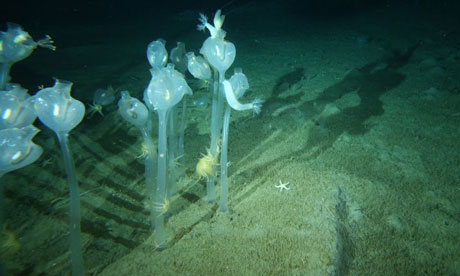
These tulip shaped creatures were snapped in the Antarctic oceanWhen people suggest humans should colonise space, it’s often said that first they should attempt to conquer an alien world on our own doorstep – the oceans. The deep cold and pressure of the seabed is just as much a challenge as the vacuum of space and the creatures that live there are just as strange as any in science fiction.

Take a look at some of these Tunicates, that look like glass tulips rising in stems from the seabed. A recent Antarctic expedition found many new species a mile underwater.

Martin Riddle, leader on the research ship Aurora Australis, said yesterday: “Some of the video footage is really stunning. Gigantism is very common in Antarctic waters. Many [of the animals] live in the dark and have pretty large eyes. They are strange-looking fish. In some places every inch of the sea floor is covered in life. In others we can see deep scars and gouges where icebergs scour the sea floor as they pass by.”

Whilst space has its own challenges and fascinations, there are still some parts of our world that have never before been glimpsed by human eyes.

[story and image via the guardian]

Gravitational lensing

Gravitational-lens-einstein-ring-galaxy Gravitational lensing is all the rage in astronomy right now. A confirmation of one of Einstein’s theories, the phenomenon has seen recent use in mapping dark matter and detecting exoplanets.

To avoid making myself look like the bluffer and layman enthusiast that I am, I’ll defer to the experts and let Phil “Bad Astronomy” Plait explain how gravitational lenses work, and point out that the Hubble telescope has just found a big new crop of them. [Image: NASA, ESA, C. Faure (Zentrum für Astronomie, University of Heidelberg) and J.P. Kneib (Laboratoire d’Astrophysique de Marseille)]

“Big deal,” you might be thinking. In which case, I’ll direct you to Centauri Dreams, where you’ll find an explanation of how the phenomenon might be used for the rapid propulsion of interstellar probes or (in the comments) communication between star systems.

Technology Review lists 2007’s 10 most exciting technologies

Poster_of_Alexander_Crystal_Seer Every year, Technology Review lists the 10 technologies the magazine’s editors “find most exciting—and most likely to alter industries, fields of research, and even the way we live.” (Via Kurzweil AI.)

Here’s 2007’s Top-10 list:

  1. Peering into Video’s Future – With the Internet being swamped by digital video, peer-to-peer networks may be the answer.
  2. Nanocharging Solar – Cheap photovoltaics through quantum-dot solar power.
  3. Invisible Revolution – The magic of metamaterials.
  4. Personalized Medical Monitors – Computer-automated diagnostics for individuals.
  5. Single-Cell Analysis – Analyzing differences between individual cells could make for better medical tests and treatments.
  6. A New Focus for Light – New optical antennas that focus light could bring us DVDs that hold hundreds of movies.
  7. Neuron Control – A genetically engineered switch lets scientists turn selected parts of the brain on and off–which could lead to new treatments for depression and other disorders.
  8. Nanohealing – Stopping bleeding, aiding recovery from brain injury–nanofibers hold life-saving promise.
  9. Digital Imaging, Reimagined – “Compressive sensing” could help make the capture of digital images more efficient.
  10. Augmented Reality – Digital information, superimposed on the real world. (And you thought people listening to iPods all the time were annoying… )

(Image: Wikimedia Commons.)

[tags]technology,inventions,predictions[/tags]

Flux of facts – the fate of news in a wired world

TV-journalistSteve Rubel points us to an article at American Journalism Review that discusses the hazards of newsrooms relying on Wikipedia for research and citations. [Image by rabbleradio]

This is hardly a new story (though usually we hear about the horrors of students rather than journalists citing the online encyclopedia), but it’s not going away any time soon – in the always-on 24/7 culture of the web, the only constant is change. As Rubel puts it:

“The big question in my mind is this: when journalists cite Wikipedia articles, what happens when the facts they reference from the wiki entries change (assuming they do)? Do the reporters go back and update their articles? The news reports call more attention to the articles, potentially opening up a can of worms each time they source Wikipedia.

Seems like a big vicious cycle. Perhaps in the future these stories will carry some of the same disclaimers that Wikipedia lists.”

And if you think that’s a symptom of postmodernism running wild, what about CNN handing over the reins of iReport to the community of citizen-journalists who contribute to it? [Via SlashDot]

Are the definitions of “truth” and “consensus” converging? Were they ever really different?

Shooting a satellite

A missile firing from a US vesselAs you may have read, a certain US satellite is heading back to Earth rather faster than expected. Some people are worried that when the satellite crashes back to Earth, the hydrazine fuel cell within may cause chlorine-poisoning-like symptoms to anyone nearby. That two thirds of our planet is water and that the size of the effect isn’t much than a few acres doesn’t seem to matter. The US have decided to blow the satellite up in orbit before we get the chance to play satellite crashland lottery, in a move that many analysts see as retaliation for China shooting down its own satellite last year. At least we might get to see some pretty effects, if someone manages to capture the missile on video.

[story and picture via Responsible Nanotechnology]

Presenting the fact and fiction of tomorrow since 2001