Friday Free Fiction for 1st February

How alliterative a title is that, eh? 😉

Alliterative the date may be, but it’s not the richest haul of free reads we’ve had. Still, there’s plenty enough here to keep you entertained for seven days …

***

A few from Manybooks.net:

***

Another email from the sharp-eyed and well-connected (not to mention fabulously-named) Cole Kitchen:

“Another e-zine for the list: Allegory, the “tri-annual online
magazine of SF, fantasy & horror,”.

(I can’t find a back-issues archive on their site, but some of these can be found via the Internet Archive.)”

Thanks, Cole – added to the sidebar!

***

Another new webzine on the block – albeit without any fiction content until the projected launch date of 1st March – is Oddlands Magazine, whose editor Soren Bask has just stepped out of the shadows. One to keep an eye on – and a new market for folk to submit to, of course. 🙂

***

Jayme Lynn Blaschke appears to be doing some kind of running serial fiction thing over at the No Fear Of The Future group blog. Just posted is part three of “Memory”, but I assume you’ll want to start at the beginning.

***

If I’m not very much mistaken, Peter Watts is also posting fictional snippets on his blog. “Job Security” certainly has his comments field buzzing, and rightly so.

***

Free audio fiction! James Patrick Kelly, obviously pining for the halcyon days of reading his novel Look Into The Sun to the public of the interwebs (way back in the dark ages of, oooh, last year), has started doing the same with his Nebula-nominated story “Men Are Trouble.

***

Neil Beynon, fellow traveller of the Friday Flash Fiction train, is having a rather productive week. In addition to the usual FFF output (see below), he’s got a whole other story on his site: “Wide Open Space“.

***

This is the second week in a row that a Futurismic staffer has had a story published. This week it’s the turn of blogger Tomas L. Martin, whose story “The Shogun and the Scientist” is now online at Aberrant Dreams.

***

It’s a very thin week for the Friday Flash Fictioneers – a lot of us (including yours truly) appear to have had obstacles thrown in our way by that thing called life (which, despite being a great generator of stories, has a neat knack of preventing them being written). But a few of the troops are holding the fort:

Neil Beynon was late to last week’s offering, so “Silver” gets a plug this time round; his thoroughly punctual offering for this week is entitled “Fragments” – these in addition to the full story mentioned further up! Go, Neil!

New recruit Greg O’Byrne examines the “Life of Diamonds“; meanwhile, Gareth L Powell appears to have been doing some writing at the “Coffee House“.

***

Non-fiction bonus! Via Warren Ellis‘s highly-trained gang of web-scouring super-monkeys at grinding.be (which anyone who digs Futurismic will probably love to bits and should subscribe to immediately):

“Stuart Home’s brilliant 1987 book THE ASSAULT ON CULTURE: UTOPIAN CURRENTS FROM LETTRISM TO CLASS WAR is available in full, here.”

As is pointed out, it’s sure to be dated. But even a dated political text can tell you a lot, if only about the time it was written. Right?

***

That’s your lot – don’t forget to contact us with any tips, winks or blatant self-plugs you may have. In the meantime, have a great weekend!

H.G. Wells on a roll: Time after Time becomes a musical

H_G_Wells Another entry in my quixotic quest to keep you posted on SFfish stuff on the stage: hard on the heels of the stage version of The Time Machine I blogged about earlier comes the news that Time after Time, the movie in which H.G. Wells uses his time machine to pursue Jack the Ripper to the modern era, is being turned into a musical. (Via SyFy Portal.)

Although it’s still early going on the project, playwright and lyricist Stephen Cole says:

“We have done several readings and the show is ready for a full fledged production…We have a prominent director interested who’s chomping at the bit and a producer with money. We’re looking for a proper venue to try it out and work on it. Musicals are tough to get right and the more work you can do in front of a real audience the better.”

Why Time after Time and not The Time Machine itself? Because, says Cole:

“I met a director who was interested in a sci-fi musical, so I considered ‘The Time Machine’ and told him to watch ‘Time After Time’ for reference…Eventually I realized a musical with Morlocks would be a surefire flop and became more enamored with Meyer’s film. Then I got the rights.”

Personally, I think a chorus kick-line of Morlocks would be boffo box office, but that’s just me.

(Image: Wikimedia Commons.)

[tags]H.G. Wells, musicals, theatre, science fiction[/tags]

Nanotube anti-radiation pill

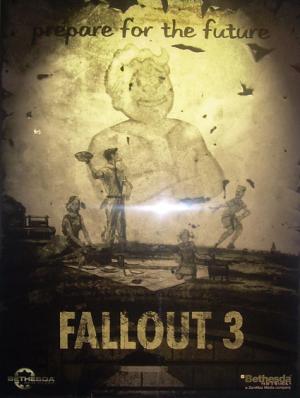
Fallout was one of the games that inspired John Joseph Adams to edit the recent anthology ‘Wastelands’After work by Stanford University found that carbon nanotubes don’t seem to have any detrimental effect inside the bodies of mice, researchers are looking for more ways of utilising the growing technology in medicine. DARPA has awarded a grant to Rice university to study whether a carbon nanotube based pill would be a good way of treating radiation sickness. Radiation in the body deforms cells and molecules, releasing terribly damaging free radicals which then cause more damage to the body.

“More than half of those who suffer acute radiation injury die within 30 days, not from the initial radioactive particles themselves but from the devastation they cause in the immune system, the gastrointestinal tract and other parts of the body. Ideally, we’d like to develop a drug that can be administered within 12 hours of exposure and prevent deaths from what are currently fatal exposure doses of ionizing radiation,” said James Tour, Rice University’s Chao Professor of Chemistry and director of Rice’s Carbon Nanotechnology Laboratory.

The Carbon pills would absorb large quanties of the radiation within the body, as well as the free radicals, which could dramatically cut down on the post-exposure spread of damaged cells. As DailyTech mention in their article about the discovery, video game Fallout had carbon-based anti-radiation pills way back in 1997. The third Fallout game is being released this year by the makers of Oblivion, Bethesda, for your post-apocalyptic gaming pleasure.

[story and Fallout 3 teaser poster via DailyTech]

A Hotel in the sky

This elegant zepplin could transport you thousands of miles in styleMichael Marshall Smith’s excellent novel ‘Spares’ had a large section of its story set in a crashed flying mall, which previously had flown around the country for people to come up to and shop, eat and live. With airships beginning to come back into favour, the French aerospace research body ONERA has developed the design for a flying hotel called Manned Cloud.

The whale-shaped dirigible would potentially house 40 guests and 15 crew with a range of 5000km. Although airships are less stable in high winds than planes, they also use a fraction of the fuel. Manned Cloud was designed by French designer Jean-Marie Massaud. This kind of sky cruise could be an important part of mid-21st Century travel and using airships for freight would also be very efficient.

[via Lou Anders, image from StumbleUponDemo]

Reassessing the mundane – James Patrick Kelly on Mundane SF

Think what you will about literary manifestos, there’s no denying that the Mundane SF movement provoked a reaction among the sf community.

The original Mundane Manifesto, written by Geoff Ryman, has been lost to the digital abyss of the interwebs, but many others have built on his initial ideas, and the Mundane SF blog keeps up a regular barrage of thought-provoking posts designed to make the reader reassess the purpose of science fiction writing.

Over at Asimov’s, James Patrick Kelly takes a look at the thus-far short history of the sub-genre, and concludes:

“… I have written some stories that fit the MundaneSF prescription and some that do not. I find myself in sympathy with their arguments when I recall my intentions as I wrote those particular stories that pass their test. It is difficult to write about futures that could actually come to pass, and not only are most of the tropes they decry unlikely, but some are in dire need of an aesthetic makeover. And yet, since so many of my best known—and favorite—stories are clearly not Mundane, I can’t in conscience declare myself for the movement.

But I am listening to what they say.”

Futurismic, by definition, has a certain sympathy with the thinking of the Mundanistas – as do I on a personal level. But I still love wide-screen space operas and well-written far-future interplanetary stories – sub-genres that the Mundane movement would see relegated to the status of pulpish wish-fulfillment and fantasy.

As Futurismic readers, I assume you all enjoy reading stories that fit the Mundane template. But do you agree that those which don’t fir the template are failing to use the full potential of science fiction as a vehicle for ideas? Should fiction have any purpose beyond entertainment?

Presenting the fact and fiction of tomorrow since 2001