Boron nanotubes better than carbon

Boron NanotubeAccording to researchers at Tsinghua University, nanotubes made from Boron could have many of the same properties as nanotubes made from carbon – and for some electronic applications, they should even be better than carbon:

Accoring to Xiaobao Yang, Yi Ding and Jun Ni from Tsinghua University in Beijing, China, the best configuration for boron is to take the unstable hexagon lattice and add an extra atom to the centre of some of the hexagons. They calculate that this is the most stable known theoretical structure for a boron nanotube.

Their simulation also shows that, with this pattern, boron nanotubes should have variable electrical properties: wider ones would be metallic conductors, but narrower ones should be semiconductors. If so, then boron tubes might be used in nanodevices similar to the diodes and transistors that have already been made from carbon nanotubes.

"Gentlemen, we can rebuild him…better…faster…stronger…"

Touch Bionics' i-LIMB bionic hand Scottish scientists report that they have produced an artificial arm that is “more powerful than the real thing.” (Via MedGadget.)

According to The Scotsman newspaper:

The researchers say their new arm is capable of repeatedly lifting a weight of 10kg up above head height and could do so all day, compared with the average human being who would tire within minutes. The wrists could rotate 360° and anyone using it could perform hundreds of push-ups.

This raises an ethical question: a patient with such an arm could possibly hurt themselves or someone else. As a result, the arm’s power might actually have to be scaled down.

(Kudos to David Gow, the lead developer, for pointing out in the article something Steve Austin [The Six-Million-Dollar Man of television fame] really should have had to worry about, but never did: “You have to attach it to the patient’s body and that could cause damage if the weight is too heavy. It could snap their ribs.”)

The arm was developed by Touch Bionics, and is designed to complement the the world’s first bionic hand, pictured above and announced last year. Touch Bionics calls its technology i-LIMB.

(Image: Touch Bionics.)

[tags]bionics, technology, medicine[/tags]

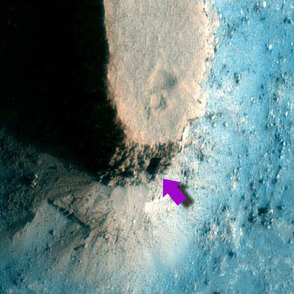
Nasa finds doorway structure on Mars

is this a remnant of an alien civilisation or a trick of the light?It’s amazing the things you can find in the universe. Images of our neighbouring red planet by the Mars Reconnaissance Orbiter picked up this little space oddity: a teardrop shaped mountain with a rectangular dark patch that, to the human observer, looks like a door.

The oddly shaped mountain, in the frozen ocean region of the planet, was discovered by a Russian reader, rather than a member of the NASA project. The blog article also has some interesting quotes about Mars terraforming plans.

“They’ve done some experiments and have noticed that some types of plants can grow under the low pressure CO2 atmosphere on Mars,” Australian physicist Charles Lineweaver noted when asked about the prospect of altering the atmosphere of our red neighbour.

Of course, this doorway is probably not the path to some alien civilisation gifting us with its future tech but one can dream…

[via Daily Galaxy, image by NASA]

Who clicks on banner ads?

pedestrian and beauty ad That’s a question I’ve asked myself more than a few times, and I’ll bet you have too. Danah Boyd also wants to know who actually clicks on internet adverts:

“A few years back, I asked this question to someone who worked in the world of web ads and I received a snarky (and condescending) answer: middle America.”

As sweeping a stereotype as it may be, it’s backed up by research done by AOL’s marketing people:

“Who are these “heavy clickers”? They are predominantly female, indexing at a rate almost double the male population. They are older. They are predominantly Midwesterners, with some concentrations in Mid-Atlantic States and in New England. What kinds of content do they like to view when they are on the Web? Not surprisingly, they look at sweepstakes far more than any other kind of content. Yes, these are the same people that tend to open direct mail and love to talk to telemarketers.”

Which leaves Ms Boyd asking questions about the ethics of advertising:

“I am not an advertiser and I’m not invested in making better ads. Instead, by raising this topic, I’m curious whether or not web marketing is capitalizing on a niche group and, if so, what the societal implications of this might be? If my hypothesis were true, what would it mean if marketing is profiting primarily off of those who are economically and socially struggling? How do we feel about this philosophically, ethically, and professionally? Would we feel proud of living off of a business model that targets the poor?”

It’s an interesting question – but I’m left wondering whether it’s really any different from the non-web ad industry. Hasn’t advertising always been designed to bamboozle the easily-led? But to extend Ms Boyd’s thoughts further, as the web moves inevitably towards being funded entirely by advertising, will it become the victim of its own success? [Via SmartMobs] [Image by Michale]

[tags]internet, advertising, marketing, demographics[/tags]

Your attic – it’s not just for stashing junk anymore

5075_0066_1_w

As many readers may know, we Americans typically are oblivious to the geographic conditions in which we live – particularly when it comes to building our dwellings.  Whereas living in Japan, you can see nearly every apartment block is built with the entrance on the north side, the apartment going all the way through to the south side, which is usually a set of glass sliding doors.  This gets you the sun shining on the balcony and into the home, providing a good place for drying laundry and putting some nice direct solar heating into the apartment.  On the other hand, the lack of insulation and single-pane windows means I’m currently freezing my buns off on this cloudy January day.  But that’s beside the point.

Meet the EcoHat.  Traditional houses are built with an attic that is stifling hot in summer, frigid in winter, and stores junk year-round.  At Oxley Woods in England, Richard Rogers is designing a new type of home, one with what is essentially a modular attic that can be adjusted to fit the housing conditions.  Following the graphic above, normal houses can only make use of solar energy when the sun is shining on the side of the house with the solar panels.  With the EcoHat placed on the southern side of a flat or slanted roof, it can absorb heat all day.  This allows for greater energy efficiency and a method for heating water.  There are other design concepts that have gone into the homes, making them somewhat attractive, and somewhat reminiscent of an industrial park.

(via Matthew Yglesias)

Presenting the fact and fiction of tomorrow since 2001