Friday Free Fiction for 4 January

Happy new year, Futurismic readers! Here’s your first dose of free fiction for 2008:

***

A big lump-lot at ManyBooks.net:

[Just to reiterate the point, the above list (and indeed some of the below) would be impossible for us to compile on a weekly basis if not for cribbing vigorously from the hard-grafting folk at SF Signal, who have our deepest gratitude.]

***

Via Nick Mamatas:

Happy New Year, and check out the latest from Clarkesworld Magazine!

Debris Ensuing From A Supervortex” by Brian Ames.

And our feature article: Countdown to Singularity: A Conversation with Vernor Vinge by Shaun Farrell.

***

Chris Roberson delivers Friday freebies yet again: “The Sky is Large and the Earth is Small“.

***

Charles Sheehan-Miles wrote in to let us know that he has released the entirety of his alternate-near-future novel, Republic, free in all formats under a Creative Commons license.

***

S.L. Viehl is using Scribd to host all her free-to-read fiction.

***

Elizabeth Bear has posted of her short story “Tideline” (from the March 2007 Asimov’s) at her website.

***

Podcast fiction! Audible offers “Could Be Worse” by James Patrick Kelly.

***

It’s a bit thin on the ground for Friday Flash Fictioneers again, but there’s always a few of us defying such niceties as seasonal laziness … 😉

Neil Beynon delivers one of my favourites from his offerings so far: “The Edge Of The World“.

And in another one of those synchronous happenstances that seem to crop up so often in the world of FFF, both Gareth L Powell and I have stories involving salvaging, though in very different settings.

So take a visit to Gareth’s “Crash Site“, and then consider popping over to my blog and getting “Tagged“.

***

And finally, a simultaneously funny and educational non-fiction bonus: The Annals of Improbable Research (also known as AIR) is the publication from the people who brought us the IgNobel Prizes, and it’s now available for free in lo-rez downloadable formats as well as old-school dead-tree media.

If you like genuine science and a good hard laugh, there’s no place you’ll ever find the two more closely meshed – consider that my personal recommendation! 🙂

***

That’s your lot for this week, folks. Don’t forget to let us know if you see or hear of any free fiction you think we should be telling people about. Adios!

[tags]free, stories, fiction, online[/tags]

Building blocks of life common in other star systems?

Dust disk surrounding the star HR 4796A That’s the promising possibility (if you like the idea of extraterrestrial life) raised by the discovery by astronomers at the Carnegie Institution of highly complex organic molecules in the disk of red dust surrounding a young star (one very different from the sun) thought to be in the late stages of planet formation. Observations of light from the star via one of the instruments on the Hubble Space Telescope reveal that the light scattered by the dust disk is very red, matching the spectrum of large organic carbon molecules called tholins that no longer exist on Earth but are hypothesized to have been precursors to the biomolecules that make up living organisms. (Via SpaceDaily.)

The image above is a false-color image of the dust disk surrounding the star, HR 4796A, with the star itself masked to make the disk visible. The inner “hole” in the disk is big enough to swallow our solar system and may have been swept clean of dust by orbiting planets.

(And even though they’re both red, no, there’s no connection between the red dust of HR 4796A and the red rain of Kerala.)

(Image: John Debes.)

[tags]extraterrestrial life, astronomy, Hubble Space Telescope[/tags]

Watching the watchers

Mike Elgan has an opinion piece in ComputerWorld about the “endemic surveillance” that now permeates society in the US and the UK.  Elgan takes a position that seems to be growing in popularity: forget privacy as we knew it in the 20th century – it is dead, cold and buried in the ground.  Instead, “privacy” advocates should take up a new fight – a fight for our right to watch the watchers:

Surveillance technology is on the rise. Powerful organizations — law enforcement, corporations, governments and others — have demanded and won their right to videotape the public, often secretly. They do this in order to hold individuals accountable for their actions.

Yet the rights of individuals to use similar technology to do the same are often restricted. Why should shoppers, pedestrians, bank customers and citizens be held accountable, but politicians, police, judges and others are not? What kind of democracy is that?

Shouldn’t recording your own police interrogation be a constitutionally protected right, like the right to an attorney? If not, why not?

Glenn Reynolds,of Instapundit fame has also recently written about this concept in Popular Mechanics and on his blog.  And of course, anyone interested in the topic should read David Brin’s masterful treatise, The Transparent Society (Brin also wrote a fantastic novel titled Kiln People based on many of the concepts presented in The Transparent Society).

WiFi flu

Haxx0r3d-router As if we don’t already have enough “regular” viruses to worry about, a research team from Indiana University suggests that a specially designed computer virus made to attack and propagate on unsecured WiFi routers could easily infect entire cities.

While the risk is apparently only theoretical at the moment, the potential for trouble is a function of the rapid uptake in wireless technology; there are enough open routers about nowadays that the theoretical bug could hop all across town unimpeded. [Image by kludgebox]

People tend to forget that routers are just little computers, but you can bet the malware industry is well aware of it. That said, I can’t really see the commercial potential of such a virus* – and if it can’t be used to make money, surely it would be a four-week proof-of-concept fad for script kiddies at worst?

[* The inevitable disclaimer here is that I’m not a computer security expert by any stretch of the imagination – if you can explain in more detail, please do so in the comments.]

[tags]WiFi, computing, virus, malware[/tags]

The debate over "Active SETI"

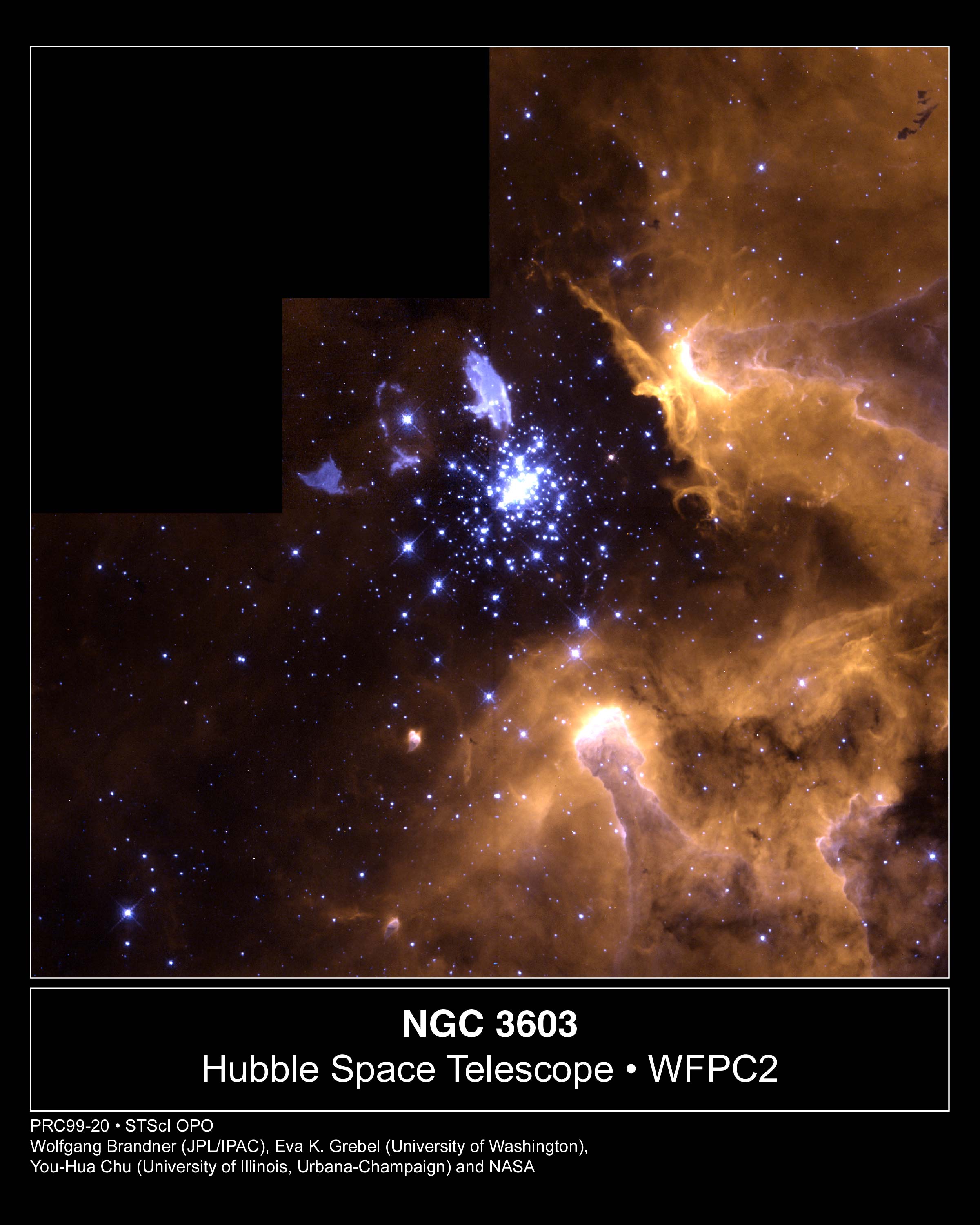
Hubble Space Telescope view of NGC 3603 I’m back! Miss me?

Now that I’m no longer wearing my actor hat and performing eight shows a week of Beauty and the Beast, I’ll be posting regularly again. And what better way to start than with this fascinating article from SEED Magazine about the controversy in SETI (Search for Extra-Terrestrial Intelligence) circles over whether we should just be passively listening for alien civilizations, or actively announcing our presence.

Those opposed to “active” SETI point out that, in effect, we might just be putting up a big neon sign on the planet that says “Come And Get Us” (or possibly “Good Eats!”) if there’s something nasty out there listening. In fact, David Brin pointed out years ago (in this paper on Xenology: check out the section called “The Great Silence”) that one theory (that originated within science fiction) for why we don’t hear signals from other civilizations is that something hunts down and destroys anybody that start broadcasting.

Check out the article, and for more discussion of it, read this post at the blog that I picked up the link from, the always-interesting Centauri Dreams.

(Image: NASA.)

[tags]SETI, extraterrestrial life, astronomy[/tags]

Presenting the fact and fiction of tomorrow since 2001