Living in Space

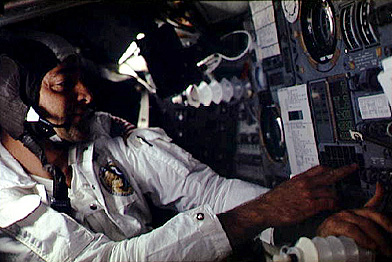
35mm pictures taken by Schmitt on the Apollo 17 missions
Space tourism is the big thing right now
, if you’re a multimillionaire looking to do something no-one else has done. Or alternatively it takes years to train to be an astronaut – if you qualify. Much of science fiction is dedicated to the thought of life outside Earth’s gravity well. Yet how easy would that be? Discover magazine lists 20 things you probably don’t know about Living In Space. It offers some handy tips to surviving in a vacuum (don’t hold your breath!) as well as some interesting facts about existing astronauts, who grow around two inches on average due to less pressure on their spines. It makes you wonder how many people will want to spend their holidays in zero-g.

[via Discover Magazine, image from Apollo 17 mission via Eric Hartwell’s Infodabble]

New fighter pilot helmet makes plane "invisible"

20071108_Testhelmet_600x400 Not invisible to other pilots: invisible to the pilot him (or her) self. (Via DefenseTech.)

Unlike modern fast jet aircraft the Joint Strike Fighter, which is planned to replace the famous Harrier, does not have a ‘traditional’ head-up display – instead the computerised symbology is displayed directly onto the pilot’s visors.

This Helmet Mounted Display System provides the pilot with cues for flying, navigating and fighting the aircraft. It will even superimpose infra-red imagery onto the visor which allows the pilot to ‘look through’ the cockpit floor at night and see the world below.

It’s being developed by Vision Systems International and Helmet Integrated Systems, and is currently being evaluated by defence scientists at Boscombe Down in Wiltshire.

As you can see from the photograph, it also makes anyone wearing it look wicked cool. Or maybe just wicked. (Photo from U.K. Ministry of Defence.)

[tags]aviation, technology, military, defense[/tags]

Speeding up CO2 absorption in the ocean

The electrochemical weathering cycle

The oceans are nature’s way of removing carbon dioxide from the atmosphere – it’s estimated that one third of human-generated CO2 has been absorbed by the sea.  But with the seas becoming more acidic, the rate of CO2 absorption is reduced.  But what happens if they become more alkaline?  Some Harvard researchers predict we could increase CO2 absorption by speeding up the natural release of basic solutions into the ocean, thus reducing the rate of release of CO2 in the atmosphere, helping corals and sea life affected by more acidic seas, and giving us cake.

There are some downsides, however, including localized pollution (the alkalines would be concentrated around the production plants, thus harming local sea life), price ($100 for every ton or CO2 removed), and energy – if  the process were powered by coal, the net effect would be addition of CO2.  Renewable energy, like geothermal, is one possibility around this, and in such a case could be more beneficial (CO2-wise) than replacing an entire coal plant.

See here for the abstract, it’s worth it just to read the title.

(article & image via Environmental Science & Technology Online)

Friday Free Fiction for 9th November

Here’s your free fiction fix for the weekend:

***

Speculative fiction e-zine Heliotrope issue #3 has been posted with fiction by Brendan Connell, Tina Connolly and Rob Vagle, as well as articles by Jeffrey Ford, Michael Moorcock and Jeff Vandermeer.

***

From Andy Cox, head honcho (and my boss) at Interzone:

"Jay Lake has posted his story "All Our Heroes are Bastards", originally published in issue 35 of The Third Alternative (now Black Static), on his website. Recommended!"

***

More fine freebies from the folk at Subterranean:

"The serial of Daniel Abraham‘s that we’re running this November, The Support Technician Tango, is definitely not sf. Think of Connie Willis in her madcap comic mode and you’ll be closer to the pleasures Tango has to offer. Look for a chapter or two every weekday over at Subterranean Online."

***

Free science fiction online at ManyBooks.net: "Unwise Child" by Gordon Randall Garrett, "Tight Squeeze" by Dean Charles Ing and "Indirection" by Everett B. Cole.

***

Mentioned here at Futurismic earlier this week, but worthy of a re-plug – the inimitable Bruce Sterling has a short story in a most untraditional venue. Read "The Interoperation" at Technology Review.

***

Friday Flash Fictioneers in tha hiz-ouse!

Martin McGrath slipped in late last week with "Stone Must Roll" – technically a rule-breaker on length terms, but we’re all friends here.

Which means we’ll excuse also Shaun C Green for posting a 2500-word short called "Half-Day of the Dead". Because, as he points out, everything goes better with zombies.

Gareth D Jones cocks a snook at superheroes with "The Ironic Man"; he also posted a late catch-up earlier in the week called "The Planet Sweets".

Neil Beynon shares some backstory from his ongoing NaNoWriMo effort: "Hakon’s Folly".

Justin Pickard is also NaNoing (if that’s a real verb). His excerpt is called "Paper Boats in the Blue Hour".

Gareth L Powell has a bleak little nugget called "The Point Furthest From The Sun".

And in one of those strangely synchronistic happenstances, both Dan Pawley and myself hit on the same theme, albeit from different angles. Dan’s is called "Abduction", and mine is "Alien Abduction".

***

As always, please get in touch (use my email address as on the Staff page) with anything you’d like to be announced … and please put "Futurismic Free Fiction" in the subject line. I’ve had to batten down the spam-traps recently, but I have a filter installed that will let through anything with that subject. If I don’t respond to your email, please try again, or leave a comment here if that doesn’t work.

In the meantime, enjoy your weekend!

[tags]free, fiction, stories, online[/tags]
Presenting the fact and fiction of tomorrow since 2001