Tag Archives: architecture

Google’s Building Maker: crowdsourcing the world’s architecture

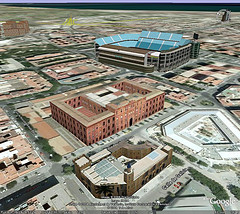
Valencia, Spain as seen in Google EarthIs there anything that can’t be crowdsourced? Google sure don’t think so, as they’ve just announced another new project for Joe Public to muck in on. Google Building Maker will be used to populate Google Earth with 3D models of major buildings:

We like to think of Building Maker as a cross between Google Maps and a gigantic bin of building blocks. Basically, you pick a building and construct a model of it using aerial photos and simple 3D shapes – both of which we provide. When you’re done, we take a look at your model. If it looks right, and if a better model doesn’t already exist, we add it to the 3D Buildings layer in Google Earth. You can make a whole building in a few minutes.

It’s entirely browser-based, too, so no compatibility problems. Of course, you don’t get the freedom of Second Life, where you can build any damned building you feel like… but then learning how to build well in SL can take weeks of practice, whereas Google have aimed to make it as easy as possible. Which is a sensible move if you want people to do work for free, I guess… [image by Visentico/Sento]

Parasitic urban housing

Here’s a nice little slice of near-future urbanist architecture-fiction; Australian architectural outfit Lara Calder have come up with a speculative scheme for “parasitic” urban housing, designed to recolonise otherwise unused vertical surfaces in the urban landscape. Architects tend to have a grasp of bombastic language far superior to my own (no, really!), so I’ll let the words speak for themselves:

To achieve sustainable densification the dwelling attaches itself to blank building fabric found in the city. It grows on empty facades, rock faces and bridges. It finds value by turning dead public space into lively private space.

prefab parasite housing - Lara Calder Architect

The Prefab Parasite is a parametric dwelling which incorporates many considerations into its flexible design. The facade reacts to orientation. The footprint can be wide or narrow depending on the site and always maintains its 36 square meters. The structural ribs are tuned to the exact building form using an algorithmic modeling system.

The fabrication and construction of the prefab parasite rely heavily on digital methods. The facade paneling system is designed and sent to fabrication to be machine cut out of an eco solid surface material consisting of compressed bamboo and recycled paper. The structural facade members are all controlled parametrically, as are the main structural ribs. The integration of the structure with the design system increases efficiency and accuracy of the construction process.

While it’s not completely implausible to imagine cities ordering the construction of buildings like this, it’s much easier to imagine them being a “favela chic” development, thrown up by guerrilla architects in the parts of big cities where the authorities no longer dare go… or just can’t be bothered to control any longer. [via Inhabitat; image ganked from Lara Calder Architect, please contact for immediate take-down if required]

Imagine for a moment a rogue city-state cordoned off from the country surrounding it; with no way of expanding horizontally, and insufficienct engineering power to expand vertically, all that’s left are the interstitial spaces. Slowly the city becomes a hive, the line between public space and private dwelling blurring to a point where the two terms become meaningless synonyms… and J G Ballard is worshipped as a visionary prophet in the hollow concrete temples of bridge piles and skyscraper foundations.
The demise of the humble bricklayer

R.O.B. bricklaying robotVia Chairman Bruce comes bad news for anyone hoping for a lasting career at the manual-labour end of the construction industry. A trailer-mounted bricklaying robot (imaginatively named “R.O.B.”) will be building its second stylishly curved wall on Pike Street, New York later this year. [image lifted from linked post at Dezeen]

OK, so it’s a little large and ungainly at the moment (and probably has a price tag to match), but that will change – plus it won’t take breaks, go home to sleep, wolf-whistle at passers-by or attempt to form a union, which will doubtless add hugely to its appeal to corporate buyers.

Perhaps you’re thinking that concrete-and-rebar specialists will still be able to find work? Don’t forget that buildings can be 3d-printed now, too…

The Floating Citadel

Seems like hardly a week can pass by without some new example of architectural futurism cropping up in my RSS feeds. Here’s the latest nugget: The Citadel is (or rather will be, when it gets built as something more than a conceptual model) an example of the sea-beleaguered Dutch attempting to come to terms with the geography of the tidal plain that is their country.

The Citadel - floating apartment complex concept

The project will be built on a polder, a recessed area below sea level where flood waters settle from heavy rains. There are almost 3500 polders in the Netherlands, and almost all of them are continually pumped dry to keep flood waters from destroying nearby homes and buildings. The New Water Project will purposely allow the polder to flood with water and all the buildings will be perfectly suited to float on top of the rising and falling water.

[…]

A high focus will be placed on energy efficiency inside the Citadel. Greenhouses are placed around the complex, and the water will act as a cooling source as it is pumped through submerged pipes.

The Citadel seems to be an officially sanctioned project, but it’s easy to imagine that once the concepts behind it are loose in the market, buildings like it could become commonplace in marginal or disputed regions considered useless because of their water-logged state… something like a half-way house between regular land living and seasteading. If the increasingly alarming data coming from climate scientists is valid, there’s certainly going to be a lot of floodplains and polders to build on. [image by WaterStudio.nl]

A final thought: if architecture is a kind of science fiction (as Chairman Bruce and others have implied), are shiny Bright Green projects like The Citadel equivalent to the boldly optimistic pulp stories of the fifties and sixties? Will the actual buildings of the near future turn out to be something less lovely, more pragmatic, weathered by environmental compromise and gloweringly Ballardian?

Bucky Fuller would be proud: geodesic urban agri-architecture

We’re starting to see a lot of these urban agriculture concepts cropping up (arf!); the Plantagon is (or, rather, might be) a geodesic dome containing a spiral ramp covered with fresh-grown foodstuffs, and its designers believe its food output would pay for its construction.

Plantagon: geodesic urban greenhouse

According to Plantagon, the farm “will dramatically change the way we produce organic and functional food. It allows us to produce ecological [food] with clean air and water inside urban environments, even major cities, cutting costs and environmental damage by eliminating transportation and deliver directly to consumers. This is due to the efficiency and productivity of the Plantagon greenhouse which makes it economically possible to finance each greenhouse from its own sales.”

No word on how exactly the Plantagon system works, but the company says that consulting engineering firm Sweco has helped untangle the technical kinks of the project. Plantagon hopes to have its first vertical farm up and running within three years.

Call me cynical, but I doubt the Plantagon as it appears here will ever make it into production. That said, the sheer number of urban agriculture concepts that are being kicked around at the moment suggests that there’s enough interest in the idea for it to become a reality at some point in the relatively near future… once pragmatism and the harsh economic truths of the world beyond the drawing-board brainstorm have shaved down the budgets a little bit, perhaps. [image by Plantagon]

Or maybe the construction of urban farms will be started in blazes of publicity and viridian glamour, only for the funding to be pulled (or embezzled, or just plain “lost”) half-way through, leaving huge Ballardian lumps of unfinished futurism lying around on the urban landscape, waiting to be colonised and turned into squelettes