Tag Archives: architecture

Bright-greening Dubai

Whatever you may think of Dubai (and however much of it is actually true), you can’t deny that those people know how to dream big. The Dubai Chamber of Commerce has apparently green-lit a plan for a self-sufficient off-grid ecotopian zone, dubbed (with what one presumes is as much hope as anything else) “Food City”. And here’s the proposal from architectural outfit GCLA:
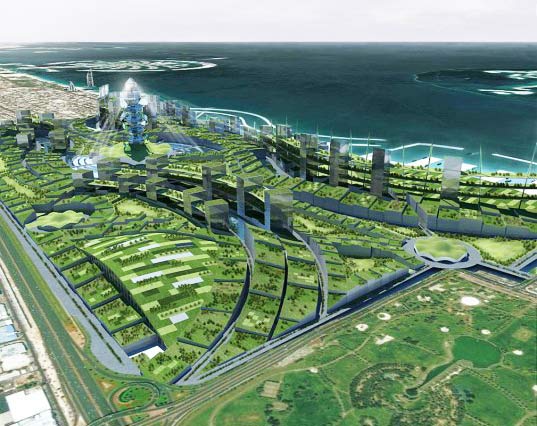
Dubai "Food City" concept

GCLA has described their proposal for Food City as the “the marriage of landscapes and urbanism”. Their project integrates a variety of proposals to decrease overall energy use — concentrated solar collectors, towers covered in thin-film photovoltaic cells, piezoelectric pads in pedestrian areas, and methane harvesting through sewage percolation tanks.

GCLA also proposes water conservation measures critical to off-the-grid survival in water-starved Dubai, like atmospheric water harvesting, solar desalination through concentrated solar collectors, grey water recycling, and application of hydroponic sand to minimize water loss. Essentially, GCLA’s vision is an amalgamation of nearly every urban sustainability initiative in the past few years. It’s certainly utopian, but it may ultimately prove necessary.

Necessary, perhaps; but plausible, practical or realistic? Even assuming the best about Dubai, I’ll be surprised if the application of money and architectural talent alone can build a self-sufficient garden city in one of the dryest places on the planet… but it sure does look pretty. [image copyright GCLA; reproduced under Fair Use terms, contact if takedown required]
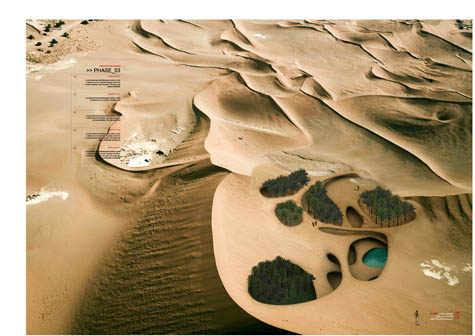
Rewriting Dune – arenaceous antidesertification architecture

I’ve mentioned before that everyone should follow Geoff Manaugh’s BLDGBLOG, and this post pretty much sums up why; Manaugh manages to find the weirdest and most wonderful ideas from the fringes of architecture and interprets them with the mind of a life-long science fiction fan.

Sometimes, however, it doesn’t take him much interpretation or extrapolation to get straight into sensawunda territory, and Magnus Larsson’s “arenaceous antidesertification architecture” is a prime example. Take it away, Mr Manaugh:

Larsson’s project deservedly won first prize last fall at the Holcim Foundation’s Awards for Sustainable Construction held in Marrakech, Morocco. One of the most interesting aspects of the project, I think, is that this solidified dunescape is created through a particularly novel form of “sustainable construction” – that is, through a kind of infection of the earth.

Larsson has proposed using bacillus pasteurii, a “microorganism, readily available in marshes and wetlands, [that] solidifies loose sand into sandstone,” he explains.

[…]

But the idea of taking this research and applying it on a megascale – that is, to a 6,000km stretch of the Sahara Desert – boggles the mind. At the very least, the idea that this might be deployed for the wrong reasons, or by the wrong people, in some delirious hybrid of ice-nine, J.G. Ballard’s The Crystal World, and perhaps a Roger Moore-era James Bond film, deserves further thought.

Indeed it does… but take a look at the concept art for the project (of which there is more in a Flickr set). Even before you start thinking about potential misuse, you can’t help but be impressed by the sf-nal visual impact of the idea.

arenaceous antidesertification architecture concept

You’d be best off reading the whole of the BLDGBLOG post for the low-down on how this concept would work (and then Larsson’s paper itself, from which the above image is borrowed), but here’s an excerpted explanation from Larsson himself:

The piles would be pushed through the dune surface and a first layer of bacteria spread out, solidifying an initial surface within the dune. They would then be pulled up, creating almost any conceivable (structurally sound) surface along their way, with the loose sand acting as a jig before being excavated to create the necessary voids. If we allow ourselves to dream, we could even fantasise about ways in which the wind could do a lot of this work for us: solidifying parts of the surface to force the grains of sand to align in certain patterns, certain shapes, having the wind blow out our voids, creating a structure that would change and change again over the course of a decade, a century, a millenium.

Beautiful? Undoubtedly. Practical or plausible? I really have no idea… but I don’t think there’s any harm in admiring a magnificent idea for its own sake every once in a while. After all, that’s one of the pillars of science fiction, isn’t it?

Shipping container tower block

In what might be some bizarre manifestation of hyper-rapid Zeitgesit symbolism adoption, the repurposed shipping container really does look like it will be one of the visual memes of 2009. Here’s the latest contender, the proposed Lotto Turm of Stuttgart, Germany:

Lotto Turm - shipping container tower block

The Lotto Turm tower will be constructed of 55 shipping containers stacked on top of each other, and will be designed to include a noise-free courtyard as well as a spiral pathway that circles around the building. Balconies, terraces, and stairs accent the tower from top to bottom, giving the stacked block structure a fantastical quality, and Gardens and plants will accentuate the varied vertical landscape. The public may enter and go all the way to the top of tower for a view of the city through the lotto sphere.

I don’t know what local development policy is like in Germany, but there’s no way that a shipping container tower block would get a green light here in the UK (more’s the pity). That said, I’m not entirely sure how straight-faced the Lotto Turm idea really is – there’s definitely an element of humour in Behrendt’s design.

Still, given the amount of shipping containers that have started piling up empty in docks and factory lots around the country, they’re just waiting to be reused for something worthwhile; pragmatism may defeat NIMBYism in shorter order than anyone might expect. [image by architect/designer Lars Behrendt]

Spiral skyscrapers for our dystopian future

Thought I’d try my hand at io9-style headlines – just for fun, you understand. 🙂

But with valid reason, too – the perforated biomimic skyscraper-arcology design below has been named Dystopian Farm by its creator, Eric E Vergne.

Eric Vergne's Dystopian Farm skyscraper design

Designed for the Hudson Yard area of Manhattan, Eric Vergne’s Dystopian Farm aims to provide New York with a sustainable food source while creating a dynamic social space that integrates producers with consumers. Based upon the “material logic of plant mechanics”, the biomorphic skyscraper is modeled after the plant cells of ferns and provides space for farms, residential areas, and markets. These organic structures will harness systems such as airoponic watering, nutrient technology and controlled lighting and CO2 levels to meet the food demands of future populations.

Vergne’s design is one of many entries in this year’s Evolo Skyscraper Competition, so we can probably safely assume that it’ll never actually be built – which will either disappoint you or make you heave a sigh of relief.

But speculative architecture eventually feeds back into the buildings we end up living in, and the need for sustainable urban food sources is pretty unavoidable. I can think of worse things to clutter a skyline with… but Vergne might want to think about giving it a slightly less grim name should it come to erection time.

Passive housing

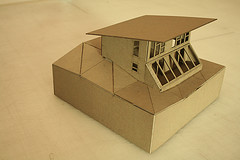
passive_houseA fascinating article here at Physorg on American versions of German “passive houses” – houses that maintain a comfortable temperature in cold climates without the need for active heating systems:

Because there is no furnace, the rooms are quiet. The only sound in the kitchen is the hum of a refrigerator, which along with other appliances, helps supply heat to the airtight 2,300-square-foot Batavia, Ill., home.

Katrin Klingenberg, founder of the institute in Urbana, Ill., said that typically, passive-house owners use 10 percent of the energy used in a standard home.

More info on passive housing can be found here.

[image from popaver on flickr]