Tag Archives: architecture

Floating cities on Venus?

Combining two of the most compelling tropes from science fiction: floating cities and colonising other planets, Geoffrey Landis, a scientist at the NASA Glenn Research Center (who also writes science fiction, apparently) suggest the idea that humans could live in aerostatic cities in the upper atmosphere of Venus:

50 km above the surface, Venus has air pressure of approximately 1 bar and temperatures in the 0

Dynamic Skyscraper in Dubai

The announcement of the world’s first dynamic building has echoes of the futuristic and modernist designers of the Archigram movement:

archigram domesThe 420-metre (1,378-foot) building’s apartments would spin a full 360 degrees, at voice command, around a central column by means of 79 giant power-generating wind turbines located between each floor.

It is interesting to see certain elements, including the modularity, individualism, and dynamism of concepts like the Archigram Plug-in-City re-emerge in the 21st century.

The Dynamic Tower itself is impressive in it’s grandeur and the scale of it’s ambition. The fact that the architect claims the building “would be energy self-sufficient as the turbines would produce enough electricity to power the entire building and even feed extra power back into the grid” adds to the wonder.

[story via BBC News][image by Claire L. Evans]

Infrastructure for the twenty first century

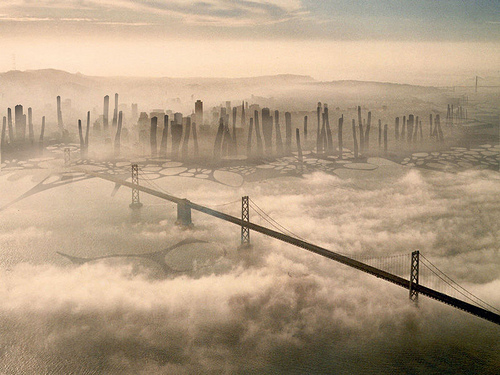
San Francisco in 100 years time looks a little different…
The ever compelling Alex Steffen over at WorldChanging is talking about Infrastructure a lot lately. A lot of the US and much of the world is built on an infrastructure of highways, electric grids and waterways, which are struggling to keep up with population growth and increased costs, especially of fuels. Whilst new technologies like superfast trains and solar panels are good, they need investment in the infrastructure for it to work – as seen by Britain having to spend millions to replace track for the Eurostar because Margaret Thatcher chose the cheaper infrastructure in the eigthies, whilst the rest of Europe put in place track suitable for what became the TGV.

There’s a lot of interesting ideas out there, from Alexander Trevi’s use of carbon-harvesting nanocrystals and radiation reprocessing to produce a green ‘New Chernobyl’, to architects IwamotoScott‘s ‘Network Hydrology’ reimagining of a water and hydrogen-producing algae based 2100 San Francisco. There’s plans to artificially create a new river delta to protect the Louisiana coastline and Amsterdam might drain its canals to create a new underground subcity. Or what about BLDGBLOG’s idea to create housing projects in the same way people make zoos? By combining good design in new infrastructure with the inventions already out there we can start looking at a future way of living rather than just trying to extend the one we have beyond its lifetime. And is it coincidence that most of best ideas also look ridiculously cool?

[picture by IwamotoScott]

Bespoke hotels of the future

There’s nothing quite like a good daily mixture of RSS feeds for generating some great serendipitous synchronicity. Today’s topic-from-the-blue – unique hotels!

Ice-hotel-interior When Geoff Manaugh isn’t cranking out what are arguably the posts most worth reading at io9, he’s churning out great posts about mad architecture-related stuff at his own BLDGBLOG … like this one about a hotel in Sweden made entirely from ice, or this other Swedish “hotel” – which is in fact just a bunch of fishing shacks on a frozen lake where you can stay to watch the Northern Lights. [Image: Photo by Ben Nilsson of Big Ben Productions, lifted from BLDGBLOG]

Geodesic-tree-house Aiming for slightly warmer climates, Warren Ellis’ grinders point us toward some impressive treehouse designs from around the world, delivered in the web-ubiquitous top-ten list format. The ice palace is pretty, but I think I’d rather be sleeping in one of these if I was to be resident for more than one night. [Image lifted from WebUrbanist]

The ice hotel reminds me of a scene from Julian May’s Galactic Milieu series, and I’m pretty sure there have been tree-cities in a number of books – Dan Simmons’ Hyperion Cantos, for a start, and a Brian Aldiss novel whose title eludes me for now.

What’s your favourite environmentally-tailored residence – fictional or otherwise?

Two miles high, one mile wide, and housing a million people

Cover of The World Inside In Robert Silverberg’s 1971 novel The World Inside (a book I remember fondly for having contributed a great deal to my early sex education), the bulk of the 75 billion people on a future Earth live inside Urban Monads, or Urbmons, each of which is three kilometres tall and houses 800,000 people. (Via io9.)

Architect Eugene Tsui has a proposal on his website for something similar: the two-mile high “Ultima” Tower, intended to be home to a million people:

There are 120 levels to the structure with great heights at each level. The scale of this stucture is such that the entire central district of Beijing could fit into its base. One must not think in terms of floors but, instead, imagine entire landscaped neighborhood districts with “skies” that are 30 to 50 meters high. Lakes, streams, rivers, hills and ravines comprise the soil landscape on which residential, office, commercial, retail and entertainment buildings can be built…the structure itself acts like a living organism with its wind and atmospheric energy conversion systems, photovoltaic exterior sheathing, and opening/closing cowl-vent windows that allow natural air into the interior without mechanical intervention….ecological efficiency is a rule and all areas of the structure feature resource conserving technolgy such as recycled building materials, compost toilets, nature-based water cleansing systems for all buildings, plentiful amounts of forrest, plant life and water-based ecosystems.

Even the setting would be beautiful:

The tower is surrounded on all sides by a lake. Sandy beaches, stone cliffs, water inlets, grass, trees and rocky islands create a beautiful and majestic setting…

Could such a thing ever be built? Well, Tsui’s concept dates back to 1991, and nobody’s breaking ground for it yet, or for similar projects like Tokyo’s SkyCity. (The projected $150 billion price tag might have something to do with that.) But the problems of urban sprawl and overpopulation aren’t going away, and structures like this could be part of the solution.

And to me, at least, it actually sounds like a pretty cool place to live…unlike Silverberg’s rather nightmarish (plentiful–mandatory, in fact–sex notwithstanding) Urbmons.

(Image: Amazon.)

[tags]cities, urban sprawl, overpopulation, architecture, skyscrapers[/tags]