If you’re looking for a way to make some extra income in the coming years, you could always consider turning that swimming pool in your back yard into a miniature subterranean apartment and renting it out to the recently-foreclosed-upon. Mooted as a potential solution to the housing shortage in Sydney, Australia, it strikes me that it might also make great economic sense in other warm countries and regions. [via BLDGBLOG; image by Addictive_Picasso]
Of course, I don’t have a swimming pool. But if anyone reading this post in California has an empty backyard bowl that they struggle to keep the skaters out of, I have some great references from my previous landlords…
The prototype cost £30,000 to build, including materials and time, but the designers believe it could be constructed for a lot less.
The artists in the N55 collective are Ion Sørvin, and Øivind Slaatto. Sam Kronick, from MIT designed the legs.
Mr Slaatto plans to live in the house when it returns to Copenhagen. He has been working on his pet project for two years and was inspired by his meetings with Romani travellers in Cambridgeshire.
He said: “This house is not just for travellers but also for anyone interested in a more general way of nomadic living.
Each leg is powered and works independently and is designed to always have three on the ground at any one time to ensure stability.
Based upon conversations with the WTC survivors, researchers from the Universities of Greenwich, Ulster and Liverpool concluded that more than half of them delayed evacuating because they wanted to gather information about what was happening; those intent on getting more info about the attacks before exiting took between 1.5 and 2.6 times longer to begin evacuating than others; and congestion in stairways was the main cause of delay in getting out, even though the towers were less than one-third occupied that day.
Taken in context, Zawahiri’s latest memos seem to indicate that al-Qaeda’s oft-cited “central front” is a persistent if increasingly difficult management challenge for the movement’s front office.
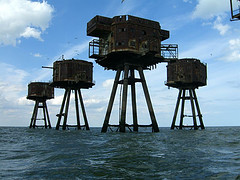
It sounds like something Bruce Sterling foresaw as long ago as Islands in the Net: Larry Dignan on ZDNet looks at a patent for a structure that would sit offshore like an oil rig:
Google is pondering a floating data center that could be powered and cooled by the ocean. These offshore data centers could sit 3 to 7 miles offshore and reside in about 50 to 70 meters of water.
….Now wild-cards abound. Jurisdiction issues will occur. Are states really going to allow Google or anyone else place these pontoons offshore without some tax hit?
And will Google take advantage of such a setup to bank your data like the Swiss bank money?
[Rusting sea forts in the Thames estuary photographed by phault; story tip: Gregory Frost]
Behrokh Khoshnevis, a professor in the USC Viterbi School of Engineering, says the system is a scale-up of the rapid prototyping machines now widely used in industry to “print out” three-dimensional objects designed with CAD/CAM software, usually by building up successive layers of plastic.
… Instead of plastic, Contour Crafting will use concrete,” said Khoshnevis.
I suppose that rapid prototyping technologies are going to be a change of web/Internet/genetic engineering proportions over the next couple of decades, affecting everything and leading to unpredictable social changes.
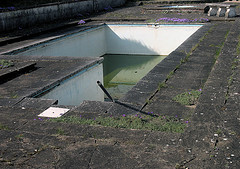 If you’re looking for a way to make some extra income in the coming years, you could always consider turning that swimming pool in your back yard into a miniature subterranean apartment and renting it out to the recently-foreclosed-upon. Mooted as a potential solution to the housing shortage in Sydney, Australia, it strikes me that it might also make great economic sense in other warm countries and regions. [via BLDGBLOG; image by Addictive_Picasso]
 Imagine trying to exit a burning building.
 It sounds like something Bruce Sterling foresaw as long ago as Islands in the Net: Larry Dignan on ZDNet looks at