Tag Archives: art

Manufacturing popularity: cultural groupthink and the lottery of art

Wired‘s Clive Thompson has an article about some intriguing research into the effects of the “self-fulfilling prophecy” on popularity in art. [image by vagawi]

It’s been known since the 1940s that we base our opinions on the opinions of others at a subconscious level, but modern web applications and social network technology have enabled researchers to quantify and assess the power of the phenomenon with much greater precision. If you’ve ever harboured a suspicion that the runaway success of certain musicians, bands, writers and artists was more down to luck and advertising budgets than any objective measure of quality, it turns out that you may have been at least partially right.

[Watts and Salganik] created a music-downloading Web site. They uploaded 48 songs by unknown bands and got people to log in to the site, listen to the songs, then rate and download them. Users could see one another’s rankings, and they were influenced in roughly the same way self-fulfilling prophecies are supposed to work. That meant some tunes could become hits — and others duds — partly because of social pressure.

Watts and Salganik ran the experiment over and over — each time with a new group of people — until they’d gotten 12,900 participants. In essence, they rewound history each time: Every new group started fresh, listened to the same 48 songs, and made up their collective mind.

The result? Different songs were hits with different groups. A few songs frequently — but not always — hovered near the top, and a few at the bottom. But for most of the tracks, success — or failure — seemed random.

Next, fake the peer feedback and see what happens:

They took the song ratings of one group and inverted them so bottom-ranked music was now at the top. Then they gave these rankings to a fresh set of listeners. In essence, they lied to the new group: They told them that songs that weren’t popular with previous listeners actually were.

The new listeners dutifully took their social cues from the bogus popularity rankings — they ranked the fake-high ones high, even downloading them, while snubbing the fake-low ones. Apparently, flat-out lying works.

But only sometimes. Eventually, some of the previously top-ranked songs began to creep back up, and previously bottom-ranked ones slid down. And people in the upside-down world downloaded fewer songs overall.

So quality matters, but so does luck and public opinion… and the effect of public opinion is magnified as it accumulates. Looking at the pop music charts at the moment, I think we can see the same results being reflected on a much bigger scale: the hegemonic power of restricted channels (radio, MTV) has been eroded by the multiplex narrowcasts of the internet, meaning adventurous listeners are more able and likely to encounter more marginal works. Meanwhile, the body of listeners still following the old channels are left with a selection of product that is increasingly groomed and engineered to appeal to those who bought whatever was selling well last week. End result: a flourishing of small-beer independent artists, and a diminishing market for increasingly predictable (and in some cases desperate) manufactured pop.

But how does this reflect on the seemingly inexplicable runaway successes of the book world – the Dan Browns and Stephenie Meyers? Might more marginal authors have replicated their success if they’d had the same degree of initial exposure, publicity and luck? If so, will the levelling of the artistic playing field promised by the Long Tail eventually start throwing more literary curveballs into the bestseller lists? Or will the same old lottery of chance and recommendation rebuild itself on top of the new networks, leaving objective quality (if any such thing really exists) forever playing diminuendo second fiddle to popularity?

Cheer up, emo writer – maybe positive sf really could make you more positive.

Well, it turns out my mother may have been right after all* – listening to music with positive messages in the lyrics encourages consideration and empathetic behaviour in teenagers, according to research at the University of Sussex here in the UK. Apparently, people who listen Michael Jackson’s “Heal the World” are more likely to help pick up some knocked-over pencils than those who’ve listened to a neutral or negative tune. [image by Vagamundos]

(I’ve obviously been emotionally mutilated by a lifetime of listening to hirsute and/or black-clad people torturing guitars… if presented with a bunch of pencils in the presence of Michael Jackson songs, my first instinct would be to jam one up each nostril and headbutt the nearest desk until I achieved release.)

But this throws an interesting light on Jetse de Vries’ call for optimistic science fictionif the same psychology pertains to the written word as it does to music, perhaps science fiction readers (and writers) really would be more positive in their outlook if there were more stories written in such a mode.

[ * – This sentence is purely included for stylistic effect; as should be completely obvious, my mother was always right about everything. ]

Prosthetics porn

Hans Husklepp - Immaculate Arm prosthetic design conceptThere is an arc of progress with human technologies: first comes functionality, then gradual acceptance, and then the aesthetic overhaul. The transition from practicality to personality has always interested me, because it hinges on that point of acceptance, be it grudging or enthusiastic; only then do notions of art start to appear and entwine themselves with functional objects.

Some objects achieve that point of acceptance more quickly than others; these are usually the objects of power, objects that make someone more than human – swords and cars, for example. Slower to achieve acceptance and freedom from stigma are those objects designed to raise the disadvantaged to the same status as everyone else.

We appear to be on that cusp of acceptance with human prosthetics. Granted, there have probably been carved crutches, peg-legs and walking sticks for millennia, but they were only ever crude stand-ins (if you’ll excuse the pun) for a damaged or missing limb. But they represented a refusal to be stigmatised, a defiant embracing of the user’s condition – “This is me; this is my replacement limb. Deal with it.”

Now we can build prosthetic legs that are in some respects superior to the originals, and it surely won’t be long before artificial arms that can replicate (or exceed) the essential functions of their biological equivalents become available to the widening sphere of those who can afford them – and that defiance, that rejection of stigma, will become more prevalent. It’s a stage of great interest to transhumanist thinkers, naturally, but it’s also attracting the eyes of artists and designers who’ve noticed a new human space to colonise with the communication of ideas.

There’s a gallery of cybernetic design concepts – like Hans Huseklepp’s Immaculate Arm, pictured top right – and photo-portraiture over at New Scientist at the moment which will get you thinking about this sort of stuff (it’s what inspired the preceding paragraphs of waffle from me, at any rate), but consider it only a starting point. Sit back for five minutes and think about the ways we already customise the human body for aesthetic effect; then imagine what we’ll start doing when prosthetics are affordable and effective enough to become ubiquitous. It’s closer than you think. [image copyright Hans Huseklepp, reproduced here under Fair Use terms; please contact for take-down if required]

Here’s your starter for ten: when will we first hear of people choosing to replace undamaged natural limbs with prosthetics, be it for practical or artistic reasons? How will the general public react to that? How would you feel if your teenaged son came home with a cybernetic hand in place of the perfectly functional one he had before?

Amanda Palmer on passing the hat for art

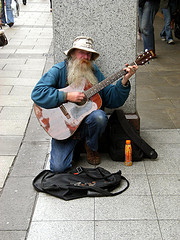
guitarist buskerI imagine many of you have seen this elsewhere (judging by the dozens of different sources I saw it bounce through yesterday) but if not, here’s the one and only Amanda Palmer explaining why she’s not ashamed to ask her fans for money:

artists need to make money to eat and to continue to make art.

artists used to rely on middlemen to collect their money on their behalf, thereby rendering themselves innocent of cash-handling in the public eye.

artists will now be coming straight to you (yes YOU, you who want their music, their films, their books) for their paychecks.
please welcome them. please help them. please do not make them feel badly about asking you directly for money.
dead serious: this is the way shit is going to work from now on and it will work best if we all embrace it and don’t fight it.

unless you’ve been living under a rock, you’ve surely noticed that artists ALL over the place are reaching out directly to their fans for money.
how you do it is a different matter.
maybe i should be more tasteful.
maybe i should not stop my concerts and auction off art.
i do not claim to have figured out the perfect system, not by a long shot.

BUT … i’d rather get the system right gradually and learn from the mistakes and break new ground (with the help of an incredibly responsive and positive fanbase) for other artists who i assume are going to cautiously follow in our footsteps. we are creating the protocol, people, right here and now.

i don’t care if we fuck up. i care THAT we’re doing it.

It’s worthwhile reading for anyone who writes with the intent to sell their work, or those who publish at the small scale of webzines or print mags (or iPhone apps, or whatever other way you’ve decided to do it). As has been suggested before, dead-tree publishing is going to take a comparatively long time to catch up with the business models of the music industry, because the pressures of piracy and freely-available content aren’t so strong yet. But they will be… and it’ll happen sooner than you expect, especially if you just sit on your hands waiting for someone to give you the answer.

So be bold, try things. Throw the spaghetti at the wall and see if it sticks. Hal Duncan’s got the right idea – he’s doing a direct-to-audience publishing experiment on his blog right now. So go throw a few bucks in his hat, and know that you’ve bought good art… and helped feed the person who made it. [image by Martin Pettitt]

(Go throw Amanda Palmer a few coins, too; she’s not just a fine musician but a crusader for independent art, and that alone deserves your support.)

The attention economy: curation by duration

This Short Manifesto on the Future of Attention by Michael Erard pushed a lot of my buttons, and I reckon it’ll be of some considerable interest to other art creators and consumers (writers and readers, for example, which is most of you lot):

I imagine attention festivals: week-long multimedia, cross-industry carnivals of readings, installations, and performances, where you go from a tent with 30-second films, guitar solos, 10-minute video games, and haiku to the tent with only Andy Warhol movies, to a myriad of venues with other media forms and activities requiring other attention lengths. In the Nano Tent, you can hear ringtones and read tweets. A festival organized not by the forms of the commodities themselves but of the experience of interacting with them. Not organized by time elapsed, but by cognitive investment: a pop song, which goes by quickly, can resonate for days; a poem, which can go by more quickly, sticks through a season. A festival in which you can see images of your brain on knitting and on Twitter.

I imagine a retail sector for cultural products that’s organized around the attention span: not around “books” or “music” but around short stories and pop songs in one aisle, poems and arias in the other. In the long store: 5,000 piece jigsaw puzzles, big novels, beer brewing equipment, DVDs of The Wire. Clerks could suggest and build attentional menus. We would develop attentional connoisseurship: the right pairings of the short and long.

Has a hint of the science fictional about it, but doesn’t seem implausible by any means given the way the web is mutating creation and commerce. But this bit deserves special attention:

I imagine an attention tax that aspiring cultural producers must pay. A barrier to entry. If you want people to read your book, then you have to read books; if you want people to buy your book, then you buy books. Give your attention to the industry of your choice. Like indie musicians have done for decades, conceive of the scene as an attention economy, in which those who pay in (e.g., I go to your shows) get to take out (e.g., come to my show). It would also mitigate one oft-claimed peril of the rise of the amateur, which is that they don’t know from quality: consuming many other examples from a variety of sources, even amateur producers would generate a sense of what’s good and what’s bad: in other words, in their community they’d evolve a set of standards. This might frustrate the elitists, who want to impose their standards. But standards would, given enough time, emerge.

This sounds very much like the online short fiction scene to me, albeit a more highly evolved version thereof, and the pparallel with the indie music scenes, especially at a local level, is palpable. I’d be tempted to make “economy” and “ecosystem” interchangeable, though. What do you think – will curation of niche artforms become a form of crowdsourced consensus of attention?

(This is yet another link from Joanne McNeil of Tomorrow Museum, who I’ll stop linking to just as soon as she stops posting really interesting stuff… which hopefully won’t be any time soon.)