Tag Archives: astronomy

Shooting the moon

An artist's impression of MoonliteSpace scientists have come up with a novel way of studying the moon (and possibly later other satellites like Europa). Scientist Sir Martin Sweeting’s Moonlite experiment plans to launch a satellite to orbit the moon. Once in orbit, the satellite would fire four dart-like missiles at the moon’s surface, penetrating three or four metres to study the composition beneath the ground.

Planned for a launch in 2013, the project has had recent tests of the high powered darts in South Wales prove very successful. The subterranean probes are hoped to provide details on the heat flow, seismic activity and water components of our closest astronomical friend.

Meanwhile, the most recent astronomical mission is having problems with its own studies of extraterrestrial soil. The Phoenix lander is struggling to sift the clumpy Martian soil to small enough pieces to study in its compact detectors. The robotic lander is resorting to shaking and sprinkling soil samples with its robotic arm to get material small enough to study.

[picture by SSTL and story via BBC]

That Smoke Ring Thing

Fans of Larry Niven’s superlative Integral Trees series will recognise the gas torus surrounding the red supergiant star WOH 64, located in everyone’s favourite neighbouring dwarf galaxy, the Large Magellanic Cloud. From The Scientific Frontline Observers Gallery:

Comparisons with models led them to conclude that the star is surrounded by a gigantic, thick torus, expanding from about 15 stellar radii (or 120 times the distance between the Earth and the Sun – 120 AU!) to more than 250 stellar radii (or 30 000 AU!).

Everything is huge about this system. The star itself is so big that it would fill almost all the space between the Sun and the orbit of Saturn,” says Ohnaka. “And the torus that surrounds it is perhaps a light-year across! Still, because it is so far away, only the power of interferometry with the VLT could give us a glimpse on this object.

In The Smoke Ring, as in much of Niven’s work – the environment is as big a part of the story as the characters. Niven describes a group of humans living within a vast “smoke ring” surrounding a neutron star.

smoke ringA gas giant orbiting the star has had it’s atmosphere stripped off by the tidal forces of the neutron star, leaving a long, ring-shaped trail within which organisms have evolved to live in a weightless, three-dimensional world, where the only meaningful direction is “out”.

There are some beautiful artists impressions of WOH 64 – unfortunately there is no suggestion that the gas cloud would be anything less than monstrously uninhabitable, like almost everywhere else in the universe.

That said, it is splendid that the VLT Interferometer is working out so well. [via PhysOrg] [image by R’Yes’]

One wandering planet can ruin your whole day

Mars striking Earth This blog is called Futurismic, but mostly we just talk about the near future. Let’s take a look at the far future…say, a few tens of millions of years down the road.

New studies suggest that after 40 million years or so, there’s a small but not insignificant chance–one or two percent–that the solar system will lose its stability, and, Velikovsky-like, start throwing whole planets off on wandering courses through the rest of the system, where they just might crash into ours. (Via NewScientistSpace.)

Although no one can say for sure what will happen beyond that, new calculations are now providing a rough guide to the more distant future. These suggest that there is a 1 to 2% chance that Mercury’s orbit will get seriously out of whack within the next 5 billion years.

This would tend to destabilise the whole inner solar system and could lead to a catastrophic collision between Earth and either Mercury or Mars, wiping out any life still present at that time.

In the case of a smash-up with Mars, for example, “all life gets extinguished immediately, and Earth glows at the temperature of a red giant star for about 1000 years”, says Gregory Laughlin, a co-author of one of the studies at the University of California in Santa Cruz, US.

Interestingly enough, it might not be the first time that has happened:

Many scientists think a Mars-sized object bashed into Earth in the early solar system, throwing out debris that eventually formed the Moon.

Earth was heated to thousands of degrees by the impact, with an ocean of lava covering its surface. A future replay of that event would be disastrous, Laughlin says.

That last quote qualifies, I think, for understatement of the year.

(Image: NASA/JPL-Caltech.)

[tags]solar system, astronomy, catastrophes, far future[/tags]

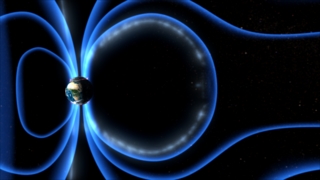
Every month the Earth beats up the Moon with its magnetotail

The Earth's magnetotail is a pretty thing to imagineThe Moon seems like a pretty static place. After all, there’s little atmosphere and apart from occasional meteorite impacts, nothing much happens. Or so we thought. NASA’s Lunar Reconnaissance Orbiter mission found that every month when the moon is full, the moon crosses through the Earth’s magnetotail, bathing our satellite in high energy charged particles that may create dust storms and electrical static.

Astronauts have never been on the Moon during this period. Landings have never taken place when the moon is full. But as Roland Piquepaille on ZDNet’s Emerging Tech blog discusses, if astronauts return to the moon to establish a base, they will have to face the challenges of the magnetotail, which could clog up vents and even give astronauts electric shocks!

[via Science Daily, image by NASA/Goddard Space Flight Center Conceptual Image Lab]

Black Holes in the sky, Black Holes in the internet

Three black holes interact in complex waysA mix of two stories about completely different types of Black Holes today. First, researchers at the Rochester Institute of Technology found that interactions between three black holes should produce gravitational waves that detectors like LISA or LIGO could detect within the next ten years. Gravitational Waves are ‘ripples’ in Space-Time caused by massive objects and events and could tell us a great deal about the big bang.

Another kind of black hole in the news is the ‘internet black hole’. Researchers for the Hubble internet project found distinct pathways on the internet where data was lost for unexplainable reasons. The project, which you can see the results of at their website, was intentionally named after the famous astronomer and telescope. The researchers say they are performing ‘internet astronomy’, looking for events in the cosmos of data that is the internet.

[image by M Campanelli/L Carlos/Y Zlochower/H-P Bischof, that plus space story via New Scientist, internet story via TG Daily]