Tag Archives: astronomy

Alpha Centauri ‘should have an Earth-like planet’

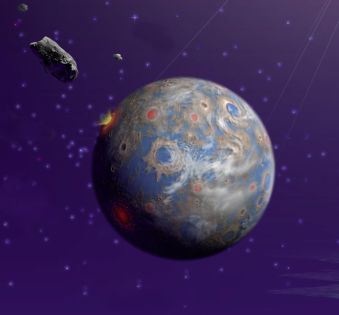
An artist’s impression of an earth-like planet around Alpha CentauriAlpha Centauri is the closest star system to our own but with a bonus: there are three stars rather than one. It’s also one of the best chances we know in the local area to have a planet similar to Earth capable of developing life like ours.
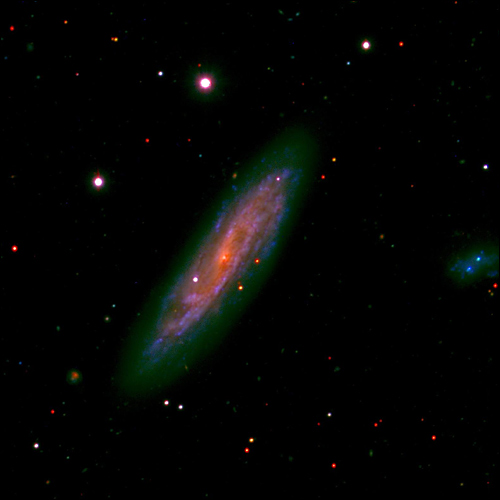
If any planet were to harbour earth-like life in the three-star system, it would likely be around Alpha Centauri A, which is most similar to the sun. However astronomer Javier Guedes and his coauthors believe that Alpha Centauri B is likely to have terrestrial planets in its habitable region. Based on computer simulations of planet formation, Guedes and his team found that no matter what starting conditions, a terrestrial planet always formed around the star. By studying the ‘wobbles’ the planet causes on its parent star, the team reckon they could find any potential planets within a few years.

[story via Daily Galaxy, image via Solstation]

First images from the Large Binocular Telescope

The first of many images by the new telescope

The Large Binocular Telescope in Arizona has ‘opened its eyes’ for the first time, marking one of the first in a new wave of high-tech astronomical devices to come online. The LBT combines two 8m mirrors working in tandem to take pictures of the sky in a wide range of wavelengths at resolutions higher than that of Hubble.

Another couple of new telescopes, Herschel and Planck, will come online this year following their launch into space in April. Laser Interferometer LISA, which measures the bending of space time, has been given the go ahead but won’t be ready for a decade. A spate of advanced telescopes are in planning and construction, taking advantage of the computer advances of the last decade to give more accurate and detailed pictures of the sky than ever before.

[story and image via BBC]

Gravitational lensing

Gravitational-lens-einstein-ring-galaxy Gravitational lensing is all the rage in astronomy right now. A confirmation of one of Einstein’s theories, the phenomenon has seen recent use in mapping dark matter and detecting exoplanets.

To avoid making myself look like the bluffer and layman enthusiast that I am, I’ll defer to the experts and let Phil “Bad Astronomy” Plait explain how gravitational lenses work, and point out that the Hubble telescope has just found a big new crop of them. [Image: NASA, ESA, C. Faure (Zentrum für Astronomie, University of Heidelberg) and J.P. Kneib (Laboratoire d’Astrophysique de Marseille)]

“Big deal,” you might be thinking. In which case, I’ll direct you to Centauri Dreams, where you’ll find an explanation of how the phenomenon might be used for the rapid propulsion of interstellar probes or (in the comments) communication between star systems.

First image of Mercury from Messenger mission transmitted

The first images ever of this side of the first planetMessenger, a NASA probe launched towards Mercury, has transmitted the first image of the unseen side of the first planet in our solar system, Mercury. Whilst Mariner 10 did pass Mercury 3 times in the seventies, it never saw this side due to the strange relationship between Mercury’s spin and orbit around the sun. The image is very good quality, with a lighter region in the top right corner believed to be the area of the planet that comes closest to the scorching heat of the sun.

[via Bad Astronomy Blog, picture by NASA]

Rogue black holes wander the galaxy, seeking whom they may devour

blackhole There’s a science fiction tale or two to be dug out of this little science item, I’m thinking:

If the latest simulation of what happens when black holes merge is correct, there could be hundreds of rogue black holes, each weighing several thousand times the mass of the sun, roaming around the Milky Way galaxy.

The simulation in question is focused on “intermediate mass” black holes, and there isn’t really even any strong evidence that such things, weighing a few thousand solar masses, exist. (Via PhysOrg.)

Still, if they exist, and two of them of different sizes and rotating at different speeds combine, the simulation indicates resulting merged black hole gets a kick in the pants that can hurl it away in an arbitrary direction at a velocity that averages 200 kilometres per second but in some instances can be as high as 4,000 kilometres per second–enough in either case to allow the black hole to escape the globular cluster where these intermediate black holes (if they exist) are predicted to form.

The researchers are reassuring:

“These rogue black holes are extremely unlikely to do any damage to us in the lifetime of the universe,” Holley-Bockelmann stresses. “Their danger zone, the Schwarzschild radius, is really tiny, only a few hundred kilometers. There are far more dangerous things in our neighborhood!”

Of course, anything with a mass of a few thousands suns wandering close to the solar system is going to play havoc with planetary orbits…but fortunately, space is very, very big.

It’s probably nothing to worry about.

(Image: Ute Kraus, Max-Planck-Institut für Gravitationsphysik, Golm, and Theoretische Astrophysik, Universität Tübingen, www.spacetimetravel.org)

[tags]astronomy, space, black holes[/tags]