Tag Archives: astronomy

Nasa finds doorway structure on Mars

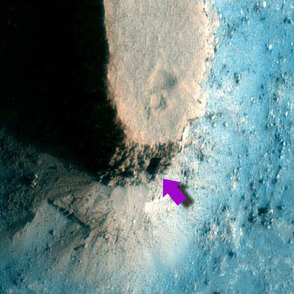
is this a remnant of an alien civilisation or a trick of the light?It’s amazing the things you can find in the universe. Images of our neighbouring red planet by the Mars Reconnaissance Orbiter picked up this little space oddity: a teardrop shaped mountain with a rectangular dark patch that, to the human observer, looks like a door.

The oddly shaped mountain, in the frozen ocean region of the planet, was discovered by a Russian reader, rather than a member of the NASA project. The blog article also has some interesting quotes about Mars terraforming plans.

“They’ve done some experiments and have noticed that some types of plants can grow under the low pressure CO2 atmosphere on Mars,” Australian physicist Charles Lineweaver noted when asked about the prospect of altering the atmosphere of our red neighbour.

Of course, this doorway is probably not the path to some alien civilisation gifting us with its future tech but one can dream…

[via Daily Galaxy, image by NASA]

Building blocks of life common in other star systems?

Dust disk surrounding the star HR 4796A That’s the promising possibility (if you like the idea of extraterrestrial life) raised by the discovery by astronomers at the Carnegie Institution of highly complex organic molecules in the disk of red dust surrounding a young star (one very different from the sun) thought to be in the late stages of planet formation. Observations of light from the star via one of the instruments on the Hubble Space Telescope reveal that the light scattered by the dust disk is very red, matching the spectrum of large organic carbon molecules called tholins that no longer exist on Earth but are hypothesized to have been precursors to the biomolecules that make up living organisms. (Via SpaceDaily.)

The image above is a false-color image of the dust disk surrounding the star, HR 4796A, with the star itself masked to make the disk visible. The inner “hole” in the disk is big enough to swallow our solar system and may have been swept clean of dust by orbiting planets.

(And even though they’re both red, no, there’s no connection between the red dust of HR 4796A and the red rain of Kerala.)

(Image: John Debes.)

[tags]extraterrestrial life, astronomy, Hubble Space Telescope[/tags]

The debate over "Active SETI"

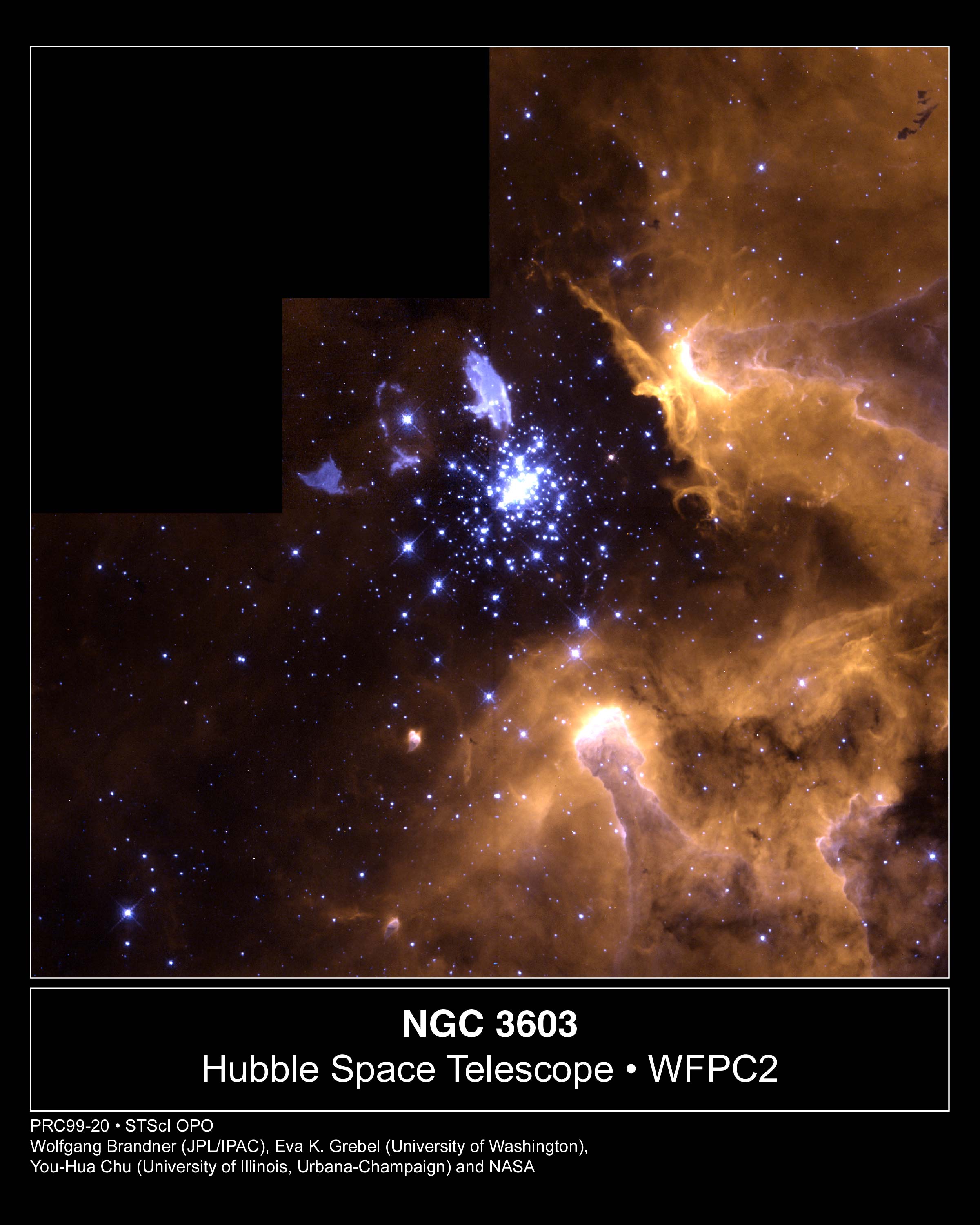
Hubble Space Telescope view of NGC 3603 I’m back! Miss me?

Now that I’m no longer wearing my actor hat and performing eight shows a week of Beauty and the Beast, I’ll be posting regularly again. And what better way to start than with this fascinating article from SEED Magazine about the controversy in SETI (Search for Extra-Terrestrial Intelligence) circles over whether we should just be passively listening for alien civilizations, or actively announcing our presence.

Those opposed to “active” SETI point out that, in effect, we might just be putting up a big neon sign on the planet that says “Come And Get Us” (or possibly “Good Eats!”) if there’s something nasty out there listening. In fact, David Brin pointed out years ago (in this paper on Xenology: check out the section called “The Great Silence”) that one theory (that originated within science fiction) for why we don’t hear signals from other civilizations is that something hunts down and destroys anybody that start broadcasting.

Check out the article, and for more discussion of it, read this post at the blog that I picked up the link from, the always-interesting Centauri Dreams.

(Image: NASA.)

[tags]SETI, extraterrestrial life, astronomy[/tags]

Asteroid may hit Mars at end of January

The asteroid is part of a small group of rocks that cross both Earth and Mars orbitsIf you’ve watched Deep Impact and Armageddon a hundred times and still want to know what a real asteroid impact would look like, mark January 30th 2008 on your calenders. On that date, the path of Asteroid 2007 WD5 passes perilously close to our neighbour Mars and may or may not hit it.

The NEO (near-earth object) was found in November and marked because it also passes close to Earth. Analysis of its path say there’s a 1 in 75 chance the 50m rock will impact on the red planet, causing a crater up to half a mile wide.

[via Chris Mckitterick, image by NASA]

More on reionisation

The universe has been expanding for 13 billion years

On Wednesday I talked about reionisation and how many of the new telescopes being designed are to study this side of astronomy. But what exactly does this mean? Well, ionisation just means that the electrons of an atom are separated from the protons and neutrons. This usually requires a lot of energy, especially if it occurs over a large area. When the universe began after the big bang (the far left of the picture), everything was close together and extremely hot. For a while even the quarks that make up protons and neutrons were independent of each other. Over time the universe grew and the temperature decreased. Quarks recombined into particles, electrons recombined with protons, leaving us with mostly neutral hydrogen, all across the universe.

Now, astronomers can’t see much from neutral hydrogen. It’s too cool to emit much EM-radiation as light, infra red or radio waves that telescopes can pick up. Today, however, we see lots of radiation – from stars, galaxies, black holes, quasars and ionised gas. If the universe was neutral 12 billion years ago, what caused it to reionise? Probably, the first stars caused this change. Over huge periods of time tiny variations in the density of the universe caused the hydrogen to collapse into stars, whose light then ionised the regions around them. By studying the ‘bubbles’ of ionisation so long ago we can work out why the universe has the structure we see today.

Astronomers have never seen that far back before in the key Radio and Infrared regions. The telescopes of the last fifty years just don’t have the power, as Scotty might say. The further back through time you want to look, the further the light has to travel and the fainter the signal. With the advances in computer technology over the last twenty years, we can finally start building equipment capable of seeing those first stars and galaxies. If people are interested, I’ll post the occasional update on how telescopes like JWST and SKA are progressing.

[photo by Nasa’s WMAP team via JSWT Science Case]