Tag Archives: biology

The mould, the map and the mass transit system

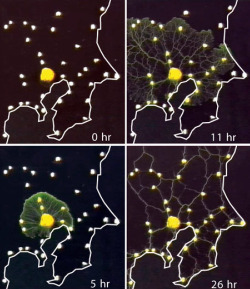
slime mould "transit network" (credit: Science/AAAS)There’s still much we can learn from the natural world – and not just the simple things. Nature has a way of solving complex problems without the need for cognition and abstract thought… or even sentience, in many cases. I remember being impressed as a child by the incredible power of tropisms in plants; the simple behaviour of growing toward a light source, for example, can make dumb vegetable matter seem tenacious, determined, relentless.

Well, it turns out that tropism can be pretty efficient, too, as discovered by a research team based in Tokyo. Having already discovered that slime mould can find the shortest route through a maze (provided there’s a food source to entice it), they made a simple map of Japan which used oat flakes to represent major population centres, and let the mould loose on it. End result: the networks of mould connecting the oat flakes closely resembled the country’s existing mass transit networks, or alternative layouts that were theoretically just as efficient. [via BoingBoing; image borrowed from linked article, credit Science/AAAS]

This reminds me of a (possibly apocryphal) story I read a long time ago about some architect employed to lay out a new section of campus for a college or business or something similar. Having set aside a large green space between a bunch of buildings, he was asked where the paths across it should go; his response was that the best way to make an efficient network of paths was to not lay any at all, and to let people walk as they wished across the green space for the first term. By the end of that time, the paths worn into the grass by pedestrians could be used as a map for the asphalters, showing not only the routes required but the comparative traffic densities thereof.

I’m not sure quite where I’m going with this, but I think it has something to do with dethroning rational planning processes in favour of waiting for the best methods or systems to emerge from the chaos of real life. For all our research, for all our academic disciplines and best practices, sometimes just letting things happen as naturally leads to the most efficient solution. I guess the trick is to recognise which problems are best solved in such a way, and which ones aren’t…

Eradicate cruelty: “reprogram” predators

hungry lionI’m sure that almost everyone would rather live in a world that featured less cruelty and pain for living creatures… but what if it were possible to eradicate them completely? Via Accelerating Future comes a provocative essay by one David Pearce, who suggests that not only would it be possible for us to engineer a biosphere without suffering, but that it is our moral duty to do so. Global veganism in the wake of readily available vat-grown meat would be merely the start of the project; next would be the engineered extinction of all obligate predator species. [image by Tambako the Jaguar]

Even the hypothetical world-wide adoption of a cruelty-free diet leaves one immense source of suffering untouched. Here we shall explore one of the thorniest issues: the future of what biologists call obligate predators. For the abolitionist project seems inconsistent with one of our basic contemporary values. The need for species conservation is so axiomatic that an explicitly normative scientific sub-discipline, conservation biology, exists to promote it. In the modern era, the extinction of a species is usually accounted a tragedy, especially if that species is a prominent vertebrate rather than an obscure beetle. Yet if we seriously want a world without suffering, how many existing Darwinian lifeforms can be conserved in their current guise? What should be the ultimate fate of iconic species like the large carnivores? True, only a minority of the Earth’s species are carnivorous predators: the fundamental laws of thermodynamics entail that whenever there is an “exchange of energy” between one trophic level and another, there is a significant loss. The majority of the planet’s 50,000 or so vertebrate species are vegetarian. But among the minority of carnivorous species are some of the best known creatures on the planet. Should these serial killers be permitted to prey on other sentient beings indefinitely?

There’s a whole raft of obvious objections to the idea, of course, but Pearce has covered pretty much all of them with the logic of our obligation to compassionate stewardship of our biosphere. I’m not even close to agreeing with him – frankly, the whole thing seems no less hubristic to me than believing that we have a moral right to impose cruelty by dint of our top-most position on the evolutionary chain, though (as Pearce points out) that’s representative of a fundamental bias toward the biological status quo. But it’s a fascinating and challenging read nonetheless… not to mention a spark for dozens of science fictional story ideas.

My heart no longer beats

HeartMateIIPhysicians have successfully implanted an artificial heart that does not beat:

Salina Mohamed So’ot has no pulse. But she is very much alive.

The 30-year-old administrative assistant is the first recipient here to get a new artificial heart that pumps blood continuously, the reason why there are no beats on her wrist.

An interesting development. I wonder if the efficiency and reliability of such artificial hearts will ever be such that people elect to replace their existing hearts with them even before their biological hearts wear out?

[via Slashdot, from The Straits Times][image from on Technology Review]

Boat-cleaning robots for a greener ocean?

autonomousunBarnacles, oysters, algae, and other sea-life can slow a ship by 10% and increase fuel consumption by as much as 40%. The U.S. Office of Naval Research is testing a Roomba-like autonomous hull-cleaning robot to cut the drag.
The robot incorporates the use of a detector that utilizes modified fluorometer technology to enable the robot to detect the difference between the clean and unclean surfaces on the hull of a ship. Used to groom ships in port, the Hull BUG [Bio-inspired Underwater Grooming tool] removes the marine biofilm and other marine organisms before they get solidly attached. This is especially important because Navy ships spend more than 50 percent of their service life in port, giving barnacles and marine life ample time to become settled and, if allowed, to further colonize and grow on the ship’s hull.

Underscoring the benefits of combining the Hull BUG with newly developed environmentally benign antifouling hull coatings, [ONR Program Officer Steve] McElvany estimates that “the Navy will save millions of dollars per year in fuel. Using less fuel also means less carbon dioxide in the atmosphere.”

[Photo: U.S. Navy]

Why you have (or had) an appendix

CT scanThe image of the appendix has been getting a makeover. Two years ago, Duke U. researchers suggested it is not the useless evolutionary vestige that Darwin said it was.

The appendix, they said, is a safe haven where good bacteria could hang out until they were needed to repopulate the gut after a nasty case of diarrhea, for example.

Now some of the team suggest the appendix has been around a lot longer than Darwin thought.

[Surgical sciences professor William] Parker and colleagues found that the appendix has evolved at least twice, once among Australian marsupials and another time among rats, lemmings and other rodents, selected primates and humans. “We also figure that the appendix has been around for at least 80 million years, much longer than we would estimate if Darwin’s ideas about the appendix were correct.”

Parker says Darwin just didn’t have access to enough information about the organ.

“If he had known about the widespread nature of the appendix, he probably would not have thought of the appendix as a vestige of evolution.”

He also was not aware that appendicitis, or inflammation of the appendix, is not due to a faulty appendix, but rather due to cultural changes associated with industrialized society and improved sanitation. “Those changes left our immune systems with too little work and too much time their hands – a recipe for trouble,” says Parker.

[Story tip: Phoenix New Times blog; CT image by jellywatson]