Tag Archives: biotech

New resin for growing flesh

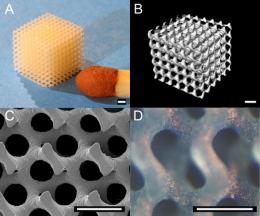
biodegradable_resinResearchers at the University of Twente have developed a biodegradable resin that can be used to create precise replicas of forms within the body around which new tissues can be grown:

The resin can be given different properties depending on where in the body it is to be used. Cells can be sown and cultured on these models, so that the tissues grown are, in fact, produced by the body itself. The new resin has been developed by Ferry Melchels and Prof. Dirk Grijpma of the UT’s Polymer Chemistry and Biomaterials research group. An article on this breakthrough will be appearing in the authoritative specialist journal, Biomaterials

The method used to recreate the specific forms is called stereolithography, the improvement in this system is that the resins have hitherto not been biodegradable. This means:

If, for example, a child has a heart valve disorder, a 3D digital image of the heart valve can be created using a CT scanner. The model in the stereolithograph can be copied exactly with the new resin. If the structure is made porous, the child’s own cells can be placed on it. This porosity also gives nutrients access to the cells. Ultimately, after the carrier structure has broken down, only the natural tissue remains.

Which is a rather wonderful development.

[from Physorg]

Viruses for nanotech components

virusTurns out viruses are good for more than just killing cancer cells. Researchers at MIT have developed a method whereby viruses are coated with iron phosphate, then attached to carbon nanotubes, thus creating  the building-blocks of nanoscale electrical components:

This advanced ‘bio-industrial’ manufacturing process, which uses biological agents to assemble molecules, could help to evolve key energy material components (e.g. cathodes, anodes, membranes) used in batteries, fuel cells, solar cells and organic electronics (e.g. OLEDs).

It’s interesting to see how researchers are making use of the native biological territory instead of reinventing the wheel when it comes to nanotechnology – using viruses to make nanomaterials to make power cells.

[from Future Blogger][image from noii’s on flickr]

NEW FICTION: AWAKENING IN SIX PARTS by Karen M Roberts

It’s time for another fresh piece of fiction here at Futurismic, and this one’s something quite unique. “Awakening in Six Parts” is a hugely immersive and somewhat gonzo tale about dreams, mathematics and relationships, set in a tomorrow whose strangeness only emphasises its plausibility. Karen M Roberts has created something that is mysterious and revelatory at once; this story has been haunting my own sleep since I first read it, and I hope it does the same for you. Enjoy!

Awakening in Six Parts

by Karen M. Roberts

One

It wasn’t precisely forbidden for a husband and a wife to discuss their dreams, but it wasn’t the sort of thing decent people did. Max’s coffee cup rattled against the saucer when Claudette raised the topic over breakfast.

“I think my night owl is defective.” Inside her teacup, some leaves had escaped the strainer. She rocked the cup in her hands, watching them swirl.

Without lifting his eyes from the editorials page, Max said, “Did you run it through the diagnostic programme?”

“It flew off before I had the chance. But the dreams, they were… ” Claudette broke off, unable to make sense of the vivid and impossible images that crowded on her tongue. “Do you ever have unsettling dreams?” She peered across the laminate tabletop. Max raised the page of newsprint closer to his nose.

The lucid dreams provided by the night owls were realistic and recurring, a secondary life experienced while the body rested. Who had designed the owls no one knew; they had simply arrived, winging down with the gift of pleasure without consequence, of fulfillment without price. Claudette had never spoken to Max about her dream husbands, and she had no desire to know about the fantasy women with whom he spent his nights. Continue reading NEW FICTION: AWAKENING IN SIX PARTS by Karen M Roberts

Biotech to the stars

dendritesCentauri Dreams discusses a DNA-based self-replicating interstellar probe:

Think of a probe that gets around the payload mass problem by using molecular processes to create cameras and imaging systems not by mechanical nanotech but by inherently biological methods.

A Von Neumann self-replicating probe comes to mind, but we may not have to go to that level in our earliest iterations. The biggest challenge to our interstellar ambitions is propulsion, with the need to push a payload sufficient to conduct a science mission to speeds up to an appreciable percentage of lightspeed. The more we reduce payload size, the more feasible some missions become

This is similar to Robert L. Forward‘s starwisp concept (popularised by Charlie Stross in Accelerando).

I suspect that if and when we do get round to interstellar exploration it will involve sending small-mass packages that are capable of bootstrapping themselves to a broadcast/exploration mode using local materials on arrival in the target system.

It remains to be seen what kind of space-based molecular replicating systems become viable. Will we be able to create space-hardened bioware, or good ol’ fashioned machine phase fullerene nanotech?

[image from neurollero on flickr]

Lungs out of body experience

lungA new technique for storing lungs outside the human body has been developed by the Toronto General Hospital:

In an operating room at the hospital, the technology can keep a pair of human lungs slowly breathing inside a glass dome attached to a ventilator, pump, and filters.

The lungs are maintained at normal body temperature of 37 °C and perfused with a bloodless solution that contains nutrients, proteins, and oxygen.

The organs are kept alive in the machine, developed with Vitrolife, for up to 12 hours while surgeons assess function and repair them.

It is hoped that this process will mean lungs intended for transplant are more likely to be usable. According to the Technology Review article as few as one in ten lungs for transplant are usable with existing cooling-based preservation techniques.

[via Next Big Future, article from Technology Review][image from Technology Review]