Tag Archives: biotech

Your transhuman future: 24/7 body monitoring

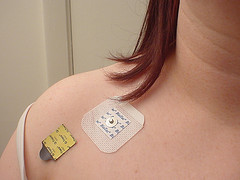
medical monitoring tagsCutting-edge medical hardware can scan and analyse our bodies with incredible accuracy, allowing doctors to diagnose and treat many of the illnesses that come as part of our mortal meatware. But these things can only be seen if we’re looking for them; we’d catch many more diseases and defects if we could be monitored constantly, rather than just when we visit a doctor or clinic.

Unfortunately (or fortunately, depending on your point of view) we’re a long way off from having nanotech swarming through our bloodstreams, but there are companies and research groups working to build realtime medical monitoring systems for the human body. SingularityHub rounds up a handful of them and takes a look at their current projects; here’s a description of one from Proteus Biomedical:

Proteus ingestible event markers (IEMs) are tiny, digestible sensors… Once activated, the IEM sends an ultra low-power, private, digital signal through the body to a microelectronic receiver that is either a small bandage style skin patch or a tiny device insert under the skin. The receiver date- and time-stamps, decodes, and records information such as the type of drug, the dose, and the place of manufacture, as well as measures and reports physiologic measures such as heart rate, activity, and respiratory rate.

So, till pretty crude by science fictional standards, but surely an improvement on being wired up to a room-full of medical monitors to record the same data. As nanotech and molecular genetic engineering converge, we’ll doubtless see systems like this become more powerful and more prevalent, at least in the richer countries.

SingularityHub points out one of the big benefits of this sort of monitoring, namely the vast tranches of data it would supply to medical researchers. But there’s a flip-side that need to be considered, namely privacy. Futurismic‘s own Sven Johnson reported back earlier this month from a possible future where biometric body scans of millions of US citizens was leaked to the public; think of the repurcussions of even more intimate data being exposed. [image by HouseOfSims]

And how about insurance? Once this sort of detailed medical data is available, it’ll become a mandatory part of your application for health coverage, and you can bet your boots that the insurance houses will use every little warning indicator as an excuse to bump up your premium… or deny you a policy completely.

Backyard biotech

Lego DNAWe’ve mentioned garage-sized biotech start-ups before, but not everyone’s in it for the money. As the price barrier to genetic engineering falls, some folk are hacking genes in an attempt to make the world a better place – like Meredith Patterson, for example:

The 31-year-old ex-computer programmer and now biohacker is working on modifying jellyfish genes and adding them to yoghurt to detect the toxic chemical melamine, which was found in baby milk in China last year after causing a number of deaths, and kidney damage to thousands of infants. Her idea is to engineer yoghurt so that in the presence of the toxin it turns fluorescent green, warning the producer that the food is contaminated. If her experiment is successful, she will release the design into the public domain.

Great stuff… but as the article at The Guardian points out, easy-entry biohacking presents as many risks as it offers fixes:

… Helen Wallace of GeneWatch in the UK thinks biohacking could be dangerous. “It is increasingly easy to order genes by mail,” she says. “Something like smallpox is hard to get, but there are other organisms that could become harmful. If you change a living organism’s properties, you could also change its interactions with the environment or the human body.” She adds: “Scientists are notorious for not seeing the unintended consequences.”

“Where is the oversight?” asks another interviewee, and it’s a good point. Will a self-policing global community of genetic scientists emerge, keeping an eye on one another and sharing data in the hopes of collaborating their way to success? The tools are there to enable it, at least.

Of course, it would be easy for individuals to slip through the cracks if they really wanted to… but the same is true of the old system as well. Maybe the best way to make sure we don’t get wiped out by a rogue scientist is to do the best we can to avoid making them feel disenfranchised and unappreciated. [image by mknowles]

Genesis2.0

The goal of engineered-from-scratch custom life-forms is still a long way over the event horizon, but bioengineering research is moving slowly and steadily in the right direction:

Many of the components of this minimal cell already work well together. Biotechnology companies routinely sell commercial kits to synthesise DNA, RNA or proteins to order in a test tube. But these kits only work for a few hours or days before the components are used up and the reaction grinds to a halt. To create a system that runs indefinitely, Forster and Church will also need to add a DNA molecule that encodes all 151 components, so that the system can make new ones as needed. Once they have combined this DNA with a starting set of components, they should in theory end up with a replicating, evolving – in short, living – system.

Good stuff, myriad potential medical uses, yaddah yaddah yaddah. But surely some long-run risks similar to those associated with self-replicating nanotech must be considered – green goo instead of grey, perhaps?

Homebrew genetic engineering

We’re beginning to see the earliest signs of the “garage startup” genetic engineering company:

In her San Francisco dining room lab, for example, 31-year-old computer programmer Meredith L. Patterson is trying to develop genetically altered yogurt bacteria that will glow green to signal the presence of melamine, the chemical that turned Chinese-made baby formula and pet food deadly.

Regardless of what any particular hobbyist or entrepreneur is actually looking for, if you have enough people experimenting there is a good chance they will find something remarkable (what Nassim “black swan” Taleb calls “stochastic tinkering“). Unfortunately there is also a downside:

Jim Thomas of ETC Group, a biotechnology watchdog organization, warned that synthetic organisms in the hands of amateurs could escape and cause outbreaks of incurable diseases or unpredictable environmental damage.

Here’s hoping a balance can be struck between regulation and innovation.

[article from Physorg][image from frankenstoen on flickr]