Tag Archives: books

How to download whole books from Google

Just in case it isn’t obvious: the following is not an incitement to (or endorsement of) copyright infringement; I have decided to publish this link because I know a number of readers here are interested in the legal and commercial future of books in a digital age (as am I), and because the Author’s Guild settlement is a current topic on which it has bearing… and because few things give me more satisfaction than pointing out that Everything Can And Will Be Hacked.

To reiterate: this link is for information purposes only, folks.

How to download full books from Google Books and save them as PDF files

To teach the love of literature, let students choose their books

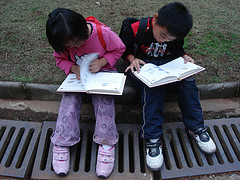
kids reading booksThere’s a lengthy article at the New York Times about middle-school English teacher Lorrie McNeill and her experiments in encouraging her students to engage with reading, and it’ll probably come as little surprise to many of you that she’s found that giving the kids (almost) free rein to pick their own titles has been much more successful than following the classics curriculum and force-feeding them Moby Dick and To Kill A Mockingbird:

The approach Ms. McNeill uses, in which students choose their own books, discuss them individually with their teacher and one another, and keep detailed journals about their reading, is part of a movement to revolutionize the way literature is taught in America’s schools. While there is no clear consensus among English teachers, variations on the approach, known as reading workshop, are catching on.

[…]

… some previously staunch advocates of a rigid core curriculum have moderated their views. “I actually used to be a real hard-line, great-books, high-culture kind of person who would want to stick to Dickens,” said Mark Bauerlein, professor of English at Emory University and the author of “The Dumbest Generation: How the Digital Age Stupefies Young Americans and Jeopardizes Our Future.” But now, in the age of Game Boys and Facebook, “I think if they read a lot of Conan novels or Hardy Boys or Harry Potter or whatever, that’s good,” he said. “We just need to preserve book habits among the kids as much as we possibly can.”

[…]

… literacy specialists also say that instilling a habit is as important as creating a shared canon. “If what we’re trying to get to is, everybody has read Ethan Frome and Henry James and Shakespeare, then the challenge for the teacher is how do you make that stuff accessible and interesting enough that kids will stick with it,” said Catherine E. Snow, a professor at the Harvard University Graduate School of Education. “But if the goal is, how do you make kids lifelong readers, then it seems to me that there’s a lot to be said for the choice approach. As adults, as good readers, we don’t all read the same thing, and we revel in our idiosyncrasies as adult readers, so kids should have some of the same freedom.”

This certainly chimes with my own experience of literature education when I was at school, and I come from a much more privileged background than McNeill’s students. We were made to read lots of classics (including To Kill A Mockingbird, which I remember as one of the most tedious books I ever had to open), and despite the fact that I’d been a keen reader from a very early age thanks to the encouragement of my parents, I honestly believe it was this teaching method that made me abandon English Lit as an education option at the earliest available opportunity. [image by <cleverCl@i®ê>]

Luckily, I never stopped reading (predominantly genre fiction, as should come as no surprise), but I wonder if I might have thought of becoming a writer much earlier in my life had the connection between books I loved and books considered “worthwhile” been made at that stage. Now I’m older, I read much more widely, and recent years have seen me exploring classic literature with a passion that could only have come from having learned for myself just how much pleasure reading a novel can bring (though, to my shame, I’ve still never gotten round to reapproaching To Kill A Mockingbird, which I suspect I’d appreciate far more now than as a callow and geeky 13-year-old).

What were your experiences of literature education at school? Did you lap up the classics, or did they bore you to tears? Do you think that it’s better to encourage kids to read “proper” literature, or just to encourage them to read, period?

Books you wish had been written, but weren’t

Wired‘s GeekDad blog has a post by Corrina Lawson in which she lists five books she wishes had been written, but which were not. They’re mostly continuations of a much-loved series or character, but none of the ones there particularly flick my switches.

So, I thought “why not throw that one open to the Futurismic gang over the coming long weekend?” Drop into the comments at the bottom of this post and call out the unwritten book (or books) you’d most love to have on your shelves.

I’ll start us off: I’d love for Bruce Sterling to write a sequel to Schismatrix (though I’m very certain he won’t), as I can’t think of another stand-alone novel that paints suuch a broad canvas of universe behind the action, and I’d quite like David Zindell to put aside the fantasy epics he’s doing currently for a return to the Requiem for Homo Sapiens universe – anything that combines deep metaphysical weirdness, galaxy spanning space-opera and subliminal references to the Illuminati is a guaranteed winner in this household.

What about you – if you could cause one unwritten book to be published, what would it be, and why?

http://www.wired.com/geekdad/2009/08/5-geeky-stories-we-wish-had-been-written-but-werent/

Is piracy irrelevent to authors?

Looks like book piracy will be one of this week’s genre blog hot topics after io9 had a chat with successful media tie-in novelist Michael Stackpole, who seems to have come round to Tom O’Reilly’s aphorism that obscurity is a bigger threat than piracy:

Writers still trying to break into the publishing world have an unprecedented chance to start their own websites, build an audience and create a market for their work without relying on major publishers at all, said Stackpole. Posting short fiction or even a serialized novel on a website won’t cause problems if a writer tries to sign a publishing deal at a later date because mainstream publishers don’t see digital publishing as a serious threat.

[As many other commenters have already pointed out, that’s not really the case… and certainly won’t remain the case for much longer. Still:]

Rather than simply changing the method of delivering stories to readers, Stackpole believes digital formats will change the nature of the stories themselves. At the very least, authors should tailor their work to these new mediums. He cited what he referred to as “the commuter market,” people who read two chapters per day on their half hour train ride to work. It’s an ideal market for fiction broken into 2,500 word chapters, and could presage a resurgence of serial fiction. “It’s kind of like a return to the Penny Dreadfuls,” he said. “But the readers today are more sophisticated, so we as writers need to put more work into it.”

Insert your own joke about skiffy media tie-ins and the word ‘dreadful’ here… 😉

Still, the web’s ability to change the publishing game is a given (as we’ve discussed here many times before). What remains to be seen is how things will look when (or if) the dust settles. A commenter at BoingBoing has a summary that seems pretty plausible:

… I’ve been saying that in the future books will be either cheap and print-on-demand, electronic, or expensive beautifully designed and crafted art objects, and that publishers will soon become irrelevant but you will see the rise of superstar editors and designers.

Nobody has disagreed yet.

Anecdotal, sure, but it matches up with similar theories from a whole raft of people both within the publishing machine and without.

In related news, fiction isn’t the only printed medium that is finding a new (and more affordable) home online. The American Chemical Society plans to move its dozen-or-so scientific journals to being published online only, according to a leaked memo:

In it, the publisher lays out the basic facts: printing a hard-copy version of a journal is expensive, and researchers simply aren’t demanding one anymore. Advertisers are undoubtedly aware of the reduction in print readership, which means that the former calculus that made print valuable—more ads per journal than could possibly fit on a webpage—was reaching a point of diminishing returns. According to the Nature article, the journals publisher flatly stated, “Printing and distribution costs now exceed revenues from print journals.”

The person who finally cracks the online publishing business model is going to be a very rich man indeed. So let’s hope it isn’t Rupert Murdoch… he seems to be heading in the wrong direction, anyway.

Self-publish and be damned… or not?

There’s lots of discussion going on about self-publishing for authors at the moment. Over at Apex Online, Maurice Broaddus talks about why he’s resisted the temptations of self-publication:

I know the temptation of going the self-publishing route. I have a novel that I’ve shopped around, but have been rejected. I believe in the book, I want to see it in print, but I won’t self-publish it. The rejections have taught me that the book isn’t ready. Self-publishing would mean that I would have a bad (at worse) or prematurely released (at best) novel on my resume.

[…]

Self-publishing if fine if you’re a hobbyist and just want to see your name in print. It’s fine if you have a small niche you wish to reach. It’s also fine if you have a guaranteed audience that you can get product to. I know a few writers with dedicated fan bases for whom it made perfect sense to self-publish a project. It’s your career choice. Do your research.

The prevailing wisdom is that self-publication is a mistake for an aspiring author, though attitudes are relaxing in some quarters as times change. Here’s Jeff VanderMeer laying out the situations in which he thinks it can be beneficial:

I self-published my first fiction collection, The Book of Frog, and also The Surgeon’s Tale & Other Tales (with Cat Rambo)–the context for each consistent with my views on self-publishing as it exists today. If you can’t get traction in the publishing world with a first collection despite having had stories in good publications, I think it’s okay to self-publish. If you’ve got books out from major publishers and you want to do a less commercial project, I think it’s okay to self-publish. That said, within five to ten years, self-publishing in general will probably lose its stigma altogether and we’ll have a situation closer to what you find in indie music.

Self-publishing’s image is tarnished primarily because it gets used as a short-cut to publication for writers who – to be nice about it – simply aren’t yet up to writing a decent book. The obvious defence to that accusation is that not all unpublished writers are bad writers, and that’s certainly true… but I know from my editing work that the overwhelming majority certainly are.

So, as Jeff points out, things will be come much like the indie music circuit: the barriers to participation and distribution will be much lower, but it’ll be no easier to sell your work to people if you’re just not writing what people want to read (or writing it very well). Perhaps that will raise the profile of reliable reviewers and critics? A medium operating under the economics of abundance has a greater need for aggregators and gatekeepers to filter the infinity of choices, after all.

Any of you lot read any good self-published books that don’t deserve the stigma? And are there any self-published authors who’d like to share their experiences?