
Tag Archives: brain

Old dogs and new tricks: web use good for the elderly brain

A silver surferYounger readers (or those with spousal units prone to nagging about excessive time spent in front of a computer) may wish to arm themselves with the news that internet use appears to restore and strengthen brain function, particularly in the elderly. In other words, surfing the web is keeping your brain young and fit. [via The End Of Cyberspace; image by mhofstrand]

For the research, 24 neurologically normal adults, aged 55 to 78, were asked to surf the Internet while hooked up to an MRI machine. Before the study began, half the participants had used the Internet daily, and the other half had little experience with it.

After an initial MRI scan, the participants were instructed to do Internet searches for an hour on each of seven days in the next two weeks. They then returned to the clinic for more brain scans.

“At baseline, those with prior Internet experience showed a much greater extent of brain activation,” Small said.

After at-home practice, however, those who had just been introduced to the Internet were catching up to those who were old hands, the study found.

Of course, this doesn’t take into account the theory that the structure of the web means we only ever get exposed to ideas that we already find agreeable, but I remain unconvinced of that notion, anyway. A brief glance at history shows that people were always perfectly capable of ignoring information that they found unpalatable, long before the internet (or even the printing press) existed…

But while you’re advising grandma to fire up Firefox, be sure to remind her that it’s an aid to learning, not a replacement for it. Recent research shows that we learn much more quickly if we take a chance to answer incorrectly before looking up the correct response… so try guessing before you Google it, in other words.
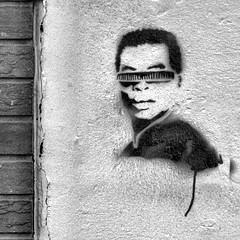
Geordi’s video-to-brain visor being built at MIT

Geordi LaForge stencil graffittiOK, so it’s going to be some time yet before Geordi LaForge video visors are high-street gadgets, but the underlying technologies are coming to fruition faster than I’d have ever expected. Via grinding.be we discover that a team at MIT have sussed a method for grafting a digital device to the optic nerve, enabling them to pipe electronically generated images direct the brain:

The implanted chip, according to the MIT team behind it, features a “microfabricated polyimide stimulating electrode array with sputtered iridium oxide electrodes” which is implanted into the user’s retina by a specially-developed surgical technique. There are also “secondary power and data receiving coils”.

Once the implant is in place, wireless transmissions are made from outside the head. These induce currents in the receiving coils of the nerve chip, meaning that it needs no battery or other power supply. The electrode array stimulates the nerves feeding the optic nerve, so generating a image in the brain.

The wireless signals, for use in humans, would be generated by a glasses-style headset equipped with cameras or other suitable sensors and transmitters tuned to the coils implanted in the head.

For now, however, the system has only been tried out in Yucatan minipigs. Three of the diminutive Mexican porkers have had the Star Trek/Gibsonesque implants for seven months, but as yet it’s difficult to tell just how well they work – as the pigs aren’t talking. The MIT boffins have fitted them with instrumented-up contact lenses to try to get an idea of what effects the implants have.

If you really need me to prompt you towards imagining the awesome and/or weird stuff that might happen as a result of this technology becoming readily available, I suspect you’re reading the wrong website. 🙂 [image by striatic]

Is psychopathy a hardware issue?

MRI brain scanNeuroscience continues to probe the depths of our grey matter, delivering blow after blow to that good ol’ mind-body dualism. The latest news? Psychopaths appear to have a detectable brain abnormality that “normal” folks do not. Interesting stuff, but there are some nasty implications also:

When discussions turn to psychopaths and sociopaths, talk of criminal proceedings cannot be far behind. While the study was small and has not been repeated, the mind immediately wanders to a court room where MRI evidence is given to support the conviction of someone on trial for mass murder. The controversy of the topic is likely to be heated. Could a jury be convinced with biological proof that a person’s brain is marked with the brand of a psychopath?

Given that there have indeed been recent attempts to convict people using MRI scans, it’s not an implausible scenario. But until we’re sure that the brain anomaly in question is only present in psychopaths, this is a type of scientific evidence that is probably best left outside the courtroom. [via SlashDot; image by jsmjr]

Silicon mindslice: artificial brains (still) “ten years away”

There’s been a rash of coverage on Dr Markram and the IBM-supported Blue Brain project, one of the experiments designed to move us closer to creating a silicon simulation of the animal brain. Blue Brain is currently based on a silicon recreation of a slice of rat cortex, and Markram’s team have observed spontaneous emergent interaction between their artificial neurons which suggest to them that they’re on the right track… though not everyone is quite so sure.

“We’re building the brain from the bottom up, but in silicon,” says Dr. Markram, the leader of Blue Brain, which is powered by a supercomputer provided by International Business Machines Corp. “We want to understand how the brain learns, how it perceives things, how intelligence emerges.”

Blue Brain is controversial, and its success is far from assured. Christof Koch of the California Institute of Technology, a scientist who studies consciousness, says the Swiss project provides vital data about how part of the brain works. But he says that Dr. Markram’s approach is still missing algorithms, the biological programming that yields higher-level functions.

“You need to have a theory about how a particular circuit in the brain” can trigger complex, higher-order properties, Dr. Koch argues. “You can’t assemble ever larger data fields and shake it and say, ‘Ah, that’s how consciousness emerges.'”

The possibility of simulating consciousness by building a model of the brain is one of those frustrating quandaries that will seemingly only ever be answered by someone succeeding at doing it; the proof is quite literally in the pudding. Still, Markram is pretty convinced he’s on the right track, going so far as to announce in his TED talk that he’ll have built a model human brain within the next decade… which is something that AI researchers have been saying since the sixties, I believe. I’d love to see it happen, but you’ll forgive me if I don’t hold my breath or place any bets just yet.

More blogs about science and food: The neuroscience of obesity

baconIn a post entitled “The Neuroscience of McGriddles,” Jonah Lehrer (How We Decide; Proust Was a Neuroscientist) samples the “eerily delicious” McDonald’s product and reaches some dark conclusions:

The most pleasurable thing about the sandwich isn’t the pancake or the bacon: it’s the calories. According to a recent paper in Neuron, the brain also receives rewarding input from metabolic processes that have nothing to do with the tongue. When you eat at McDonald’s, a big part of the pleasure comes from the fact that the food is sustenance, fuel, energy. Even mediocre food is a little rewarding.

Indeed, even mice with an impaired sense of taste still prefer sugar water over both plain water and water with artificial sweetener. “What they enjoyed were the calories.” And humans’ desire for high-calorie food seems based on our evolutionary investment in a large cranium.

This is a troubling idea, since it reveals the very deep biological roots underlying the obesity epidemic. Let’s imagine, for instance, that some genius invented a reduced calorie bacon product that tasted exactly like bacon, except it had 50 percent fewer calories. It would obviously be a great day for civilization. But this research suggests that such a pseudo-bacon product, even though it tasted identical to real bacon, would actually give us much less pleasure. Why? Because it made us less fat. Because energy is inherently delicious. Because we are programmed to enjoy calories.

[Image: brian cors; thanks to Dinosaur Comics for the link: “Food’s neat, you guys!”]