Tag Archives: brain

DARPA flirting with transhumanism?

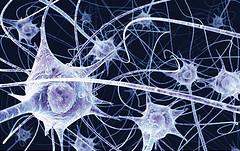
neuronsIt shouldn’t come as any great surprise, I guess; it’s not like DARPA doesn’t routinely churn out ideas with more than a tinge of the science fictional about them. But according to Wired’s DangerRoom blog, everyone’s favourite Pentagon agency has decided to investigate the human brain in the same reductionist/physicalist terms that transhumanist thinkers use to discuss the potential of mind uploading and simulation:

The idea behind Darpa’s latest venture, called “Physical Intelligence” (PI) is to prove, mathematically, that the human mind is nothing more than parts and energy. In other words, all brain activities — reasoning, emoting, processing sights and smells — derive from physical mechanisms at work, acting according to the principles of “thermodynamics in open systems.” Thermodynamics is founded on the conversion of energy into work and heat within a system (which could be anything from a test-tube solution to a planet). The processes can be summed up in formalized equations and laws, which are then used to describe how systems react to changes in their surroundings.

Now, the military wants a new equation: one that explains the human mind as a thermodynamic system. Once that’s done, they’re asking for “abiotic, self-organizing electronic and chemical systems” that display the PI principles. More than just computers that think, Darpa wants to re-envision how thought works — and then design computers whose thought processes are governed by the same laws as our own.

As pointed out, that’s a pretty tall order – even for DARPA, the world leader in tall orders. But if there’s one thing they’re good at, it’s throwing money and expertise at otherwise intractable problems… and in a young field of research like this one, there’s as much to be learned from failure as success. [image by LoreleiRanveig]

And there’s an added bonus – the tinfoil hat crowd have got a nice new conspiracy to gnaw on.

A drug to help recover "lost" memories?

492px-Frederick_Leighton_-_MemoriesBack in 2007, researchers at MIT’s Picower Institute for Learning and Memory in Cambridge, Massachusetts, discovered that mice with symptoms of Alzheimer’s disease regained long-term memories and the ability to learn when treated with a new type of experimental drug called a histone deacetylase (HDAC) inhibitor.

Now that same team, led by Li-Huei Tsai, Picower Professor of Neuroscience, has pinpointed the gene involved. It’s called HDAC2. (Via EurekAlert.)

“This gene and its protein are promising targets for treating memory impairment,” Tsai said. “HDAC2 regulates the expression of a plethora of genes implicated in plasticity — the brain’s ability to change in response to experience — and memory formation.

“It brings about long-lasting changes in how other genes are expressed, which is probably necessary to increase numbers of synapses and restructure neural circuits, thereby enhancing memory,” she said.

The researchers treated mice with Alzheimer’s-like symptoms using histone deacetylase (HDAC) inhibitors. HDACs are a family of 11 enzymes that seem to act as master regulators of gene expression. Drugs that inhibit HDACs are in experimental stages and are not available by prescription for use for Alzheimer’s.

As noted in the excerpt from white sands, HDAC inhibitors are experimental and not yet available by prescription for use for Alzheimer’s (they’re actually being tested in pre-clinical studies to treat Huntington’s disease, and some are already on the market to treat certain forms of cancer–they help chemotherapy drugs better reach their targets), but now that a specific target has been identified, more potent and safe drugs can be developed…which is what Tsai and her team will be focusing on next.

Of course, the focus is entirely medical at the moment, but if, as Tsai notes,

The fact that long-term memories can be recovered by elevated histone acetylation supports the idea that apparent memory “loss” is really a reflection of inaccessible memories

then this also raises the intriguing possibility of memory enhancement drugs for non-medical purposes…law enforcement, entertainment, remembering a loved one…heck, even an actor returning to a role he hasn’t played in 20 years could benefit from a drug that helps access “lost” memories.

Hmmm. On the other hand, aren’t there things you really don’t want to remember? What if the drug forced everything you thought safely buried into the light?

There’s an SF story in there somewhere…

(Image: Memories by Frederick Leighton, via Wikimedia Commons.)

[tags]memory,drugs,medicine,pharmaceuticals,brain,Alzheimer’s[/tags]

Of two minds

brain-simulationAn old science fictional argument: to what extent is it correct to characterise the human mind as a digital computer? According to this insightful article [via Charles Stross] many AI researchers have been making an error in their belief that the human mind can be thought of as a computer:

The fact that the mind is a machine just as much as anything else in the universe is a machine tells us nothing interesting about the mind.

If the strong AI project is to be redefined as the task of duplicating the mind at a very low level, it may indeed prove possible—but the result will be something far short of the original goal of AI.

In other news:

A detailed simulation of a small region of a brain built molecule by molecule has been constructed and has recreated experimental results from real brains.

The “Blue Brain” has been put in a virtual body, and observing it gives the first indications of the molecular and neural basis of thought and memory.

Is there a meaningful distinction between the traditional view of a strong AI and a molecular-level simulation of a human mind?

[image and article from the BBC]

I think, therefore I Tweet

460px-EEG_32_electrodes WIRED reports on what “may be a modern equivalent of Alexander Graham Bell’s ‘Mr. Watson, come here. I want to see you.’:

Early on the afternoon of April 1, Adam Wilson posted a message to Twitter. But instead of using his hands to type, the University of Wisconsin biomedical engineer used his brain.  “USING EEG TO SEND TWEET,” he thought.

The research, which could provide a new means of communication for people locked in their own skulls by paralysis or other problems, is built on the BCI2000, a software tool pioneered by Justin Williams, head of the University of Wisconsin’s Neural Interfaces lab, and Wadsworth Center neural injury specialist Gerwin Schalk, which translates thought-induced changes in a scalp’s electrical fields to control an on-screen cursor.

Although it’s in wide use in labs, notes WIRED, “its communications applications have been largely restricted to messages appearing on a nearby screen. “

“A lot of these have been scientific exercises, geared to writing things out but not really doing anything with it,” said Williams. “We wanted to say, that’s not how a person would want to communicate, especially with the advent of online communications.”

Williams notes that emailing is relatively difficult and inefficient for someone using a brain-computer interface. Twitter, by contrast, “is very serendipitous. It handles all the things that we’ve been struggling to make easy for a patient to do. It puts messages where people can find them. Let the world know how you’re doing, what you’re thinking, and they’ll find you. And that’s perfect for these patients and their families.”

So brain-computer interfaces are already here for limited uses (Wilson and Williams will next install the program in the homes of 10 people already outfitted  with trial versions of the BCI2000). In the future, more advanced brain-computer interfaces could help people control prostheses, powered exoskeletons, humanoid robots

Well, what would you do if you could control a computer with your thoughts?

(Image: Wikimedia Commons)

[tags]brain, computers, disabled, Twitter[/tags]

The fives ages of the brain

brain of manJust for a change, I’m going to post a link without running my metaphorical mouth off about the article in question. New Scientist has been running a multi-part feature on the five ages of the human brain – from gestation to ageing and senescence – with loads of related material on the side, and I thought those of you who’ve not read it already might find it very interesting. [image by Andrew Mason]

There’s a kind of final frontier aspect to neuroscience that really intrigues me; it’s got the same sensawunda kick that good sf gives, as well as a sense of potential that’s starting to rival pure technology as we develop the ability to observe and test the systems in close detail. For example: sew a new set of hands onto someone, and their nervous system gets busy with rewiring the connections and making them work like the originals. That’s a pretty good resilience feature right there, wouldn’t you say? Especially considering it’s a built-in capability of the unmodified 1.0 release…