Tag Archives: business models

Crowdfunding the creatives: should writers ask for money before they write?

The entry of former Pirate Bay co-founder Peter Sunde into the micropayments scene with the beta-launch of his new Flattr service has people discussing donation-based funding models for creatives once again. Micropayments have been mooted plenty of times before now, but no one has ever made them work well enough to catch on – PayPal could have gone that way, for instance, but there wasn’t a big enough margin for them in those minuscule payments, so we’ll have to hope that Flattr (or something similar) can fill the gap at the nickels-and-dimes end of the market. Even if it never becomes a prime revenue stream for anyone, I’d like the ability to be able to donate money to my favourite bands in that sort of manner, for instance, without having to send it through the grasping hands of the record label middlemen.

But the need for new ways to support creative workers is becoming increasingly apparent – as is the set of jobs included under that catch-all, with Deanna Zandt suggesting that one way for journalism to survive is to start considering the journalist as another sort of artist, at least as far as looking for income streams is concerned [via Stowe Boyd]:

How can journalistic endeavors, desperately needed to maintain our terribly just and free society and all that, be supported? Since information/news is no longer a scarce commodity, it just doesn’t fit into a market-based model anymore, in my head. Advertising is only going to carry it so far, as we’re seeing. And besides, do we really want news to be only of commercial value? Do I only want to read news in places where advertisers want to see their ads?

[…]

If you’re a musician, for example, it’s easier than ever to get your work heard by more people than just your friends. But not paid for by a whole bunch, probably. That’s the sticker, eh? A few years ago, as Napster started ticking off the recording industry, someone said that it was clearer than ever what the musician’s job is: not to sell records, but to travel around and play for people. That’s what they’ve always done, and that’s what they’re returning to.

Journalism is grasping at straws for a new model to pay everyone’s salaries. The old model, though, was in many ways distorted, and probably distended. Maybe it’s not, however, that journalistic endeavors are going to be the new starving artists— maybe it’s that news producers and art makers need to get their heads together and figure out how we’re going to create not a model, but a whole new system that creates thrivable conditions for creators to get their jobs done.

Zandt is preaching what she practices here, having crowdsourced the advance for her imminent book on social networks (as discussed by Michelle Pauli of The Guardian):

Using the wisdom of the crowd to research a book is nothing new. Clay Shirky based a whole tome around the concept. But using the wealth of the crowd to fund your book? For no return? That’s a new one.

It’s the unusual approach taken by Deanna Zandt, an American “media technologist and consultant to key progressive media organisations”. Last summer she issued a plea on her blog for donations to support her while she spent three months writing a book about social networking as a tool for social change and action, looking specifically at communities she says have too often been marginalised as social networks have developed: “women, people of color, queer folk, and more”.

Zandt has a publisher for this book, Berret Koehler, but they do not provide authors with advances to write their books. For some (unexplained, especially as the book is due to be published in June 2010) reason the book is “incredibly fast-tracked” and so she needed
“to stop working as a consultant for the next three months and do nothing but write the book. Thus, I need investors. I need you to help me raise $15,000 to cover my expenses, travel, and research. Please toss some money into a ‘Feed Deanna’ pot!”

A lot of people have taken issue with Zandt’s approach, mostly focussing on the perceived lack of return that her crowdfunders receive for their donations; for my money, I think the problem is with Zandt’s particular implementation of the idea (which is easily read as saying “send me money and I might do some work”, though that’s a massive oversimplification) rather than the idea of crowdfunding itself (which offers a whole raft of implementations and models, many of which I expect haven’t even been thought of yet). For some people, perhaps just knowing they’ve supported the creation of something is enough; that’s how patronage of the arts used to work, I believe, though I have no idea how prevalent the “anonymous benefactor” used to be.

Pauli’s piece goes on to point to a post by Futurismic‘s very own Tim Maly, which gathers up some of the discussion around the Zandt story before setting out his own opinion:

My feeling is if you find a way to get paid for your work full-time: TAKE IT, TAKE IT, TAKE IT.

[…]

Here’s the thing about money: it’s fungible. If I give you $25 and you buy a $25 steak, we can’t say for sure that I bought you a steak. The only thing we can say is that I gave you $25 more than you would have had otherwise. If you give me $200,000 to make a video game, all you can say for sure is that at the end of the day a game got made to your satisfaction (or not) and I got $200,000. Maybe the money came from you, maybe some of your money funded another project. Maybe money from another project funded yours. Maybe we took out a loan, hoping that future income would cover the costs of current work.

Here’s the thing about writing: when you are a writer, you become a studio of one. You have a monthly burn rate and some sort of source(s) of cashflow. For your work to be sustainable, cash-flow needs to meet or exceed your income. That’s it.

Another factor to consider with crowdfunding, especially for journalism, is that it can end up supporting work that wouldn’t be produced under the old “pitch it, sell it, write it, get paid” system. Case in point: Paige Williams’ article on legendary off-the-gridder Dolly Freed, which she pitched and pitched until she was blue in the face, before turning to what she calls “Radiohead journalism” (as a hat-tip to the experimental business model around the In Rainbows album of 2007*) as a way to get the money to cover the expense of writing the piece.

A common (and valid) counteragument against this sort of funding is that it currently has the fashionable appeal of novelty, plus the support of social media entrepreneurs who can afford to waft a few hundred bucks toward a project that chimes with their own philosophies of creative endeavour and visions of the future of business. I’ve got dozens of ideas for journalistic pieces sat in my notebooks and text files, but I doubt I’d have the same success as Williams – no one knows who I am, and my journalism is (being generous) raw and untrained. Crowdfunding looks plausible for those who already have their foot in the door, but how would a hypothetical wannabe reporter like myself nudge the door open far enough to achieve the same results?

Perhaps the answer is to start small, keep your goals realistically ambitious at first, build up your reputation and contacts and fanbase, get the snowball rolling. That’s how it’s always worked for non-mainstream bands, after all, and the other route for musicians – get “discovered”, get signed by a major, be groomed into megastardom – is looking more shaky and hollow by the week (thanks in no small part to Simon Cowell and their ilk, who may have managed to squeeze some last spurts out of cash from a dying business model, but have done so at the cost of finally exposing the mechanics of that business model for the manipulative sham it’s always been).

A small but die-hard clade of fans is enough to keep an artist in business nowadays (provided their tastes don’t run to Hollywood mansions and Gaultier bling, and assuming they’ve built up a strong level of engagement with said fanbase), so is it completely implausible that the same could work for writers, be they novelists or journalists? Indeed, it’s the rabid fandom of (often young, often female) early supporters that has traditionally catapulted musicians into the public awareness, and we shouldn’t discount the power of that sort of fandom in our networked world, be it for books (Twilight, anyone?), music or movie stars:

In an essay entitled “1,000 True Fans” Kevin Kelly, one of the founders of Wired magazine, defines a true fan as “someone who will purchase anything and everything you produce.” Kelly’s theory is that all any artist needs to survive in the “long tail” environment of the web is a core of one thousand true fans who will spend one hundred dollars on the artist’s products each year. That’s about one concert ticket and a couple of CDs, which by my calculations would put a fangirl at least one notch above a “true fan” in the hierarchy of fanhood. And that is precisely why the earth shakes when girls decide that something is likable. Greater than just buying power, true fanhood is about participation, and the web presents a multitude of fangirl opportunities both to consume and produce idol information. Of course all this includes a willingness to follow a band, artist, or celebrity until they are no longer working in the industry – well, maybe even a little after that too.

Of course, writers aren’t usually very rock’n’roll (except the late and much-missed Doctor Thompson, perhaps); writer fandom is predominantly based around the writing rather than the writer, at least at first, and writing is (sadly) harder to market than a personality or a pretty face. But everyone has to start from zero at some point, and I’m confident that the market for good writing, fictional or otherwsie, isn’t going to go away – it’s going to migrate to new places and change its shape, but as a species we’re too obsessed with stories to let it wither and die off. And as a final positive note, research indicates that internet habitues are willing to pay for quality content online, albeit with a few important caveats:

The survey, which included more than 27,000 customers globally, found that consumers are (naturally) more inclined to keep already free things free. Still, things that people pay for offline—such as movies, music, and games—were the same things that people were most willing to pay for (or consider paying for) online.

[…]

This doesn’t mean the money will come without conditions, though; more than three-quarters of those surveyed said they expect online content to be free if they already subscribe to a newspaper or magazine offline, and 71 percent said that the online content would have to be be “considerably better” than what’s currently free before they’ll get out their wallets.

At least some users seem to be realistic about what to expect if they don’t pay for it: almost 4 in 10 (34 percent) said they thought the quality of online content would suffer if companies could not charge for it. (Another 36 percent had no opinion on the matter.) Forty-seven percent of respondents said they would accept more advertising in order to subsidize free content.

It’s a brave new world out there, and I suspect that even if crowdfunding doesn’t become the norm, it’ll still be an important part of the creative ecosystem in a decade’s time… and if you PayPal me some cash, I’ll start researching and writing a book about its progress right away. 😉

[ * – Good grief, In Rainbows was released nearly two and a half years ago… where does the time go? ]

The artwork that sells itself

Consider, for a moment, the trials and tribulations of the plastic artist. You create your masterpiece, and – if you’re lucky – you sell it. And that’s your lot – not only is it beyond your control once it leaves your studio, but it can’t make you any further income.
Or can it? Caleb Larsen thinks he’s found a way to keep a persistent revenue stream flowing back from his latest piece, a featureless black plastic box entitled A Tool to Deceive and Slaughter; once it arrives at its new owner’s home or gallery and gets plugged in to power and ethernet sockets, it will wait for a handful of days before logging into eBay and putting itself up for auction again:

“Inside the black box is a micro controller and an Ethernet adapter that contacts a script running on server ever 10 minutes. The server script checks to see if box currently has an active auction, and if it doesn’t, it creates a new auction for the work. The script is hosted on a server to allow for updates and upgrades if and when the eBay API (the interface used for 3rd party programs to talk to eBay) changes.”

The technology is designed specifically so that the buying and selling process could carry on ad infinitum, suggests Larsen, who adds that, if eBay “dries up and disappears, then another platform, either propriety or public, can be used for the selling.”

However, the process is also reliant on purchasers agreeing to stringent rules. There are, in fact, 18 terms listed on the eBay auction site, although Larsen is confident that buyers will comply because they could make money by doing so.

Here’s how it works. The purchaser can set a new value for the artwork, which must be based on “current market expectations” of Larsen’s work, and which could be considerably more than the price they paid. When A Tool to Deceive and Slaughter decides it wants to be sold again, bidders will start their battle at the value set by the current owner.

This is where the art collector could make money. However they must first pay any fees to eBay and give Larsen 15 percent of any increase in value of the artwork.

I expect that once the novelty of the story has worn off, the income stream will dry up pretty fast; Larsen’s real gain here is notoriety and cultural kudos rather than cold hard cash. But his work is an interesting conceptual collision, and doubtless says something quite profound about the value we place on art, the ephemeral nature of that value, and the abstraction between the creator of a work and its existence independent of him or her – a metaphor for modern parenthood in a networked world?

Or something like that, anyway. [image lifted from linked article; please contact for takedown if required]

Ebooks cost a lot of money to make; will no one explain why that has to be so?

Andrew Wheeler wants people to stop saying that ebooks don’t cost publishers lots of money to make:

Creating an individual ebook format — one of the current suite of them — costs roughly as much as creating a print-on-paper edition; the costs of the actual paper and ink are vanishingly small in this equation. Some ebook formats, such as the currently fashionable one, have a baroque process of creation that involves multiple transformations and iterations of quality control, which drives up costs further. And the cost per unit is massively higher for ebooks than for printed books — infinitely so in some cases, since there are plenty of ebook editions that have never sold a single copy.

Now, I feel the need to respond to this post, because I’ve chimed in on ebook economics before and it’s a topic I care a lot about. However, I’m going to first point out that I have a great deal of respect for Andrew Wheeler, both as a blogger and an editor, and I’m fully aware that he knows a lot more about the inner workings of the publishing industry than I do; I’m not going to tell him he’s wrong, because he isn’t. I’m not going to refute the claim that ebooks currently cost a lot of money to make. I am, however, going to say that they shouldn’t cost a lot of money to make, that they don’t have to, and that the longer they do, the smaller the chances of them ever becoming a viable industry in their own right.

Part of this isn’t the fault of the publishers; as Wheeler points out, there are a dozen competing ebook formats with arcane creation processes; there are DRM frameworks; there are ebook vendor requirements that predicatably take advantage of the over-the-barrel status of the publisher and milk them for as much as they think they can get away with. This is pretty much how new technologies always work; I can see parallels with the digital music business as it meared the Napster era. The publishers dragged their feet then, as well, and in the process allowed an openly accessible file format (the mp3) to gain ascendancy in a series of distribution networks that they had no investment in or control over. I expect book publishers are well aware of this parallel; what surprises me is that they’re not talking to the consumers about it more actively.

I do need to quibble on one of Wheeler’s points:

… the cost per unit is massively higher for ebooks than for printed books — infinitely so in some cases, since there are plenty of ebook editions that have never sold a single copy.

Now, again, I’m not saying he’s wrong here – he’s seen figures and spreadsheets that I’ll never be shown, of that I’m certain. But if you’re running a set-up where the per-unit cost of an infinite good is higher than that of the physical finite version, either there’s something massively wrong somewhere in the production chain, or my understanding of the publishing process has a huge flaw which I would sorely appreciate being corrected on.

Allow me to explain: some of you may be aware that I work for UK small press PS Publishing. Now, we don’t sell ebooks (yet), but we make PDF versions of our books available to reviewers. Those PDFs are almost identical to the file we send to the printers, except for being saved at a lower resolution to save on disk space and download times. In other words, the work to produce a template for the reproduction of a physical book or an electronic one can be exactly the same; the same editing, proofing and typesetting/layout process, all the way up to the stage where the book is released to duplication.

The obvious answer to that statement is “well, you’re using PDFs and no other formats, so of course it’s easy”. Well, yes; and that’s kinda my point – if the publishing industry continues to allow intermediary vendors to shaft them with ludicrous hoop-jump requirments and costs for multiple proprietary formats, then they’re never going to make a dime out of selling ebooks. There needs to be a concerted push by the industry for a single, simple and secure digital format that everyone uses; then leverage can be applied to the makers of reader hardware to support that format, plus the formats used by public domain material (e.g. the humble and ubiquitous PDF, which is either unsupported or charged for on most current readers of which I am aware).

Part of the establishment of that file format should include software for easy conversion of proofed electronic galley files directly into it, so that once a book is ready for printing, it’s also ready for ebooking in one click. At this point, there’s no way the per-unit cost for ebooks can be higher than print, because that ebook is ready to ship, and any intermediary vendors should be willing to eat the storage and distribution costs out of their final to-consumer price. If they’re not, you go with the one who will; the rest will soon follow. Now, sure, you’ve still got your marketing and promotion budget to consider in to that per-unit cost, but that’s the same outlay for both editions up to this point in the process, and with a digital format that cost is spread over a theoretically infinite number of units at no extra cost.

By comparison, after that final file is deemed ready for production, printed books must be printed, warehoused, shipped, lifted onto shelves in brick-and-mortar stores and run past the till scanners there, too… and all that money has to be coming from the profit margins. By any rational analysis from outside (with the caveat that I’m not an economist or an accountant), that must cost more than making digital books available; I’m prepared to believe that there may be reasons that it doesn’t, but I’d suggest that those mysterious reasons point to a heroic flaw in the economics of book publishing as it stands.

To reiterate: I’m not saying Andrew Wheeler is wrong to say that ebooks cost more to make than dead-tree books; I’m saying that disparity in cost is impossible to understand for anyone not privy to the way the system works – people like me, and people like the ones who want to buy ebooks but find them either unavailable due to antiquated regional licencsing, hobbled or useless thanks to proprietary and restrictive file formats, or just simply too damned expensive by comparison to the dead-tree version.

Wheeler’s final point s that many ebooks never sell a single copy, which surely only underlines my point that making every effort to reduce that inexplicably high per-unit cost is the only way to make them a viable business. As Blue Tyson says in the comments below the post, “[p]ricing them double is a pretty good strategy to sell zero, certainly.” If your current system means you have no choice but to charge an arm and a leg for an infinte good, your system is surely broken. I think part of the problem is considering the physical and electronic versions as two separate products; that proofed and typeset file is the product, and the ebook or bound paper are just the delivery systems for it.

Now, I’m fully prepared to admit that there are things I don’t know about how the system works, as mentioned above. The point I’m trying to make here is that until the consumer has been shown why that price must be so high, they will never stop complaining about it. I’d genuinely like to know the truth of the matter, and as such I’d like to invite Andrew Wheeler (and anyone else with the pertinent experience and knowledge) to set us straight; I’ll happily publish a response here, or link to it if published elsewhere. Sunlight is the best disinfectant, so they say. 🙂

Amanda Palmer on passing the hat for art

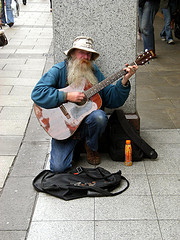
guitarist buskerI imagine many of you have seen this elsewhere (judging by the dozens of different sources I saw it bounce through yesterday) but if not, here’s the one and only Amanda Palmer explaining why she’s not ashamed to ask her fans for money:

artists need to make money to eat and to continue to make art.

artists used to rely on middlemen to collect their money on their behalf, thereby rendering themselves innocent of cash-handling in the public eye.

artists will now be coming straight to you (yes YOU, you who want their music, their films, their books) for their paychecks.
please welcome them. please help them. please do not make them feel badly about asking you directly for money.
dead serious: this is the way shit is going to work from now on and it will work best if we all embrace it and don’t fight it.

unless you’ve been living under a rock, you’ve surely noticed that artists ALL over the place are reaching out directly to their fans for money.
how you do it is a different matter.
maybe i should be more tasteful.
maybe i should not stop my concerts and auction off art.
i do not claim to have figured out the perfect system, not by a long shot.

BUT … i’d rather get the system right gradually and learn from the mistakes and break new ground (with the help of an incredibly responsive and positive fanbase) for other artists who i assume are going to cautiously follow in our footsteps. we are creating the protocol, people, right here and now.

i don’t care if we fuck up. i care THAT we’re doing it.

It’s worthwhile reading for anyone who writes with the intent to sell their work, or those who publish at the small scale of webzines or print mags (or iPhone apps, or whatever other way you’ve decided to do it). As has been suggested before, dead-tree publishing is going to take a comparatively long time to catch up with the business models of the music industry, because the pressures of piracy and freely-available content aren’t so strong yet. But they will be… and it’ll happen sooner than you expect, especially if you just sit on your hands waiting for someone to give you the answer.

So be bold, try things. Throw the spaghetti at the wall and see if it sticks. Hal Duncan’s got the right idea – he’s doing a direct-to-audience publishing experiment on his blog right now. So go throw a few bucks in his hat, and know that you’ve bought good art… and helped feed the person who made it. [image by Martin Pettitt]

(Go throw Amanda Palmer a few coins, too; she’s not just a fine musician but a crusader for independent art, and that alone deserves your support.)

Niche magazine survival strategies and the author-publisher synergy

magazines at the news-standThe Death-Of-Magazines debate seems to have gone off the boil in the genre fiction scene (albeit temporarily), but there’s still plenty of discussion – and innovation – going on elsewhere. Former Wired columnist and Japanophile Momus takes a look at the migration of magazines onto portable devices like the iPhone over in the Land of the Rising Sun:

Already, musician friends are thinking in terms of iPod apps the way they once might have thought of releasing albums on labels. Who needs a label when an app could be a worldwide delivery system for people interested in your music? Or how about keeping up with Japanese magazines? I’ve already mentioned Nakatree Viewer, a free app that lets you look at the paper ads for magazines that hang in Japanese subway cars.

Nakatree Viewer began as the ad sheets themselves (typically showing a modified version of the mag’s latest cover), then added pop-up QR codes allowing you to access some of the content of the magazines. Now there’s talk of the Viewer actually taking you to online versions of the magazines, either reduced versions (like Courrier Lite, a standalone application for one mag) or full ones.

At a time when magazines are dropping like flies, giving them a new distribution platform is giving them the chance of new life. Whether the iPhone is the ideal reading environment for magazines is another matter. I have a digital subscription to The Wire, but prefer to read it on my big computer, or on paper. But when Apple releases its iPhone-OS tablet computer — rumoured either for next month or early next year, depending on who you believe — who knows?

Meanwhile, Lifehacker flags up a web2.0 site called MagMe that puts full-resolution scans of magazines right into your web browser. While none of these examples are omega points for magazine survival, it’s plain to see that people are working to find solutions. The genre short fiction scene sadly lacks the money to invest in playing around with potentially viable solutions, but we can at least hope that one will come along soon enough for them not to die off entirely. [image by Diane S Murphy]

But talking of publishing models, and looping back to Momus’ comment about his musician friends thinking beyond the traditional record publication process, here’s an interesting reversal from the world of music: a record label that have signed a deal with a band [via TechDirt]. Yes, you read that right.

The release outlined a unique setup Blue Scholars have put together between Seattle’s Caffe Vita Coffee Co. and the excellent hip hop label Duck Down. Simply put, Caffe Vita is providing the cash flow, and they’re hiring Duck Down to run point on marketing.

Just another sign of what we’ve been saying for two years: the business is changing, artists have choice, and artists will find partners to help them get done what they need to — the mantra is no longer: “I’ve gotta get signed I’ve gotta get signed…”

Could this reversal of power work in book publishing? Consider a hypothetical author like Cory Doctorow, whose public profile gives him (or her) a lot of traction beyond the traditional book marketing channels; if they were offered a weak or creatively restrictive deal from their standing publisher (or, indeed, no deal at all) and decided to look around for alternatives, what small press wouldn’t jump at the opportunity offered by the chance to let that author publish the book they really want to write?

The author’s stature would reflect onto the small press and garner more media attention, enhancing its ability to shift units by lesser known authors; meanwhile, the author benefits from the experience and connections of the small press in the more traditional book marketing network, reducing the amount of leg-work required by comparison to a self-published (but already well-known) author trying to get the word out. It’s a potential synergy – and while there are plenty of details missing from that off-the-cuff idea, it doesn’t strike me as the most crazy scheme I’ve heard this week.

What do you think – can fiction publishing save itself by slimming down and becoming more flexible, or will consolidation, cost-cutting and rigid control be its saving grace?