Tag Archives: business

Crowdsourcing FedEx

mail packageSometimes I think I should have more faith in my own mad ideas. While the UK postal strikes were in full effect earlier in the year, I was kicking around an plan for replacing the increasingly beleaguered Royal Mail with a sort of peer-to-peer localised mail delivery system, which everyone I mentioned it to told me was completely impractical. [image by piermario]

I dare say they were probably right, but it’s still somehow gratifying to see that it’s not so crazy an idea that I’m the only person to have had it – via Global Guerrillas comes a post by a fellow called Chase Saunders in which he describes a similar idea: UsExpress.

I have mental picture of millions of people driving back and forth to work (and other places) over and over again.  It’s almost like Brownian motion.  Even if people rarely took long trips, there would be plenty of this routine, back and forth motion to ship all the packages we could possibly want, if only there were a service that gave a percentage of these drivers the right incentives, information, and infrastructure to hand off the packages at the proper moment. USExpress could be that service.

[…]

If my father took 10 packages, 4 days a week, fifty weeks a year, that would be 120 x 10 x 200 = 240,000 package miles.  How much do you think it costs to pay for a UPS driver to carry and deliver 240,000 package-miles?  Even if we assume an average of 300 packages on board at all times, that’s probably at least a week’s salary, not to mention overhead and benefits.  The difference is, the UPS guy is not going to drive that route unless we pay him (and train him, and buy him a truck, etc.)  But my father is going to drive to work anyway. If the pickup and dropoff locations are close enough to his work and home, why not generate a few hundred — or a few thousand — extra dollars a year?

Sure, there are some flaws to the idea, but Saunders addresses some of the big ones. The major stumbling block would be getting past the largely unfounded institutional trust we have in national mail systems – the trust that parcels won’t be lost, and that they will get to where they’re supposed to go, on neither of which Royal Mail has a flawless record. But such a system might just fill the gap as energy costs soar toward the day that physical delivery becomes obsolete

Bookstore futures from Shirky and Doctorow

bookstore signContinuing the increasingly ubiquitous discussion of the future of bookstores (in the wake of Borders in the UK going into receivership), two heavyweight thinkers have thrown their opinions out into the ring in the last few days. First of all, Clay Shirky, who notes that there are three basic groups of people arguing for bookstores to be rescued from what seems to be an unstoppable decline, and that it’s the one that treats bookstores as having in intrinsic community value that has the most hope of coming up with a workable model for the future:

[This] third group, though, is making the ‘access to literature’ argument without much real commitment to its truth or falsehood, because they aren’t actually worried about access to literature, they are worried about bookstores in and of themselves. This is a form of Burkean conservatism, in which the value built up over centuries in the existence of bookstores should be preserved, even though their previous function as the principal link between writers and readers is being displaced.

This sort of commitment to bookstores is a normative argument, an argument about how things ought to be. It is also an argument that might succeed, as long as it re-imagines what bookstores are for and how they are supported, rather than merely hoping that if enough nice people seem really concerned, the flow of time will reverse.

Then we get a response from Cory Doctorow, who can come at the question from multiple angles – as someone who has both frequented bookstores and been employed by them, and as someone whose creative output is sold through them. As always with Doctorow, out-of-the-box thinking comes as standard; for example, instead of seeing print-on-demand technology as a business-killer, why not look at how you can use it to add value to the bookstore experience?

At the Harvard Bookstore, they have someone who spends the day mousing around on Google Book Search, looking for weird and cool titles in the public domain to print and shelve around the store, as suggestions for the sort of thing you might have printed for yourself. This is a purely curatorial role, the classic thing that a great retailer does, and it’s one of the most exciting bookstore sections I’ve browsed in years. And even so, there’s lots of room for improvement: Google Books produces the blandest, most boring covers for its PD books, and there’s plenty of room for stores to add value with their own covers, with customer-supplied covers (the gift possibilities are bottomless), and so on. I can even imagine the profs across the street producing annotated versions — say, a treatise on Alice in Wonderland with reproductions of ten different editions’ illustrations and selling them through the store’s printer and shelf-space, restoring the ancient bookseller/book-publisher role.

Plenty of room for one-person middle-man businesses in there, as well… maybe the publishing houses should start thinking in this direction, too. What if they outsourced the physical side of book publishing – design, layout, so on and so forth – entirely to custom designers? You’d quickly get a range of services from the utilitarian to the luxurious, and add an element of individuality to a medium that has become increasingly homogenised… [image by jayniebell]

Blue-sky thinking aside, Doctorow and Shirkey make it plain that there’s no reason bookstores have to die off… but it’s up to the people that run them (and, to some extent, those who use them, too) to make some changes in the direction of sustainability.

Publishing economics round-up

OK, here’s another link-collection post, but there’s more of a theme to this one: I noticed I had a whole bunch of pieces about the economics of publishing, so why not shove ’em together and see what juxtapositions we get?

We’ll start with this article discovered at TechDirt, an impassioned rant from a librarian that responds initially to the American Booksellers Association and their anger at big-box stores for deep-discounting books:

In order to draw customer into their stores, Target and Wal-Mart are making ten bestselling author’s books available for under ten bucks. (Wisconsin is missing all the excitement—they have a law against dumping goods below wholesale prices —but Amazon has joined in the fray, so Wisconsinites can still go online and pre-order bestsellers at low-low prices.)

The American Booksellers Association has even asked the Department of Justice to intervene. […] But I’m also taken aback by the horrified response of the book industry. I thought the big crisis was that nobody reads. Now it turns out the problem is that books are so popular with the masses they’re being used as bait to draw in shoppers.

Come on, guys, get your story straight! Which is it?

Reminiscent of ebook pricing and the strange circular logics that emerge when it is discussed, no? There’s lots more good stuff in there, too, about the internet and libraries, peer-reviewed journals and the true value of information (as defined by its accessibility)… as a former library employee who was permanently frustrated by upper-management attitudes to changing technologies, it’s nice to see some common sense being spoken aloud in that sphere.

Ever wondered how much a “best-selling” author makes from a book? It’s less than you might think, especially if you’re not Stephen King or J K Rowling; via BoingBoing, here’s Lynn Viehl running the numbers on her latest novel:

So how much money have I made from my Times bestseller? Depending on the type of sale, I gross 6-8 percent of the cover price of $7.99. After paying taxes, commission to my agent and covering my expenses, my net profit on the book currently stands at $24,517.36, which is actually pretty good since on average I generally net about 30-40 percent of my advance. Unless something triggers an unexpected spike in my sales, I don’t expect to see any additional profit from this book coming in for at least another year or two.

My income per book always reminds me of how tough it is to make at living at this gig, especially for writers who only produce one book per year. If I did the same, and my one book performed as well as TF, and my family of four were solely dependent on my income, my net would be only around $2500.00 over the income level considered to be the US poverty threshold (based on 2008 figures.) Yep, we’d almost qualify for foodstamps.

Now, what happens to the remainders after a debut book has passed its initial “window of opportunity”? Sometimes they’re pulped, of course, but sometimes they’re sold off super-cheap. Via Ian Hocking comes a bit of soul searching from new author MFW Curran, who wonders which is the best outcome for writers:

Judging by the people walking out of the shop with armfuls of novels, if someone did buy The Secret War for £3, would it be such a hardship? True enough, I won’t get anything from that sale, but if it leads that reader to pick up another of my books, that must be good, mustn’t it? I myself have bought books from remainder shops and have then gone on to pay full price for another of that author’s books […]

So this leads me to another question about “what price is a book to an author?” Especially a debut book? Can a writer bear to have a debut book sold for bugger-all if it will lead to a following? Is it worth it for no gain in the short term only for a longer term outlook?

With the rights to my books reverting to me around summer of next year, there is a question about where do I go from here in terms of publishing and many people have suggested self-publishing. But what of the first book? Should this go out gratis to entice people to buy the next two or three? Maybe as an e-book? It’s definitely something worth thinking about.

And while authors nervously joke about it, and friends and family may tease that they’ve seen your book in The Works or a similar remainder bookshop, you know, I don’t think it’s a bad thing at all. Remainder bookshops may seem like a graveyard for novelists, but perhaps its just a new beginning or an opportunity.

Whatever gets it out there, right?

Looking at the music business, I’d suggest that giving as much as you can bear away for free is the way forward… but as has been pointed out to me many times, music and written fiction are very different businesses in some respects. That said, I think the freemium business model is going to be hard to escape, at least in the near- to middle-term; it’s unappealing to many publishers and writers alike, but there aren’t many other options on the table.

Finally, another link from MetaFilter, though one of more general application. The last couple of years have made me realise that I need to undestand a lot more about economics, not only as a writer but as someone who wants to understand how the world operates as a system; hence, I’ve added the History of Economic Thought website to my list of resources that I really need to get round to reading. The web design is very late-nineties retro, but the actual content looks pretty useful.

If you’ve any further recommendations of good introductory sources on economics (or comments on the articles above, natch), please drop a note in the comments!

Second Life Enterprise: virtual worlds behind the corporate firewall

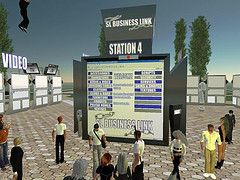
Second Life business link terminalHere’s an interesting development in the metaverse – Linden Lab, creators of Second Life, have announced the formal launch of their “Second Life Enterprise” platform, which is essentially a fragmented piece of the virtual world that runs on corporate servers behind the firewall. Private, hermetically-sealed virtual worlds, in other words. [image by Daneel Ariantho]

This is important for two reasons. First of all, it’s a major step in Linden Lab’s attempts to turn a decent profit from Second Life, which it has struggled to achieve with the free-to-use business model of the public version. If they can convince some big players of Second Life’s utility as a collaborative business tool, the subsequent inflow of money might enable them to step up the bug-hunt and fix some of the virtual world’s bigger flaws. IBM have been a presence in SL for some time, as have other big corporations (to whom we can now add the US Army’s Medical Research and Materiel Command branch, who are financing a “therapeutic space” for amputee veterans using SL Enterprise); the potential for the same tools in a more secure environment (e.g. devoid of flying penis barrages, for a start) may entice more money into Linden Lab’s coffers, and open up the field for competition from other virtual worlds. So now’s the time to set up a business making sharp business suits for executive avatars, I guess…

Secondly, the veil of privacy will doubtless encourage experimentation, and should lead to some new and weird ways of interacting with (and creating within) synthetic spaces. After all, you wouldn’t want to go developing your top-secret big-money idea in public where anyone could see (and copy) it, would you? Imagine for a moment that DARPA decided to set themselves up with an SL Enterprise installation… I’d pay a good big bribe to check out the crazy crap they’d have filled it with after a year or so of getting to grips with the interface, that’s for certain.

And, of course, one can’t help but be reminded of the abandoned corporate virtualities featured in William Gibson’s Bridge Trilogy, most particularly Idoru. Like the adandonware websites that already festoon the web, sat on some server somewhere, waiting for a rental agreement between two companies that no longer exist to expire, the metaverse could soon become a multimetaverse, with a few vast virtualities with public access and countless little bubbles of digital existence locked away behind firewalls and restrictive protocols. Urban exploration is a growing trend at the moment, but in a decade or so, the adventurous people will be cracking their way into abandoned corporate and gubernatorial realities to see what they can find lying around… and hell knows some of it will be more interesting than rusty old swivel chairs.

One-click celebrity endorsements!

As much as I have high hopes for the future, sometimes it seems that “the future” is just a place where you can buy a wider and weirder range of things more quickly and conveniently than before. This doesn’t just apply to us consumer types, either; the mechanics of business are being shortened and tightened and streamlined constantly. Speed is everything. We need it yesterday!

So, you’re building a new model of car (or cooker, or genetically modified guard-armadillo), and you need to get some instant credibility for it before your product launch next week. You need a celebrity endorsement, stat! But don’t they take ages to arrange? Not any more…

Brand Affinity’s goal is to automate the process by which marketers offer contracts to athletes, along with the process by which ads featuring those endorsers are created and produced. The Web site promises that those transactions will take no more than 96 hours.

It provides “a quick turnaround for something that would normally take months,” Mr. Brees said. “A company can contact a player, come to an agreement and the next day the ads could be up.”

That fast pace, said Brian Bos, senior vice president and convergence director at Team Detroit — the alliance of WPP agencies that work for Ford Motor — “reduces risk and provides flexibility, because you’re not tied into long-term deals.”

[…]

Athletes are “human capital brands,” said Ryan Steelberg, president and chief executive at Brand Affinity in Irvine, Calif., who share in an estimated $3 billion paid each year to celebrity endorsers.

Although “the days of someone right out of the draft getting a multimillion-dollar shoe deal are over,” Mr. Steelberg said, large sums are being spent on the handful of big sports names, active and retired, who appear in multiple campaigns.

“Relative to the cost of the superstars, you could potentially activate 5, 10, 25” players who are popular in local or regional markets, he added.

Now, that’s a strong modern business model right there. You’re trading in the currency of celebrity, which (sadly) shows little sign of decaying in perceived value, despite being based on a nebulous social concept whose hollowness is revealed on a daily basis; you’re using the web for swift brokerage and expediting; you’re offering a national service tailored to localised needs. You’ve bolted yourself as middleman onto the Long Tail of celebrity. [via TechDirt]

As pointed out in the article there, the biggest plus point of Brand Affinity’s service is its fine-grain duration scale. No need to risk a lot of money and kudos on a season-long campaign with a particular jock or clothes-horse; keep an eye on trending topics for rising names, jump on ’em when they’ve got enough cachet to give your product a boost, and drop ’em like a hot potato when their star slips out of the ascendant. In a world where fame burns brighter for ever shorter periods of time, that’s a system with a lot of appeal for the marketing and branding wonks… the sort of thing Leggy Starlitz might have stumbled into had he spent longer in the States, perhaps.