Tag Archives: business

Virtual economies, virtual reputations and virtual business suits

Metaverse office space?Once the hype over Second Life died out, virtual worlds kinda disappeared from the high-profile headlines. But there’s still plenty of stuff going on in the metaverse, not least its use as a test-bed for theories to apply in reality. [image by Ramona.Forcella]

Economics is a popular choice; we’ve reported before on the bank runs and currency collapses of EVE Online, and now Edward Castronova – author of Synthetic Worlds, which should be your first port of call if you’re even vaguely interested in metaverse economics – is leading a team who’re examining the economy of EverQuest II. [via SlashDot]

Researcher Edward Castronova, professor of telecommunications at Indiana University, said researchers can learn almost anything about human society in games as they really are human societies.

However unlike real society they can be observed and tweaked.

“We can do controlled experiments in virtual worlds, but we can’t do that in reality,” said Castronova.

“Controlled experimentation is the very best way to learn about cause and effect. We are on the verge of developing that capacity for human society as a whole.”

[…]

After studying 314 million transactions within the fantasy world of Norrath in “EverQuest II,” including trading in-game goods like armor, shields, leather, herbs and food, the researchers were able to calculate the GDP of one of the game servers (the back-end computer that hosts thousands of players in one world).

As more people opened accounts and flocked to Norrath, spending money on new items, researchers saw inflation spike more than 50 percent in five months.

Game economies are, much like real economies, predicated on more than just a currency. Reputation scores are a big part of game economies (and many social networks, too), but the problem with “karma” systems is that they’re usually implemented in a way that renders them pointless, and which leads to the formation of in-game “mafias” [via BoingBoing]:

There can be no negative public karma-at least for establishing the trustworthiness of active users. A bad enough public score will simply lead to that user’s abandoning the account and starting a new one, a process we call karma bankruptcy. This setup defeats the primary goal of karma-to publicly identify bad actors. Assuming that a karma starts at zero for a brand-new user that an application has no information about, it can never go below zero, since karma bankruptcy resets it. Just look at the record of eBay sellers with more than three red stars-you’ll see that most haven’t sold anything in months or years, either because the sellers quit or they’re now doing business under different account names.

A different (though related) kind of reputation will be bothering the business crowd, however, and the Gartner firm of analysts is convinced that in less than five years, 70% of businesses will have issued avatar dress-codes to their employees [via SlashDot]:

“As the use of virtual environments for business purposes grows, enterprises need to understand how employees are using avatars in ways that might affect the enterprise or the enterprise’s reputation,” said James Lundy, managing vice president at Gartner, in a statement.

“We advise establishing codes of behavior that apply in any circumstance when an employee is acting as a company representative, whether in a real or virtual environment.”

This puts me in mind of a recurring motif in William Gibson’s novels, where he repeatedly makes the point that the most powerful and resource-rich virtual environments will be the ones that look subtle and understated, while the low-budget hucksters will dress to impress with excessive bling and extravagant eye-candy. The subtle grunge and mundane decay of reality is harder to simulate than grandiose overstatement; as in real life, it’ll be wise to tread lightly around the ostentatious.

Not interested in playing games or doing business in the metaverse? Well, you could always go learn to speak a dying language.

Web2.0’s international profit paradox

internet cafe sign - Varkala, IndiaSlowly but steadily, the world is becoming wired; internet penetration in developing countries is growing at a surprising rate, and the residents of said countries are taking to Web2.0 like ducks to water. Great news for start-up entrepreneurs, right? [image by piccadillywilson]

Well, not entirely. Citizens of developing nations are providing a huge influx of users to Web2.0 platforms, certainly, but the problem is that they chew up a lot of expensive bandwidth without returning much in advertising revenue:

Web companies that rely on advertising are enjoying some of their most vibrant growth in developing countries. But those are also the same places where it can be the most expensive to operate, since Web companies often need more servers to make content available to parts of the world with limited bandwidth. And in those countries, online display advertising is least likely to translate into results.

This intractable contradiction has become a serious drag on the bottom lines of photo-sharing sites, social networks and video distributors like YouTube. It is also threatening the fervent idealism of Internet entrepreneurs, who hoped to unite the world in a single online village but are increasingly finding that the economics of that vision just do not work.

I imagine this problem has been magnified recently by the economic slump; the pricing of online ads everywhere has taken a nosedive in the last year or so. That may be temporary, though, as print media venues close their doors in response to the same pressures. [via SlashDot]

What’s most likely, as the NYT article points out, is a sort of tiered service; MySpace is allegedly planning to serve its Indian userbase with a stripped down page design to save bandwidth (a course of action that, if deployed globally a few years ago, might have stopped people from abandoning it in droves for Facebook), while Veoh has entirely blocked users from many developing regions from watching videos on its service.

A big outfit like Google can afford to bleed money on this sort of thing (and indeed it is – some people estimate YouTube is costing them $1.65million every single day), but not forever. Which means that, if things continue in the same vein, the internet may become the latest frontier where the omnipresent (and ever-growing) gap between the haves and the have-nots makes itself manifest.

It’s a bit of a Catch-22 situation: ad revenue in developing countries is low, but it will only increase at a decent rate if the internet in those areas doesn’t become a second-rate ghetto with limited services. It’s the ages-old battle between idealism and profit margins… and a crucible test for Google’s “don’t be evil” manifesto.

Comics Self-publishing 101… from a man who’s been there and done that

If you’ve ever considered setting yourself up as an independent comics publisher to push your own work, novelist and indie-creator Jim Munroe has got your back with a self-publishing primer.

One of the coolest thing about the comics world is that it doesn’t dismiss self-publishers the way the lit world does. Maybe because it’s a less pretentious field, or a newer one, or that drawing talent is more quickly discerned at a glance.

Pretentious? Us? Au contraire! Well, that’s a debate for another day… for now, let’s see what Munroe suggests as a start:

Someone wrote in another Xeric testimonial that you should not attempt self-publishing and all of this business unless you have no choice. This is really true. It’s a tonne of work, there’s no money in it, and trying to put comic books out there for public consumption is another full-time job on top of doing the actual (creative) work.

[…]

But the more of your own work you do the more focused you become, and the easier it gets, at least to be confident enough to start a project, to see it through, and to learn a thing or two about it and yourself in the process.

In other words, self-publishing shouldn’t be considered a short-cut to success for shoddy work… which is the one thing that the majority of self-published novelists seem to have utterly failed to realise. There’s lots of solid practical advice in Munroe’s post, so if you’re a comics writer or artist (or just interested in the business side of small-scale publishing) go take a look.

Will increasing ease of access to self-publishing tools make it more acceptable to self-publish novels, or less?

Escaping the downward spiral of newspapers

printing pressYou know what they say about rats leaving sinking ships… but then again, you know what they say about rats being survivors. The sinking ship of newspapers is seeing a few of her passengers make a beeline for the portholes; now The Guardian has followed the lead of the New York Times and is opening itself up to the web with APIs rather than shutting the doors. [image by Baltimore City Paper, ironically enough]
As TechDirt points out, many Guardian staff are quite keen for competitors like the NYT to (as they keep threatening) start charging for access to content – because it would hand Teh Grauniad a naked advantage for no effort on their part.

That said, the NYT isn’t sitting on its hands:

“Paper is dying, but it’s just a device,” Bilton told Wired.com […] “Replacing it with pixels is a better experience.”

Bilton, a youthful technologist who programs mashups in his free time, is charged with inventing the future for the Gray Lady in an era of troubled times for newspapers. Fewer people are subscribing, classified ads are decamping for the internet and online revenues aren’t making up for lost print ads.

But Bilton envisions a world where news is freed from the confines of newsprint and becomes better.

It’s whether the shareholders and board of directors agree with him that counts, of course.

Also via TechDirt we see that Slate are using crowdsourced reportage (in this case photojournalism of Depression2.0, or whatever you prefer to call it) to lower costs and improve audience engagement at the same time. Contrary to the teeth-gnashing of industry pundits, newspapers aren’t going to die… but it’s clear the herd is going to be culled pretty seriously as it passes through the needle’s eye of technological and sociological pressure.

Unsurprisingly, younger members of the newpaper business believe that newspapers could save themselves by learning from the Silicon Valley approach – by embracing technology, change and way-out ideas rather than suppressing or ignoring them. They’d better move quickly, though.

Progress – the ebooks debate rumbles on

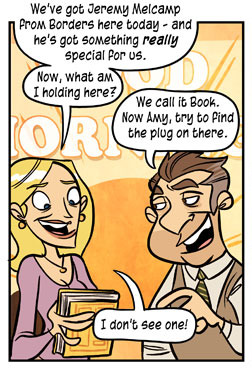
Progress - Penny Arcade on ebooksI suppose I shouldn’t be, but I can’t help feeling surprised at how widespread the debate about ebooks is becoming – I honestly didn’t expect so many people would care so soon. Penny Arcade‘s take is unsurprisingly snarky [see right], but also somewhat conservative given their games’n’gadgets leanings (even allowing for comic license).

The best thing about the breadth of the discussion is that we’re getting a whole lot of different perspectives beyond authors and book-nerds. For example, The Big Money gives us the business logistics guy’s view, namely that “[d]igital readers will save writers and publishing, even if they destroy the book business”:

Here’s where the Kindle comes in. The collapse of bookstores almost ensures that the Kindle will thrive. Not because it’s better than a book; that doesn’t matter. The nation-within-a-nation that reads for pleasure and to be informed is a small but vibrant republic. Heavy readers make up a large portion of the book-buying public. These are people who read two to three books a week and buy 50 or so books a year. The Kindle will solve a number of problems for the citizens of Biblandia, not the least of which is having to go find a bookstore to get their next read.

Elsewhere, uber-PR guy and social media pundit Steve Rubel sees the Kindle and its ilk as “the last Great White Hope” for monetizing text media like journalism:

The Kindle, like the iPod, is an emerging critical mass device that actually encourages people to pay for content rather than get it for free. When Apple launched the iTunes Music Store, people were skeptical that people would shell out cash for music they could snag for free from file sharing networks. They did. The same was true when Apple, and later others, rolled out movies. However, today millions rent or buy movies online.

The Kindle offers a similar experience in a much larger market – text. This one is tougher to monetize. In the digital age books have managed to remain premium content. However, beyond books, magazine and newspaper content is available in abundance online for free. Yet, I still believe that people will pay to receive some of their favorites on their Kindles or their Kindle-enabled phones. Meet them there now while you can.

And of course, there’s the segment of the publishing industry that has gotten itself beyond denial and/or arm-flapping to the point of grappling with the potential that’s sat on their doorstep. Rather than dismissing ereaders as imperfect implementations, the Pan Macmillan digital team are looking ahead to what they see as an inevitable “iPod moment” for text:

… the iPod had a phenomenally intuitive control, especially given the bemusing buttons and rollers of it’s competitors (and I should know as I held out for some time, before caving in with a combination of resignation and glee). Characteristic of it’s manufacturer this no doubt has been an enormous boon to the device. Beyond that though the now iconic look from legendary Apple designer Jonathan Ive was what made us want one. The iPod wasn’t just useful, fun etc- it was jaw grindingly desirable.

Usability and covetability. Two principles for world domination.

What strikes me as being the interesting parallel with these two, aside from the the slightly obvious observations just outlined, is that both came from behind. They did not have first mover advantage. Instead they used these design concepts to leapfrog into pole. Indeed, it could be argued that precisely not coming first was an advantage in that it allowed the pair to fine tune their product and get these two crucial areas right.

Going back to the ereader then, I get the sense that we are on the cusp of when useability and covetability collide, uniting in a glorious burst of reading device nirvana. Ok maybe not quite, but once those user interfaces have been tweaked, and once someone like Ive gets there hands on a reading device, they will be back.

So we’re not quite at the “all bets are off” stage, but we’re certainly beyond the point where it’s a few evangelists with sandwich-boards prophesying the end-times. The more I look at it, the more I suspect that with ebooks the question is no longer “if?” but “when?”

What about you lot – how many of you have a reader already, and how has it changed your text media consumption? And for those that don’t have one, what will be the change that makes you cross the line?