
Tag Archives: business

Yanking on the Long Tail

Ring-tailed lemurChris Anderson’s Long Tail‘ theory of online economics gained traction with great rapidity, but gathered its fair share of detractors along the way. Hence when a group of economists examined some different data and found a different distribution, there was much snarking:

This really isn’t the upbeat fairy tale message Anderson has spent four years selling on the conference circuit. However, as he took his “message” to Davos and beyond, the Long Tail has gradually developed into a ‘Policy Based Evidence Making’.

Ouch. Anderson’s not giving up just yet, though:

Unfortunately, Page didn’t send me the data or reveal its source, so we may not be able to answer these questions. He’s a good economist, so I’m sure his analysis is excellent. But without knowing where the data came from, we really have no way of knowing whether he’s discovered anything about music demand broadly, or has just been reminded once again that some music markets, such as mobile, don’t work very well.

Anderson also points to a post at Hitwise which suggests that – in the business of search, at least – the Long Tail is alive and well.

So, is the future of business in “selling less of more”? Who knows – as with most predictions about the future, those of us who aren’t economists will just have to wait and see. [image by benoutram]

Bookstore chains: What you can and can’t read

A disturbing number of writers are apparently being effectively blacklisted by bookstore chains, even though some of these writers’ books sell pretty well. Gregory Frost witnessed this first-hand when good sales and repeat printings for his novel Shadowbridge weren’t enough to induce a U.S. chain to stock the sequel, Lord Tophet (actually the second half of what should have been one long single volume, but that’s another story). Greg rises above the level of rant to explore why this might be so:
The publisher is required by its owner to turn out bestsellers with assembly line regularity. The dying megastores need the extra income at the same time that they have begun to winnow other titles by those already handicapped authors. In the frenzy of rewards and discounts and product placement, the entire industry has completely lost sight of what it once was in business to provide: Good books. We the readers are the ultimate losers in this rigged game.

My solution is no different than all the writers who’ve shouted from the battlements before me: Buy your books from independent bookstores; the ones that have survived the onslaught, the ones that we hope will arise to fill the gap.

Writers pre-published and otherwise, of course, have an even better motive to support indies. The chains are not our friends. They limit your choices — and your purchases pour money into a dying business model anyway. Whatever chains may be today, they are not the future.

[In my next life, I’d like to be a cat in a bookstore by Glynnis Ritchie]

Metaverse musician lands meatspace recording contract

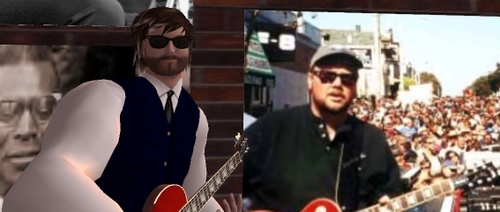
Following on rather serendipitously from Mac’s latest column, New World Notes is carrying the story of Tennessee bluesman Von Johin, who has just been snapped up for a recording contract by Reality Entertainment — an ironic name for a record label, when you consider that Johin has been signed on the basis of his performances in Second Life. [image borrowed from linked New World Notes article]

Von Johin, Second Life bluesman

Johin has had some degree of success in the live music business before now, but the Second Life format seems to appeal to him more:

For the most part, however, he no longer has any interest playing live in person. “This is more fun,” he says, referring to his virtual stage. “No gas costs, no travel, worldwide audience, exciting new people, no smoke, no drunks on the road, no hassles.”

So there’s your answer to the indie-bands-touring conundrum, perhaps. If the cost of fuel keeps rising, maybe the metaverse will be the only place you’ll get to see bands that come from a different country to you.

Green technology boom

There are a couple of articles in Wired and the FT today about the recent increase in investment in green technology; including solar power, carbon sequestration, wind turbines, energy efficiency technology, and water purifiers.

Highlighted in both is the how rapidly the amounts of money being invested are increasing, from Wired:

Investments in companies working on green technology in North America totaled almost $4 billion in 2007, according to the CleanTech Group. And 2008 is on track to yield five times what was invested in 2004.

They also compare the current increase in investment with the dotcom boom of the late nineties, noting the comparatively high cost of entry as well as the long term outlook of green technology industries, from The FT:

Earlier this year, Arvind Sodhani, president of Intel Capital, an important venture capital investor, warned of a speculative bubble in clean technology start-ups. It is an inevitable concern in the wake of the dotbomb and the less-than-impressive performance of many social networking websites. But echoing the words of solar power entrepreneur Mr Ford, Mr Traversone ripostes: “This is not a fad, this is a secular trend in investment.”

It would be wonderful if there was a second industrial revolution in clean, green technology. Thinkers like James Martin in his excellent book The Meaning of the 21st Century: A Vital Blueprint for Ensuring our Future talks about the idea of “eco-affluence” – the idea of developing an environmentally-friendly but extremely prosperous economy. I recommend Martin’s book as it discusses many speculative ideas but is grounded in reliable evidence.

[articles from Wired and The FT]

The economics of book retailing

Bookstore shelvesDepending on who you ask, recent changes in the book publishing landscape are either great news or a calamity. What’s not so certain is the cause of the change, but a blogger at The Economist has a theory – the same technological factors that have flattened the music industry sales curve have made the book market more spiky:

Our cultural consumption exists on a spectrum from “individual” to “collective”. Technology has shifted the balance for both books and music. Digital distribution and the iPod have made music consumption much more individualistic, while the internet and global branding have made book consumption increasingly collective.

This is very easy to blame on chain bookstore business models – there’s plenty of evidence to support the assertion. But as this piece at The Guardian points out, the boutique bookstore is still a viable proposition … again, counterintuitively, partly thanks to the internet (though it helps to have a strong brand identity from the outset):

Each independent has its own survival strategy. Ours has been to stock not just those titles our core customers would expect to find, but to second-guess those customers and offer books to surprise and excite them (what Gabriel Zaid calls “a fortunate encounter”). That in itself is not enough, which is why we set out from the very beginning to establish an involved community …

Still, at least fiction publishers can be thankful that – for the moment at least – the price of a novel isn’t high enough to make peer-to-peer piracy a serious threat. The same cannot be said for the $100 academic textbook, however. [first two links via Cheryl Morgan, latter link via Slashdot] [image by Soul Pusher]