Tag Archives: climate-change

Study finds little solar link to cloud formation, not the driver of climate change?

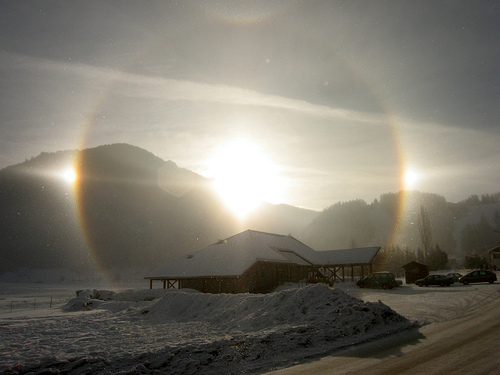
A pretty picture fo the sun, which doesn\'t look like it\'s causing global warmingTwo of the major criticisms of global warming theory I’ve seen recently have been that a) 1998 was actually the hottest year on record and since then it’s been cooler and b) that solar winds and cosmic rays are driving the climate change process, not human emissions.

These are valid points and scientists have been spending a lot of time researching their impact. Lancaster University have just released a major report on the latter, concluding from 20 years of data that global temperatures have little influence from solar activity. The original hypothesis, by Danish scientist Henrik Svensmark, hypothesized that when the 11 year cycle of solar wind is weak, more cosmic rays make it through the earth’s atmosphere, making more clouds and cooling the earth. Correspondingly, when solar wind is strong, Svensmark’s theory expected more global warming. However, with solar winds currently near their minimum, global temperatures are still high. The Lancaster study used three different experimental methods to find little correlation between the two, contradicting Svensmark’s theory, which was heavily cited in the documentary ‘The Great Global Warming Swindle’.

Related to this discussion is the citing of 1998, the hottest year on record, as proof that global temperatures are going down. This is a compelling argument on the surface but when you look at other global weather patterns the reason for the difference in numbers becomes apparent. 1998 was incredibly hot in main part because it was in an El Nino cycle, in which the warming of the Pacific Ocean disrupts weather patterns. Today however, we are in the midst of a significantly strong La Nina event, the sister condition that dampens global temperatures. This means that whilst it will still likely be in the top ten hottest years, 2008 will not be a very hot year, due to that effect.

Both the cosmic ray and 1998 hypotheses were picked up as proof that global warming doesn’t exist. These criticisms are important because by either disproving or proving them to be right, our understanding of this science improves. When the outlying criticisms of climate change are themselves shown to be lacking, the consensus grows stronger and vice versa. Like all cutting edge science, it’s a learning process.

UPDATE: you can read the Lancaster paper here, whilst some of Svensmark’s papers are available on his website, although I can’t find any after 2001.

[via BBC Science, picture by Feuillu]

Depleted Cranium gives good advice on where Environmentalists could spend their time

Flaring is an unneccessary waste of resources that could quickly lower CO2 emissionsI think action is needed to prevent climate change and to mitigate against peak resources. However I don’t think we should go back to the stone age to do so. By pairing good governmental regulation with the invention and investment of smart business, important steps can be made without destroying either our livelihoods or the world.

Bad Science blog Depleted Cranium has some good posts on ten things Environmentalists rail against that is probably a waste of time and on what would be a more productive use of their protests. Things like Flaring, underground coal fires, Landfill gases and ship pollution are all things that could cut a huge chunk out of greenhouse gas emissions without denting our lives too much. Overall, we need to be encouraged to make everything we do more efficient, to give economic and social penalties to unneccessary waste. In many cases, this can often increase profits rather than losing them. There are some excellent posts on the Oil Drum related to this, especially those about Relocalization of Agriculture, The Limits of growth and an analysis of smaller cars and Jevons paradox – as cars get cheaper and more efficient, will the world just buy more and end up using just as much energy?

[via Charles Stross, image via Depleted Cranium]

Climate change explained through probability and risk: It doesn’t matter if it exists, we should act anyway


Craven has created a series of fun, educating videos that should be watched by all.Science teacher Greg Craven posted a video entitled ‘The Scariest Video you’ll ever see’ on Youtube in June 2007. The ten minute video garnered over 7000 replies including many criticisms from global warming sceptics. Craven decided to rebut these criticisms. He spent four months of his spare time researching data on the debate, ticking off each criticism that had been made. He then released “How It All Ends”, another ten minute video but this time with an ‘expansion pack’ of videos going into each of his arguments in exhaustive detail.


Interestingly, much of the content of the six-hour, 44 part series is not devoted to proving whether global warming is happening or not, or whether man is causing it or not. He looks instead at the four main outcomes: global warming exists and we do something, it exists and we don’t do something, it doesn’t exist and we do nothing or it doesn’t exist and we do something. He concluded the costs of doing nothing far outweigh the cost of doing something, so it makes sense to take action even if we don’t know whether global warming is happening or not.

A site has also started up devoted to the videos, where the forum members critique and find responses to each new criticism as it comes through on Youtube. The efforts of these people to encourage reasoned debate is heartening. Many of the arguments against combating climate change revolve around the fact that science doesn’t agree 100% with the precise outcome. Well, science never will agree, not totally, especially with oil industry-paid advocates in the mix. But even without more and more evidence leaning towards the ‘we need to do something camp’, the logical thing to do is to take action, even if it turns out we didn’t need to. There’s also a great interview with Kim Stanley Robinson at BLDGBLOG about this.

Bad, bad Lester Brown

PB3 web So listening to Science Friday’s podcast today, one of the topics was Lester Brown of the Earth Policy Institute, an organization dedicated to preventing us from screwing up our planet any more than it already is. He’s come out with the latest version of his book, the 3rd edition of his book called, appropriately, “Plan B 3.0”. In it, he discusses the usual energy crisis, but he also carries it further, describing water wars, the effects of biofuels on food prices, etc. Brown also discusses some things that can be done to rectify these problems. It’s not terribly upbeat, however, as the fixes are rather more politically radical than anything we Americans have heard.

Ok, so it’s not SF, but the speculation is pretty good, and if it doesn’t motivate you to do something, it might just plant the seed for an entertaining story. Check out the book here, the first chapter or so is available free now, and the whole book will be released free later this week. Now that’s a promotional offer!

(image via EPI’s website)

Geoengineering – a new form for warfare?

flooded city Jamais Cascio has been having some unsettling thoughts about the potential of geoengineering technologies to provide nation-states with subtle yet powerful alternatives to conventional warfare:

“Geoengineering as a military strategy would appear to offer a variety of benefits. Research can be done out in the open, taking advantage of civilian work on anti-global warming geoengineering ideas. If my argument that nuclear weapons and open-source warfare have made conventional warfare essentially obsolete is correct, climate-based warfare would offer an alternative non-nuclear weapon, one that would be out of the reach of non-state actors. And the more we learn about how human activities alter the climate — in order to alter those activities — the more options might open up for intentionally harmful manipulation.”

Yikes. How’s that for taking the edge off your new year optimism, eh? 😉

Still, it strengthens my theory that nation-states are a root cause of a lot of the challenges we face. Call me a hippie if you will, but isn’t it high time we got over this arbitrary geographical factionalism and realised we’re all in the same boat? [Image by Cikaga Jamie]

[tags]climate change, geoengineering, warfare, politics[/tags]