Tag Archives: climate-change

Graphene ultracapacitors

hexagonsMore developments in the field of ultracapacitors, this time using graphene (like a single layer of the graphite molecule, apparently), from researchers at the University of Texas:

“Through such a device, electrical charge can be rapidly stored on the graphene sheets, and released from them as well for the delivery of electrical current and, thus, electrical power,” says Rod Ruoff, a mechanical engineering professor and a physical chemist. “There are reasons to think that the ability to store electrical charge can be about double that of current commercially used materials. We are working to see if that prediction will be borne out in the laboratory.”

My understanding is that a key part of solving the two problems of anthropogenic climate change and the depletion of primary energy resources involves finding new and more efficient ways of storing energy.

Ultracapacitors are on option, synthetic petrol is another, or hydrogen fuel cells.

It will be interesting to see which technology (if any of these) becomes dominant as a means of storing energy.

[story from Physorg][image by procsilas on flickr]

Ohio earthworks: Not a fort but a 2,000-year-old water project

ohio-riverThings aren’t always what they seem. More than 200 years ago, General (and future U.S. President) William Henry Harrison decided that a structure at the confluence of the Ohio and Miami Rivers was a fort. Now University of Cincinnati archaeologists and anthropologists say it’s really an irrigation system built by the Shawnee to deal with long-term drought.

Two points stand out: one is that the engineering expertise required to conceive of such a massive irrigation system must have been far greater than what history has traditionally assigned to Native American groups from that time in history, and the second is that the cultural priority of engaging in such a massive undertaking as building these earthworks by hand was done by this culture not because of military motivations but for a more civil cause.

The builders were probably women, too.

[Photo: Ohio River, Chris Breeze]

Global warming and the Plague (yeah, that Plague)

plague-towerOutbreaks of bubonic plague in the U.S. might be linked to climate change in the Pacific Ocean.

Scientists from Norway, The US and Sweden found that the number of infections in the US seemed to shift along with changing climate conditions known as the Pacific Decadal Oscillation (PDO).

The outbreaks seemed to occur during times of warm, wet conditions, authors wrote in the Royal Society journal Biology Letters.

Global warming might mean fewer cases in a hotter, drier North America, but parts of the world expected to see warmer, moister tempertures might not be so lucky.

[Plague tower, Austria by celesteh]

The Gulf Of Mexico becomes Hurricane Alley

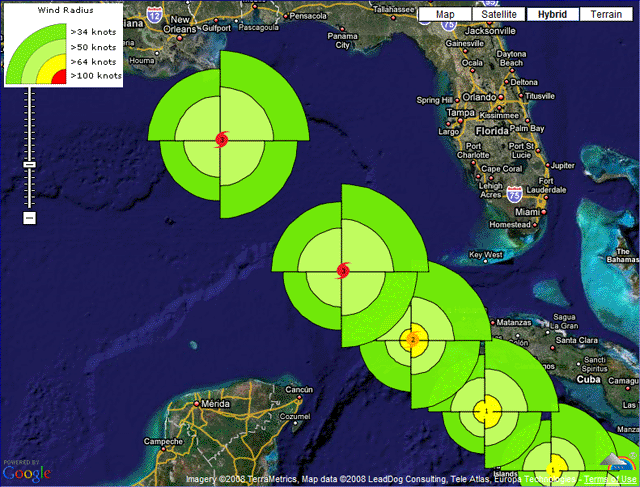
Gustav and Hanna are both predicted to be 'big ones'In the sixties, Roger Zelazny wrote ‘Damnation Alley’, in which Hell Tanner drives from Los Angeles to Boston in a land ravaged by near constant hurricanes and tornadoes in an attempt to deliver a life-saving plague vaccine. While we’re nowhere near that doomsday scenario, this year’s hurricane season is certainly hotting up.

Hurricane Gustav is crossing Cuba into the centre of the Gulf of Mexico today, with many of the simulations projecting it to land as a strength three hurricane somewhere in Louisiana on Tuesday night. Meanwhile, a few days further out in the Atlantic tropical storm Hanna (the eighth named storm of the year) is growing steadily and is also projected to land as a hurricane next weekend anywhere from Florida to Mexico. It may or may not enter the Gulf.

Further out than that a number of other weather systems are beginning to form in the infamous ‘hurricane alley’, creating a conveyor belt of large storms. High ocean temperatures of 28-32 degrees in the Gulf of Mexico in particular are increasing the size of intensity of these systems. When the sea temperatures are above 26 degrees, a tropical storm or hurricane above it will intensify. Below that level the cyclone begins to unravel. With Ocean temperatures high and a number of storms forming, the Southeast coast of the US and the caribbean are in for a pounding over the next few weeks. Oil experts are already beginning to predict problems for oil production, with large percentages of US oil production and refining taking place in the Gulf of Mexico. While it would be inaccurate to link a single hurricane to climate change, if tropical ocean temperatures remain high, the residents at the end of hurricane rally will have to expect more storms.

[via The Oil Drum, Gustav weather picture via Weather Underground]

Economist Opens Debate on The Future of Energy

The story, as it is, from Wired Science:

The Economist, that venerable British magazine about money, has opened a new online debate on the future of energy.

The debate presents the pro and con sides to the following proposition: “We can solve our energy problems with existing technologies today, without the need for breakthrough innovations.”

The debate is a closed discussion between the panelists but they’ve opened up parts of the site to user participation.  I’m not convinced that this debate is going to move any of the current arguments forward, as both sides will be tackling the topic through the global warming lens.  But, check it out here, on the Economist website.