Tag Archives: computer

The rise of the subnotebook computer … and the fall of the computing economy

Asus-Eee-subnotebook-computer Slashdot notes a story that quotes a big wheel at Sony as being worried about the potential mainstream appeal of the Asus Eee and its ilk:

“”If (the Eee PC from) Asus starts to do well, we are all in trouble. That’s just a race to the bottom,” said Mike Abary.”

The Slashdot poster observes:

“Presumably by ‘we’ he means all the hardware manufacturers who sell over-priced, full-fat laptops. […] Looks like what’s bad for Sony may be good for the consumer.”

In the short run, certainly, he may be right – but what about the long game? A drop in hardware prices for us consumers would be nice, sure, but there’s bound to be more consequences than that. [image by Scrambled Egg]

This is an issue that Charles Stross broached late last year (right after purchasing his own Eee, naturally). You should read all of Charlie’s thoughts about the inevitable (and long-overdue) commoditization of computing technology, because they add weight to his final blow:

“… how deep will be the recession that follows once the personal computing industry deflates to its natural value (i.e. peanuts)?”

Ouch.

Mice? Where we’re going, we don’t need mice.

I don’t know about you, but I’ve adapted well to the standard keyboard/mouse computer interface. I started as a child with DOS and Win 3.1. Touch-typing on various-languages’ keyboards are no problem and my twitch response works well in Team Fortress 2.

Unfortunately, this ability honed over decades may soon be obsolete, what with some new technologies on demonstration at the Game Developer’s Conference recently. Specifically, eye-tracking hardware from EyeTech that is currently available (for several thousand dollars) allows the disabled to simply look at a place on the screen and the cursor goes there. It’s a rather expensive way to reduce repetitive stress injury, but according to the journalist trying it out, it makes games almost too easy.

We’ve written before about touchless interfaces, and there’s a promising brainwave-powered interface on the horizon too. The future’s bright for new ways to handle digital interactions. Check out the rest of the Ars Technica piece for some other interesting ways to interface reality and digital gaming.

(photo from flickr user F1RSTBORN)

Advances in brain-machine interfaces

400px-BrainGate Okay, technically your typing fingers are already brain-machine interfaces, but they’re rather clumsy ones, especially if you’re not a great typist. Wouldn’t it be easier to just think at your computer to get it to do what you want it to do? (Via ScienceDaily.)

Well, as this fascinating overview of the state of the art makes clear, it’s coming. The lede:

Neuroscientists have significantly advanced brain-machine interface (BMI) technology to the point where severely handicapped people who cannot contract even one leg or arm muscle now can independently compose and send e-mails and operate a TV in their homes. They are using only their thoughts to execute these actions.

Read, as they say, the whole thing. (Photo from Wikipedia.)

[tags]brain, computer, technology[/tags]

Semi-sentient Storm botnet fights back

computer innards OK, I might be stretching the point with "semi-sentient", but it still has all the hallmarks of a bad AI thriller movie plot. The infamous and still-growing botnet created by the Storm worm virus is able to detect when its command and control structure is being probed by computer security types, and launch denial-of-service attacks at them in retaliation. While some experts believe that Storm has pretty much run its course, others estimate that it may be sitting on a power-base of more than 15 million infected machines, waiting to be hired out to the highest bidder. It’s a long step from the golden era of the Christmas Tree and Friday The Thirteenth viruses. [Via BoingBoing] [Image by RileyRoxx]

[tags]computer, security, Storm, virus, botnet[/tags]

Multi-touch computer as an expensive coffee table

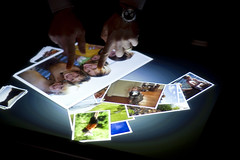
It seems like the time is ripe for new technology in the way we view media and interact with computers.  First we saw wearable monitors, and now Microsoft’s come out with a tabletop touch screen with a range of applications.  The Microsoft Surface will be available only to companies at first, so it’s got applications for ordering food, a map function to help you find your way in a mall or hotel, and a jukebox function compatible with the Microsoft Zune ("subject to DRM restrictions, of course").  Possible home functions include Paint, a photo application, and a sort of jigsaw puzzle where each piece displays part of a movie and you must arrange them in the proper order.

At a launch price of $5,000-$10,000, it’s just as well your average Joe won’t be able to buy it.  But Microsoft hopes the price will come down as demand grows and technology gets cheaper.  And when it gets cheap enough, I’ll be there ready to play at being John Anderton (without the cops chasing me, of course).

(image from kjd)