Tag Archives: computers

More advances lead towards smaller, flexible computing

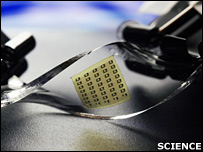
Flex those… silicon chips…A couple of neat new advances in computing this week. The first is an amazing flexible silicon chip designed by US researchers. The components of the chip are applied onto a thin layer of plastic, at first glued down to a substrate. When the circuit is completed, the glue is disolved and the plastic peels away a flexible chip. The researchers think that removing the traditional blocky form of a chip allows the bendable material to be used in many new applications such as brain implants or smart clothing.

“Silicon microelectronics has been a spectacularly successful technology that has touched virtually every part of our lives,” said Professor John Rogers of the University of Illinois at Urbana-Champaign. “In many cases you’d like to integrate electronics conformably in a variety of ways in the human body – but the human body does not have the shape of a silicon wafer.”

Meanwhile, Japanese scientists working on the developing technology of printing circuitry like an inkjet printer have developed a technique they believe is good enough to print TFT computer monitors. With all the components of a computer getting smaller and easier to manipulate, the days of the traditional shape of a desktop tower are surely numbered…
[ image and stories via BBC technology]

Nokia creates flexible phone prototype that can be worn as bracelet

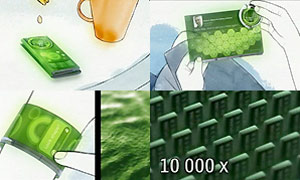
Nokia innovates new flexible mobile phonesExciting times in the world of electronics as phone company Nokia have designed a wearable, flexible phone. Resembling a normal handset folded in half, when fully unrolled it can be used as a keyboard but it can also be folded lengthways and widthways and curled into a bracelet to wear on the wrist.

Although current battery technology isn’t good enough to join this flexible technology revolution as improvements in nanowire batteries and even static electricity generating clothing could mean that in ten year’s time we wear our phone/mp3 player/personal computer on our sleeve and link up our headphones to it wirelessly.

[image and story via the Guardian]

Vaccine worms to spread virus patches?

Despite being used for nefarious purposes, “worm” viruses are clever little bits of self-distributing code. Microsoft researchers here in the UK are considering fighting fire with fire, and using the same replication methods deployed by malicious viruses to spread software patches.

It’s an interesting approach – using the weapons of the enemy against them, so to speak. But one wonders whether the effort wouldn’t be just as well spent on, y’know, making sure the software had less holes in need of patching before it got released?

Just a thought.

[Guess who’s been helping a friend clean viruses off their computer this week …]

A touchless computer interface

home-finger-604x220

There’s not a lot of technical detail about exactly how this works, but a company called Elliptic Labs is developing a very science-fictiony touchless computer interface (Via Gizmodo):

Elliptic Labs is paving the way for use of computers and screens without touching, simply with the finger or hand in the air. Manipulate images, play computer games, control robotics or use touch screens without touching or without holding a hardware control unit.

Their technology is based on the work of Dr. Tobias Dahl from the University of Oslo, who is also the company’s founder. According to the website, their technology can recognize “with high precision” the position and properties of a finger or hand or other object up to 1.5 meters away from the sensors, which can be placed on or next to a monitor: no need for a clunky “data glove” or anything on the hand at all. The company says the technology is so compact it could even be fitted on to a mobile phone. You can view video demonstrations of it here.

Since I’m a Windows user I’ve occasionally made rather violent hand gestures at my computer, but it’s never taken the slightest notice. Perhaps that’s about to change.

(Image: Elliptic Labs)

[tags]technology, computers[/tags]