Tag Archives: culture

Here comes everyone – why the internet won’t belong to the West forever

Wired UK has a passing mention of a keynote speech by BBC internet pundit Bill Thompson, who points out that the days of the internet’s predominantly white Western constituency are numbered:

Thompson has just returned from a BBC trip to Kenya, where he explored the internet take-up in Africa, specifically the effects of one of the six cables being laid to boost bandwidth to the continent. “The internet has been dominated by the West,” he says, but now “our little pond is going to be replaced with an ocean as millions of new internet users come along.”

This is nothing but a good thing, says Thompson, as with the surge of users will come new ideas. The internet, he says, is soon to enter a period of “punctuated equilibrium”, in which we will all be trying out new technologies and those that fail will sink.

The real successes, he said, could come off the back of the failures: “People will need to feed on the carcasses of other people’s failed ideas,” he says, immersing themselves in a process of innovation “play and flow”. To quote countless life coaches: “In this day and age there’s no such thing as failure – only feedback.”

I love the smell of change in the morning. Smells like… victory.

[ In case you’re wondering as to my choice of title, by the way, it’s not a homage to Clay Shirkey’s book (which I have yet to acquire and read). It’s actually a reference to the music of my youth… UK readers of a certain age may remember an early-90s indie band called The Wonderstuff. And as I’ve already posted two videos today, why not make it a hat-trick? I don’t think there was ever an official video for the original, but here’s Wonderstuff frontman Miles Hunt performing “Here Comes Everyone” (with one cuss-word, for them what’s worried about such things) at the Womad Festival a while back:

Off-topic? Yup, sure is – but hey, I’m the editor. Gotta take my perks where I find ’em. Enjoy. 🙂 ]
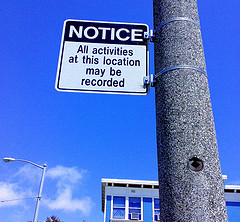

Will transparency make us boring?

surveillance warning signI’ve long been a cheerleader for the sort of informational transparency that our increasingly wired world seems to encourage, if not make inevitable. After all, surely a world where it’s harder for those in power or authority to lie to us behind our backs is an improvement on the status quo, right?

I still hold that view, but Russell Davies has a column at Wired UK where he suggests that an unwanted outcome of that transparency might be to erode the sorts of brash personality that create change and new ideas:

I realised the other day that this is what’s happened to me. Everything I produce, however private or NDA’d, is filtered through the voice in my head, whispering, “how would I feel if this got online?” Because a slip of the email or a misplaced YouSendIt and it could easily happen. And, mostly, that’s good; it keeps the bullshit to minimum-required levels. It’s a reality we’re all going to have to get used to. It’s sensible to assume that everything you think is private might one day be read.

And this won’t just be by accident – this will be about policy. Openness is next to godliness. Sunshine is regularly touted as the best disinfectant. It’s just that disinfectant kills good bugs as well as bad ones, and there are some healthy things that need to breed in the dark. Good, positive, non-evil ideas sometimes need to be whispered in private before they’re shouted in public. Pretentiousness is occasionally necessary among friends. And if we’re afraid to be slightly different people in private, we’ll end up with a world of well-trained Michael Owens; sincere, good-looking people with no dark side, no sins, no doubts. Media training has driven the personality out of sport – I wonder if constant, enforced openness will drive it out of everything else?

Call me cynical, but I’m not sure sport ever really had that much personality, beyond the more ornery characters having freer license to be unpleasant in public… but leaving that aside, I still suspect Davies is overstating the problem, here. Yes, sure, there are some situations where ideas have to be brewed up out of sight of the public eye for them to gel properly, and a certain level of confidentiality in personal friendships is necessary. But speaking from my own personal experience, being continually mindful of transparency has made me more considerate of the feelings of others – not to the point of changing my opinions or ideas outright, but certainly making me consider their wider ramifications and think harder about how I express them. [image by jm3]

What do you think – will ubiquitous transparency make us a species of dullards, as Davies suggests? And if it does, is that a reasonable sacrifice to make for a kinder world?

The slowing of technological progress

technology_plug_laptopAlref Nordmann writes in IEEE Spectrum of how technological progress is, contrary to the promises of singularitarians like Ray Kurzweil, actually slowing down:

Technological optimists maintain that the impact of innovation on our lives is increasing, but the evidence goes the other way. The author’s grand mother lived from the 1880s through the 1960s and witnessed the adoption of electricity, phonographs, telephones, radio, television, airplanes, antibiotics, vacuum tubes, transistors, and the automobile. In 1924 she became one of the first in her neighborhood to own a car. The author contends that the inventions unveiled in his own lifetime have made a far smaller difference.

Even if we were to accept, for the sake of argument, that technological innovation has truly accelerated, the line ­leading to the singularity would still be nothing but the simple-minded ­extrapolation of an existing pattern. Moore’s Law has been remarkably successful at describing and predicting the development of semiconductors, in part because it has molded that development, ever since the semiconductor manufacturing industry adopted it as its road map and began spending vast sums on R&D to meet its requirements.

there is nothing wrong with the singular simplicity of the singularitarian myth—unless you have something against sloppy reasoning, wishful thinking, and an invitation to irresponsibility.

This is the same point made by Paul Krugman recently. Nordmann points out that most of the major life-changing technological changes of the past 100 years had all already happened by about the 1960s, with the IT revolution of the last fifty years being pretty much the only major source of technological change[1] to impact him over his lifetime.

This arguments suggests that the lifestyle of citizens industrialised countries will remain fairly stable for a lengthy period of time. It raises the serious point that the best we can hope for vis a vis technological change over the next few decades will just be incremental improvements to existing technologies, and greater adoption of technologies by people in poorer countries.

This would be no bad thing of course, but the suggestion that Ray Kurzweil’s revolutions in nanotechnology, genetics, biotechnology, and artifical intelligence may not arrive as early as Kurzweil predicts is pretty disappointing.

It could be that, to paraphrase William Gibson, the future is in fact here, it’s just not evenly distributed.

[1]: By “major source of technological change” I mean things like antibiotics, mass personal transport, and heavier-than-air flight. There certainly have been improvements in all these areas in the last 50 years, and much wider adoption, but these have not had as great an initial impact.

[from IEEE Spectrum, via Slashdot][image from Matthew Clark Photography & Design on flickr]

Dead famous: microblogging and morbidity

Another thought-provoking post from Joanne McNeil of Tomorrow Museum sees her musing on the way Twitter, the 24-hour news cycle and citizen journalism have escalated the death of minor celebrities to the status of the fashionable small-talk of the digerati:

Every day on Twitter, news of another death. Les Paul, John Hughes, Farrah Fawcett, those big names, but also the editor at this publication, the founder of this startup, the people who we might not all know, but someone you know knew them and they are using the space to remember them.

Sure, Maria Shriver’s euology made me sit up straighter and think I want to be like that. But, I mean, was I supposed to be shocked that Eunice Kennedy passed on? I guess it’s small talk of a darker sort. You could talk about the weather or whose heart stopped.

Sometimes I feel like I don’t want to sign on Twitter, precisely for that reason. What if David Cronenberg died? Or Bill Callahan? Sophia Coppola, Rachel Maddow, Tilda Swinton, anyone I like.

[…]

I still think the web has the capacity to bring out the best and the worst in us. We’re going to look back at the spectacle of Jade Goody’s wedding earlier this year and think how innocent it was, how damn near respectful people were to her and her family. It’s all downhill from here. Death is just something you think about until the next 140 character tweet appears.

I don’t think it’s going to get all that much worse – and if it does, we won’t be appalled by it, because the frog will be boiled slowly – but I’ve long been fascinated by the visceral sense of Zeitgeist that working all day on the web has given me, and there’s definitely a change in my attitudes to different sorts of news. (That said, my complete disinterest in manufactured minor celebrities remains strong, which I’m quite pleased about.)

It’s almost as if dying is the best way to get the whole world to take notice of you these days. But how much harder is it to disappear from view completely? In another of Wired’s more interesting journalistic projects of late, they’re sending off Evan Ratliff with instructions to drop “off the grid” for thirty days, and offering a prize of $5,000 to anyone who finds him using the publically available data trail that he’ll generate. I’ll not be surprised if someone snags him pretty quick  (unless he has some sort of ace in the hole for staying incognito), but the story promises to be interesting whatever the outcome, especially in light of other recent disappearances, successful, deliberate or otherwise.

The Iron Cage of Fantasy: World of Warcraft, City of Heroes and Fable II

If modern gaming is all about escapism, why do we choose to escape to virtual worlds that contain so many of the negative pressures of the world we’re trying to leave behind?

Blasphemous Geometries by Jonathan McCalmont

###

I’d like to begin this column by discussing escapism. Describing something as “escapist” has always struck me as something of a back-handed compliment. A tacit (and sometimes dismissive) acknowledgement of a work’s lack of topicality or verisimilitude coupled to an attempt to shift the critical yardstick from the aesthetic to the psychological : Yes, we know that this film/game/book is all about giant stompy robots hitting each other but it scratches an itch that we, the audience, need scratching.

The itch in question is the need to escape from an increasingly inhospitable 21st Century existence; an existence filled with long commutes, unpaid mandatory overtime, credit card bills, mortgage foreclosures, unemployment, failed relationships and the plethora of modern-day worries, problems and fears that many choose to medicate with alcohol. People justifiably want to escape to a world that is less oppressive and miserable. This explains why the grand-father of escapist fiction is J.R.R. Tolkien and not Jean-Paul Sartre. Continue reading The Iron Cage of Fantasy: World of Warcraft, City of Heroes and Fable II