Tag Archives: culture

Krugman on slowing pace of change

changeNobel economics laureate Paul Krugman, speaking at Worldcon, holds forth on the slowing pace of change:

“The pace of change has actually, generation by generation, been slowing down,” he claimed. “The world of today is not as different from the world of 1959 as the world of 1959 was from 1909.”

So let’s say that you travel 30 years into the future and find yourself in a shopping mall. You’ll be astounded at the “great gizmos” that are for sale there, but you’ll still be able to recognize it as a shopping mall, said Krugman. On the other hand, lots of trends are likely to come to a head over the next few decades, including climate change and peak oil, and they could result in a drastically different world.

It kind of makes sense. In the Western world technology – specifically consumer electronics, medicine, communications, and computers – have developed enormously in the past 40 years, but cultural and social change has been less pronounced. We still live a fairly automobile-centric, consumer-based, culturally egalitarian lifestyle[1] that would have been recognisable to someone living in 1959.

But Krugman points out that this could change in the future, with climate change, peak oil, disruptive biotechnology, radical life-extension, resource wars, AI, and the changes in attitudes and culture that these thing could lead to.

[1]: I think that we (i.e. the Western liberal democracies) are certainly a more culturally egalitarian society (with greater gender equality, gay rights, and less racism) than we were in 1959, but I’m not entirely sure that 1909 was substantially more racist, homophobic, and sexist than 1959. Question: did our *culture* (as distinct from technology) change more between 1959 and 2009 than between 1909 and 1959?

[from iO9][image from kevindooley on flickr]

SocNets == Groupthink?

Via those crazy kids at grinding.be comes an article whose writer analyses the culture of social networks and media with the “groupthink” criteria of Irving L Janis, coming to the conclusion that our favourite websites and communication channels may be (gasp!) gathering us into groups where the established and accepted truths remain unquestioned.

It’s not the first time the issue has been raised (and frankly I’ve given it greater credence on those occasions when I’ve seen it on sites who employ a copyeditor and/or whose side-barred “all-time most popular article” isn’t entitled “10 Ways To Have Fun With Boobs”) but my response remains the same: find me a human social construct or communication platform that doesn’t put vague ticks in most of those boxes.

Groupthink is a function of being human; it’s the phenomenon that makes party-based political systems not just possible but debilitatingly pervasive. Do social networks enable groupthink to take root? Sure they do – but I think it’s safe to say they offer more opportunity for dissent and debate than the old centralized broadcast media that they’re replacing ever did. As always, the problem isn’t technology, it’s people.

iHobo augmented reality app: a spoof with truth

So, did you see the Wired spoof piece about the iHobo augmented reality application? Yeah, yeah, I know it’s a joke, they make that pretty clear. But it’s a clever joke – and not just because it says a number of things about technology, class and culture.

iHobo - spoof augmented reality app screenshot

What iHobo does is highlight not only the imminent mundanity of augmented reality – a technology whose path to near-ubiquity in the developed world is defined only by time and falling prices – but also the fact that we’ve always had augmented reality. It’s not a thing you buy, it’s a thing you do.

Reality is perception – when I go to, say, Berlin, whose Berlin do I see? Do I see the Berlin of the German Tourist Board or the Lonely Planet writers? Do I see the Berlin of a modern experimental architect, or the Berlin of Albert Speer? Of the gallery-owning cognoscenti or the punk squatter kids? They’re all different cities, yet they share the same geographical space.

In addition to time and space, there’s another dimension you can move in – call it culture, call it perspective, call it viewpoint, call it contextual relevance, call it popularity. It’s all of those things, and none. It’s something we build as groups and as individuals, a shared semiotic system of value and meaning – and soon we’ll be able to travel inside other people’s systems at the swipe of a finger across a touchscreen.

Of course, there’s a very good chance I’m stating the obvious here*, but this ties in so closely to a bunch of the weirder theories of reality I had when I was younger that I can’t help but geek out about it. Sorry.

[ * Seriously, sometimes it’s a real struggle finding stuff that I think won’t just bounce right off of you jaded lot. But then I console myself with the thought that I’m lucky to have a very smart and well-read audience by comparison to a lot of similar sites. So don’t go changin’. 🙂 ]

Culture wars: Authors, social media and the tribes of entitlement

We all know that the web and social media are useful things for authors, enabling them to keep in touch with each other and their fans and – when used inventively – add some buzz and cachet to a newly published book.

But – as with all things – there’s a dark side, and recent events have gotten me wondering whether the unprecedented level of access we have to the creators of our favourite cultural currency isn’t breeding a sense of entitlement above and beyond the appropriate. The trigger was this photo on Warren Ellis’ blog, showing a note written to comics maven Brian Michael Bendis from a disgruntled fan who’d not found him signing books when he expected him to be:
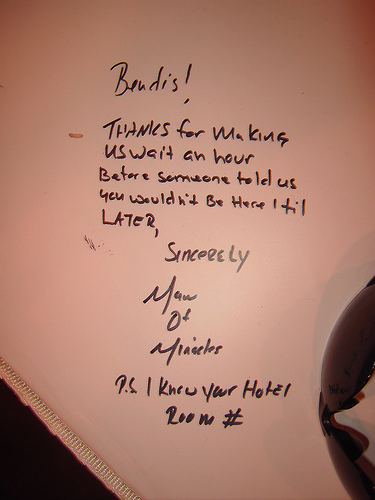
A "fan" note to Brian Bendis

Creepy and threatening – you can see why Ellis isn’t keen on doing convention appearances and signings (though woe betide the fan who hassled a cane-wielding Ellis in need of another Red Bull and nicotine fix).

Now, this sort of behaviour is hardly new, and as pointed out in the comments thread the root of the word “fan” is “fanatic”. But authors especially seem newly exposed by social media, because they’ve always been one of the less public types of artist – writers historically do not “perform” in public in the same way as musicians, for example, and would have been protected from a lot of the weirder communications from the outside world by having their publisher as an intermediary.

But not so much these days – look at the recent wave of bitching from George R R Martin’s fans when they discovered the next instalment of his current series would be delayed. You’d think that die-hard fans would be the first to sympathise with a creator’s need for a life beyond their work, but there’s a vocal minority who are anything but. As Scalzi points out, such people are fools – but the web has made them fools with metaphorical megaphones and your home address.

A related phenomenon seems to be arising on review and discussion blogs, something that Larry of OF Blog of the Fallen has labelled “The New Tribalism” – a situation where groups of fans with closely related passions fall into a kind of groupthink. This has its upsides – it’s that sense of tribe that motivates many fans in the first place, and there’s nothing wrong with discussing art you love with others who appreciate the same material – but there are downsides too, which manifest themselves as vocal disapproval of voices from outside the tribe (or occasionally within) who dare to criticise the tribe’s focus of interest.

This isn’t new either – as any member of any subculture anywhere will surely agree – but again the mobility and power of the phenomenon is amplified by the web. Debate around cultural opinions is a good thing, but mob psychology and the web’s potential for anonymity seems to be an open invitation to be taken to task for daring to have a different opinion to someone else.

Some of my concerns are professional in nature: I advise my clients about the the benefits of a strong web presence, and it’s almost shaming to have to confess that there’s this negative aspect to it. That said, I still hold that it’s worth the risks – why let a few bad apples spoil the barrel for everyone? Writers like Ellis and Scalzi have developed good tactics for dealing with trolling and tribalism; the primary component seems to be developing a thicker skin, though a strong sense of personal space and practiced rhetorical chops seem to be pretty useful as well.

But there’s a more Futurismic edge to it all as well, because it feels safe to assume that web-based creator-consumer relations are likely to become more prevalent as time goes by. As such, it’s not impossible to image a fandom with similar clout to the fabled Anonymous: what might said flashmob do in response to criticism of their totem? As the barriers between physical and informational realities become increasingly permeable, comment-thread flamewars and denial-of-service attacks would be just the start. Vernor Vinge’s Rainbows End features warring fandoms battling it out in augmented reality, with the action spilling out into damage to property and people; the more I think about it, the more plausible it becomes.

After all, we’re prone to going to war over ideologies; given the decline of interest in religion and politics among the younger and more net-native generations, it’s easy to see cultural affiliations taking their place. These culture-mobs could easily be great forces for fun and creativity, but the potential for the opposite to occur can’t be brushed aside. How might Brighton have looked had the mods and the rockers had mobile phones with web access to coordinate with?

The end of science?

science in action?Over at The Guardian, Ehsan Mahsood wonders whether the culture of modern science is stifling the radical thinking and new discoveries that have always been science’s hallmark and driving force:

Revolutions in scientific thinking are always difficult – but perhaps one reason why we may see fewer of them in the future is because of the highly professional way in which modern science is organised. It takes a lot of courage to challenge conventionally accepted views, and it needs a certain amount of stamina to constantly battle those who want to protect the status quo. Mavericks do not do well in large organisations, which is what some scientific fields have become.

Progress in science needs researchers who are not afraid – or who are encouraged and rewarded – to ask awkward and difficult questions of theory and of new data. It is easier to question mainstream views if you are independently wealthy, as many scientists in previous ages tended to be. But I wonder how many of us would do so if we were employed by the state and our career progression depended on the validation of our peers?

Mahsood has a point here; you only have to look at the computer industry to see that the bigger a corporation gets the less likely it is to do something genuinely innovative. But it strikes me he’s overlooking the potential for unaffiliated independent scientists to work together in ways that wouldn’t be funded by cautious or conservative governments or foundations – what about all the DIY biohackers, for example?

Sure, there’s only so much they can do alone, but the internet means they have all the tools they need to network with their fellow enthusiasts, share information, collaborate… so maybe we’re not seeing the end of science as Mahsood would have it, but the end of state-funded science (at least for non-military applications). You could argue that clades of unaffiliated ‘rogue’ scientists would introduce a large element of danger, especially with regard to genetic or viral research… but then state-funded establishments have made their fair share of screw-ups, too, despite (or perhaps because of) the baroque architecture of procedural regulations. [image by neys]

But hey, let’s think positive here: at least science is opening up new channels for international diplomacy.