Tag Archives: energy

Is Solar feasible – absolutely!

A Concentrating Photovoltaic array by Solfocus using mirrors to concentrate light onto a III-V photovoltaic
Earlier today TJ wrote a post about the possibility of solar power as an alternative fuel. Now I have to admit to having a vested interest in this field as recently I began work as a Solar Analyst for a renewable energy developer. I’ve spent the last six weeks conducting studies into every aspect of the solar market and its feasibility. Although some more outlandish technologies have been overstated, the future of solar is incredibly bright.

There are four main types of solar power on the horizon. Most people know about silicon photovoltaics, which are now reaching record efficiencies of 23%.

"Major discovery" could spark solar revolution

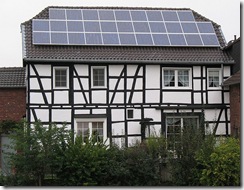
776px-SolarFachwerkhaus MIT scientists are touting a “major discovery” that will transfer solar power from a “limited, far-off solution” to “unlimited and soon.” (Via EurekAlert.)

Daniel Nocera, the Henry Dreyfus Professor of Energy at MIT and senior author of a paper describing the work that’s in the July 31 issue of Science, and Matthew Kanan, a postdoctoral fellow his lab, have created a new  catalyst that produces oxygen gas from water. When combined with another catalyst that produces hydrogen, their system can duplicate the water-splitting reaction that occurs during photosynthesis. Hydrogen and oxygen produced during the day while the sun is shining can be combined in a fuel cell at night when it’s not, solving the biggest problem with solar power–it doesn’t work when the sun doesn’t shine. Current methods of storing that energy are both too expensive and very inefficient.

Best of all, the new catalyst is made from abundant, non-toxic natural materials: it consists of cobalt metal, phosphate and an electrode, placed in water. When electricity runs through the electrode, the cobalt and phosphate form a thin film on it, and oxygen gas is produced. The catalyst works at room temperature and in neutral pH water, and is easy to set up.

Superlatives are being implemented to describe the discovery:

James Barber, a leader in the study of photosynthesis who was not involved in this research, called the discovery by Nocera and Kanan a “giant leap” toward generating clean, carbon-free energy on a massive scale.

“This is a major discovery with enormous implications for the future prosperity of humankind,” said Barber, the Ernst Chain Professor of Biochemistry at Imperial College London. “The importance of their discovery cannot be overstated since it opens up the door for developing new technologies for energy production thus reducing our dependence for fossil fuels and addressing the global climate change problem.”

Nocera hopes that within 10 years the system will be available to homeowners, allowing them to power their homes during the day with photovoltaic cells and use hydrogen and oxygen produced with the day’s excess energy to power their homes at night.

The net result?

Electricity-by-wire from a central source could be a thing of the past.

(Photo by T

Where to put the carbon…

Aside from nuclear power, one of the most enticing possibilities for solving problems of energy security, peak gas, and global warming is carbon sequestration.

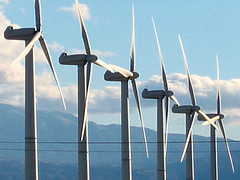
windfarmBy burning cheap and widely available coal but storing the resultant carbon dioxide rather than venting it into the atmosphere means you (theoretically) have a cheap and low-carbon energy source.

The main issue is finding a place to stick all that carbon dioxide. Dave Goldberg of the Lamont-Doherty Earth Observatory claims there is a vast area off the east west coast of Oregon under the Juan de Fuga Fuca tectonic plate which addresses many of the safety issues of carbon sequestration:

“We have insurance upon insurance upon insurance,” he said.

First, the center of the proposed location is about 100 miles off the coast, obviously far away from human settlement. Second, the impermeable sediment cap on the permeable basalt reservoir is hundreds of feet thick, creating an effective seal for the compressed CO2. Third, when CO2 mixes with water inside the basalt, over time it turns into a variety of carbonates, which are, essentially, chalk. Fourth, if there were an unforeseen leak, in deep water, CO2 forms into icy hydrates in the water, preventing it from floating up to the surface.

As to the UK: what about using the recently emptied North Sea oil wells as a carbon sink?

It is becoming clear that if we are to create a genuinely zero-carbon (or even low-carbon) economy we are going to have to embrace nuclear power and carbon sequestration, as suggested in Plan D of David David J. C. Mackay’s excellent (but unfinished) free ebook Substainable Energy – Without the Hot Air. The evidence is mounting that wind power, solar thermal, and photovoltaics don’t work well enough.

[story from Wired][image from Scott Ableman on flickr]

Turning windows into solar panels

apartment windowsI’d love to be able to fit solar panels to my home (not that we’ve been getting much sun this year, grouch grouch), but as I live in a flat I don’t have a roof to put them on. Thanks to a crafty hack from the boffins at MIT, that may not be a problem – they’ve found a way to turn windows into solar panels. [image by uqbar]

Sunlight is concentrated in existing solar power devices using large, mobile mirrors that track the sun as it moves across the sky. But these can be expensive to deploy and maintain. In the MIT device, called an “organic solar concentrator” and described in the latest issue of Science, the researchers painted a mixture of organic dyes onto the surface of a pane of glass. The dyes trap different wavelengths of sunlight and then guide the energy along the glass towards the PV cells at the edges.

“The point of all this is to get away with using far fewer solar cells,” said Marc Baldo, an electrical engineer at MIT. “The concentrator collects light over its whole front surface, but the solar cells need only cover the area of the edges.”

Not only does this make solar an option for people who don’t own an entire building, it also makes it a much cheaper proposition in general; solar cells aren’t cheap to make, and the industry can’t keep up with current demand as it stands.

And just to pre-empt someone piping up and saying that solar will never fully replace [energy source x], yeah, you’re probably right. But as one of a suite of renewable sources, it can make a contribution towards doing so – and right now we need every option we can get.

Rock Port – wind town

Wind turbineCongratulations are in order for Rock Port, Missouri – it just became the first town to have its complete energy supply needs met by wind power. [via Slashdot]

Granted, Missouri is a windy region, and wind power wouldn’t suit every town. Plus Rock Port has a population of just 1,300 … but it’s encouraging to see ordinary people waking up to the economic realities of alternative energy sources. [image by Michael Tyas]