 What do you get when you combine thin sheets of gold leaf and a protein found in spinach? You get an artificial leaf that can photosynthesise energy from sunlight. It’s not a highly efficient conversion rate yet – way behind the top-of-the-range silicon photovoltaics – but the simplicity of the design means it could become a much cheaper alternative. [image by angelrays]
Tag Archives: energy
Testing spray-on solar cells
 A microscopic sensor to detect toxins needs a power source. Xiaomei Jiang and colleagues at the University of South Florida respond with an array of 20 polymer-based cells, each about the size of a 12-point lower-case letter O.
The polymer they selected has the same electrical properties as silicon wafers, but can be dissolved and printed onto flexible material. “I think these materials have a lot more potential than traditional silicon,” Jiang said. “They could be sprayed on any surface that is exposed to sunlight — a uniform, a car, a house.”
The next step is to test the array with the sensors. The team hopes to generate 15 volts by the end of the year.
[Sun Spray by littleblackcamera]
Energy doesn’t grow on trees. Except in Patagonia, maybe.
The natural world still has plenty of surprises waiting for us, it seems. Scientists have discovered a Patagonian rainforest fungus that produces something pretty close to diesel by consuming cellulose:
The fungus, called Gliocladium roseum and discovered growing inside the ulmo tree (Eucryphia cordifolia) in northern Patagonia, produces a range of hydrocarbon molecules that are virtually identical to the fuel-grade compounds in existing fossil fuels.
Of course, burning the stuff is going to do as much environmental harm as the oil-based equivalent, but if they can scale up the process it might be an attractive renewable alternative to making fuels from dwindling oil supplies or otherwise useful food crops.
Fingerprinting mercury emissions from coal
 About 2000 tons of mercury from human-generated sources enter the environment every year, but tracing natural versus human sources, and sorting out local pollutants from distant sources, has been been a problem. University of Michigan scientists say they’ve taken a big step towards reading mercury “fingerprints.”
“For some time, we weren’t sure that it was going to be technically possible, but now we’ve cracked that nut and have shown significant differences not only between mercury from coal and, say, metallic forms of mercury that are used in industry, but also between different coal deposits,” [ecologist Joel] Blum said.
How it works:
The fingerprinting technique relies on a natural phenomenon called isotopic fractionation, in which different isotopes (atoms with different numbers of neutrons) of mercury react to form new compounds at slightly different rates. In one type of isotopic fractionation, mass-dependent fractionation, the differing rates depend on the masses of the isotopes. In mass-independent fractionation, the behavior of the isotopes depends not on their absolute masses but on whether their masses are odd or even. Combining mass-dependent and mass-independent isotope signals, the researchers created a powerful fingerprinting tool.
[Image: Christopher Gruver]
Your backyard nuclear plant will be ready in five years
Energy crisis? What energy crisis? You’ll be laughing all night in your floodlit garden under the gaze of your jealous fossil-fuel using neighbours once you’ve got Hyperion’s clean, safe and portable[1] backyard nuclear reactor up and running!
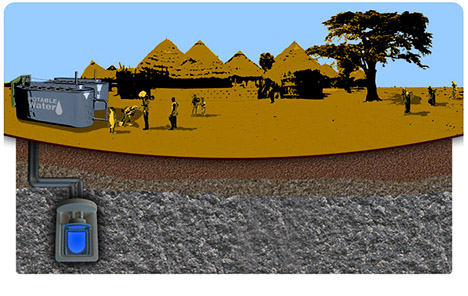
Yes indeed; using good clean water as both moderator and coolant, the Hyperion reactor simply cannot become a runaway reaction, and the uranium hydride fuel is useless for making weapons with – so you’ll not get any politically-motivated sanctions imposed on you by coalitions of powerful nation-states!
The Hyperion reactor will start shipping in the summer of 2013, so start saving now! Or alternatively take out a loan based on the projected amount of energy you’ll be able to sell back to an increasingly desperate and expensive national grid – provided you can find a bank that’s guaranteed not to collapse[2], or a cooperative government administration to bail you out when the worst happens.
[ 1 – 2.5m tall concrete unit can be transported by most commercially-available heavy plant machinery. ]
[ 2 – You may want to consider researching financial institutions based in China or other Asian nations. ]
[Story originally found at grinding.be; image from Hyperion’s website, and there’s an interview with surprisingly lucid and woo-free Hyperion CEO; please note snarky tone of post is a form of gallows humour after an hour of wading through the day’s news.]