Tag Archives: energy

Of vapor and violence: Do gasoline fumes fuel aggression?

gastoonHere’s the agenda for this item: I distinctly remember that when I was a kid, sometimes–not always–the smell of gasoline would get me what one would today call high. It’s been a long time since it had that effect on me, but I also remember looking forward to those visits to the gas station.

So for obvious reasons this post fascinated me:

A new study, published in the open access journal BMC Physiology, has shown that rats exposed to fumes from leaded and unleaded gasoline become more aggressive.

Amal Kinawy, from Cairo University, Egypt, examined the emotionally incendiary properties of gasoline in three groups of male rats, each exposed to either leaded-gas fumes, unleaded-gas fumes or clean air. As well as observing the animals’ behavior, she studied any resulting neurological and physiological changes. She said, “Millions of people every day are exposed to gasoline fumes while refuelling their cars. Exposure can also come from exhaust fumes and, particularly in the developing world, deliberate gasoline sniffing as a means of getting high”.

The research demonstrates that rats exposed to either kind of fuel vapor showed increased aggressive behavior, such as more time spent in belligerent postures and increased numbers of actual attacks, in comparison to the clean air group.

Can’t recall either of my parents remarking on any strange behavior on my part. Not because of that, anyway. The ever-traditional more research is needed to rush to assumptions about gasoline vapor’s effect on humans, but it’s one more thing to worry about.

(Leather in shoe stores, too, gave me a distinct high, but that’s another fetish) (Call me) (Airplane glue, not so much)

[Cartoon: Richard Masoner]

Cheap > good: renewable energy and the developing world

A chap from MIT called Daniel Nocero has been making a bit of a splash with a report on his recent development of a new catalyst for electrolysing hydrogen from water. While the catalyst itself is pretty big news, it turns out that Nocero’s research is geared toward a much larger vision – namely changing the way the global energy economy works.

Nocera pointed out that most of the work in providing carbon-neutral energy has focused on increasing efficiencies of existing technology and creating economies of scale, both of which will ultimately reduce the cost of electricity produced in the developed world. The problem has been that this has kept the price of the hardware expensive. As a result, the solutions we’re arriving at won’t make sense for the developing world. “We need to tackle the non-legacy world, and they don’t have any money,” Nocera said.

[…]

Hydrogen production isn’t generally considered a solution, because each step of the process involves energy losses and inefficiencies. But again, Nocera doesn’t care: if it’s cheap, the inefficiencies don’t matter, because higher-priced solutions are simply never going to be deployed.

There’s a strong general point here – namely that chasing after new and ever-more ingenious methods of generating clean energy is kind of self-defeating. We already have solutions that work – and while their efficiency curves may not appeal to the sensibilities of scientists and engineers, their ability to get the job done should be all the reason we need to roll them put to the places that need them most. We in the West can afford to wait for efficiency; the world’s poorest people cannot.

India to export thorium nuclear reactors

wheels_and_cablesCharles Stross highlights the news that the Indian government is preparing to manufacture and export nuclear reactors that use the thorium fuel cycle:

The original design is fuelled by a mix of uranium-233 and plutonium bred from thorium using fast neutron power reactors earlier in a thorium fuel cycle. The LEU variant is suitable for export because it does away with the plutonium, replacing it with uranium enriched to 19.75% uranium-235.

As countries like India and China continue to industrialise we will see more and more technological innovation from these developing countries. Both India and China are hungry for cheap energy to raise the standard of living for their people. This thorium reactor design is important because it can be used by developing countries with minimal industrial infrastructure:

The design is intended for overseas sales, and the AEC [India’s Atomic Energy Commission] says that “the reactor is manageable with modest industrial infrastructure within the reach of developing countries.”

The reactor design is intended minimise the threat of nuclear proliferation, as it does not produce the right amount of bomb-worthy plutonium-239, and the long-term high-level waste is also minimised. All in all, it looks like a really excellent piece of hardware, and a thoroughly Good Thing.

Thorium is more plentiful than uranium and offers the opportunity of a long-term low-CO2 energy base. I strongly suspect that when the brown-outs start there will be huge public demand for a solution, as it will be difficult for the UK to generate all its energy needs using renewables, and it could well be that the UK ends up buying thorium reactors from India or pebble-bed reactors from China to secure our energy future.

[via Charles Stross, from World Nuclear News][image from Shahram Sharif on flickr]

Ultracapacitors: the game-changer for renewable energy sources?

Sf author Karl Schroeder points us to a development that may redraw the map for renewable energy use. EEStor, long suspected by some to be the sort of vapourware company that spends a few years making big promises before dissolving in a puff of evaporating venture capital, are believed to have applied for certification of their ultracapacitor technology.

There’s a Wikipedia page on ultracapacitors, which have existed for some time in smaller form, but here’s Schroeder’s summary:

… the ultimate in electricity-storage technology:  a device capable of running your car for hundreds of miles on one charge, and of recharging in under five minutes.  A device that is not a battery, and hence never wears out.  A technology that would make intermittent power generation sources such as windmills directly competitive with baseload generation sources such as coal.

Sounds great, doesn’t it? As pointed out by Schroeder, there’s a great deal of justifiable skepticism around the technology in general and the EEStor news in particular – snake-oil is still a thriving business in the information age, after all. But signs suggest we’ll find out the truth behind the speculation pretty soon… and if we dare to hope that this is the real thing, perhaps we’re about to see what Schroeder calls “a truly disruptive change […] nothing less than the first nail in the coffin of the fossil fuel age.”

Scottish island to shift to tidal power

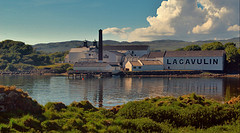
Lagavulin Distillery, IslayThe remote Scottish island of Islay suffers from irregular electricity supply thanks to being separated by the sea from the the soon-to-be-decommissioned Hunterston nuclear reactor on the mainland. That’s set to change, however, with ScottishPower about to sign a deal that will see the island getting all its power needs from tidal generators:

The company is close to signing a supply contract with Diageo, the drinks group, to provide electricity from the project to eight distilleries and maltings on Islay – including the makers of the renowned Laphroaig and Lagavulin whiskies.

The 10MW tidal project, one of the world’s largest, will provide enough electricity for Islay’s 3,500 inhabitants for 23 hours a day.

ScottishPower will submit a planning application in the next couple of months and expects the ten 30-metre underwater turbines to be operational in 2011. The turbines will cost about £50m to install.

Note that corporate tie-in? Smart move; gives you good leverage against the NIMBY lobby. In fact, the whole operation has a “hearts and minds” tone to it:

The Islay Energy Trust, a community organisation chaired by Philip Maxwell, has been helping to lobby local politicians and opponents of the project. In return, it will receive a small slice of the revenue to fund community projects on the island, such as a swimming pool.

I wonder if this will become a blueprint for renewable energy switchovers? Make the deal sweet enough, and the objections will shrink away… sounds like another battleground where the rules of infowar will come in handy. [image by _basquiat_]