Tag Archives: energy

Boat-cleaning robots for a greener ocean?

autonomousunBarnacles, oysters, algae, and other sea-life can slow a ship by 10% and increase fuel consumption by as much as 40%. The U.S. Office of Naval Research is testing a Roomba-like autonomous hull-cleaning robot to cut the drag.

The robot incorporates the use of a detector that utilizes modified fluorometer technology to enable the robot to detect the difference between the clean and unclean surfaces on the hull of a ship. Used to groom ships in port, the Hull BUG [Bio-inspired Underwater Grooming tool] removes the marine biofilm and other marine organisms before they get solidly attached. This is especially important because Navy ships spend more than 50 percent of their service life in port, giving barnacles and marine life ample time to become settled and, if allowed, to further colonize and grow on the ship’s hull.

Underscoring the benefits of combining the Hull BUG with newly developed environmentally benign antifouling hull coatings, [ONR Program Officer Steve] McElvany estimates that “the Navy will save millions of dollars per year in fuel. Using less fuel also means less carbon dioxide in the atmosphere.”

[Photo: U.S. Navy]

Charlie Stross on the future of nuclear power

power_plantCharles Stross has made an interesting point on the view that there is only a very short supply of useable nuclear fuel:

firstly, the supply of known uranium deposits will only last 80-100 years if we don’t recycle it and start burning MOX. I’d like to note that today’s light water reactors are horribly inefficient — they only extract 3% of the available energy from their fuel before it is considered “spent” and reclassified as waste. If we use high burn-up reactors such as the EPR, we can get a whole load more energy out of the same amount of fuel. And if we use fast breeders and run a plutonium cycle we can convert U238 into Pu239 and burn that instead of U235: there’s 500 times as much U238 lying around.

Secondly, we haven’t even tried to build a thorium reactor yet, although we’ve got good reason to believe it would work — and thorium is considerably more abundant than uranium.

As I have mentioned before, nuclear really should be part of the future energy mix of any industrialised country. Renewables can provide a large chunk (depending on local availability) of our energy needs but that still leaves a gap that needs to be plugged with something reliable and non-carbon-dioxide emitting.

David JC MacKay has more on nuclear power in his excellent free online textbook Sustainable Energy – Without the Hot Air.

[image from christian.senger on flickr]

Fusion on a budget

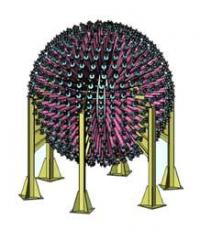
fusionreactorCanadian company General Fusion are developing a fusion reactor that is based on a process called magnetized target fusion:

The reactor consists of a metal sphere with a diameter of three meters. Inside the sphere, a liquid mixture of lithium and lead spins to create a vortex with a vertical cavity in the center. Then, the researchers inject two donut-shaped plasma rings called spheromaks into the top and bottom of the vertical cavity – like “blowing smoke rings at each other,” explains Doug Richardson, chief executive of General Fusion.

The last step is mainly well-timed brute mechanical force. 220 pneumatically controlled pistons on the outer surface of the sphere are programmed to simultaneously ram the surface of the sphere one time per second. This force sends an acoustic wave through the spinning liquid that becomes a shock wave when it reaches the spheromaks in the center, triggering a fusion burst.
General Fusion has just started developing simulations of the project, and hopes to build a test reactor and demonstrate net gain within five years. If everything goes according to plan, they will then build a 100-megawatt prototype reactor to be finished five years after that, which would cost an estimated $500 million.

Like general artificial intelligence, generative fusion power is one of those technologies that always seems to be 10-20 years in the future.

It is good to see alternative techniques to the well-known ITER project or Inertial Fusion Energy being adopted as it increases the chances that some genuinely practical approach will be found.

It’s also heartening to see (relatively) smaller operations engaging in generative fusion research.

[from Physorg][image from Physorg]

Damless hydroelectricity?

Otter Estuary, Devon, UKHydroelectric power generation usually relies on harnessing the potential energy of water moving down from springs in high places, but there’s an as-yet unexploited source of power available at the estuaries where rivers flow into the sea. [via SlashDot; image by me’nthedogs]

In the inverse of the desalination process, energy is released as pure water mixes with salt water… and we may be nearing a point where technology will allow us to exploit that reaction and tap a new sustainable source of electricity:

Extracting clean, fresh water from salty water requires energy. The reverse process – mixing fresh water and salty water – releases energy. Physicists began exploring the idea of extracting energy from mixing fresh and salty waters, a process known as salination, in the 1970s. They found that the energy released by the world’s freshwater rivers as they flowed into salty oceans was comparable to “each river in the world ending at its mouth in a waterfall 225 meters [739 feet] high,” according to a 1974 research paper in the journal Science. But those who have chased the salination dream have collided with technological barriers.

Brogioli has developed a new approach to salination, a prototype cell that relies on two chunks of activated carbon, a porous carbon commonly used for water and air filtration. Once he jump starts the cell with electric power, all that is required to produce electricity are sources of fresh and salty water and a pump to keep the water flowing. When the separate streams of salty and fresh water mix, energy is released.

A typical cell would require about three dollars worth of activated carbon, and, given a steady flow of water, the cell could produce enough electricity to meet the needs of a small house. It’s the equivalent, in hydroelectric power, of running your appliances from a personal 100 meter (338 feet) high waterfall.

Science being science, there are plenty of skeptics who don’t think it’ll work – or, more generously, who don’t think it will scale well. But it’s still worth looking into, as Brogioli points out:

Brogioli maintains that his salinity cell could be ramped up faster than other salination approaches and could be made as affordable as solar power in a decade or so. He argues that any new renewable energy source is worth looking into, even if it is only a partial solution to our energy and environmental problems.

“There is no really clean energy source, and none of them can replace fossil fuels alone,” he said. “So, it’s a matter of compromise: find the best resource for a given region and use many different resources together.”

Europe in 2030: An Optimist Predicts

small worldSo you want an optmistic vision? How about a vision named after Voltaire’s absurdly optimistic hero?

Publishing “Candide’s Garden” in Spielgel Online, Wolfram Eilenberg, who teaches international studies at Indiana University, advances this bracing hypothesis:

Anyone who now wants to talk about the future of Europe must first grasp the fact that we are — at this moment — experiencing a European utopia that has been cultivated for millennia.

The dogma-free, democratic marketplace of ideas, for which Socrates gave his life in Athens, is today a communicative reality in which hundreds of millions of citizens are actively taking part.

Eilenberger, who it turns out is not Dr. Pangloss after all, warns of big changes ahead, but he believes the European Union is well-positioned to weather them. We are entering an age of instant information accompanied by a scarcity of fuel, food, and water.

Put simply, the world will become bigger again.

… Instead of a globalized world economy that crosses continental barriers with ease, we will see continental autarchic zones being formed that will be shaped by the military defense of the basic resources available in each zone. We will thus see the logic of imperial expansion replaced by an aspiration to autarchic inclusion (already the EU strategy). The internal market of each zone will reassume economic primacy. This process does not have to end in war. It could well take an ordered course and lead to a multipolar equilibrium, the stability of which — like that of the Cold War — is guaranteed by an awareness of what military options are not available.

OK, that is sounding a good deal less optimistic. “Does not have to end in war” could mean “may well end that way.” But Eilenberger believes the EU is well positioned to weather these changes:

In cultural terms, Europe is equipped with a plurality of languages that lends itself to innovation as well as a global lingua franca: English (though by 2030 Spanish will be the European Union’s second main language). It is not burdened by any politically effective fundamentalisms, and Europe’s communications and transportation infrastructure leads the world. The thesis of a relative optimum also holds in demographic terms.

As for the USA – well, it’s up to those of us who live there, and our willingness to adapt.

An entire way of life, including the country’s suburban landscapes, will have to be fundamentally restructured. Today it is estimated that this inevitable process of economic and infrastructural renewal — one that will certainly also present new opportunities — will take at least twenty years to complete and, as is already becoming evident, will follow the process of reorientation to internal markets characteristic of autarchic zones. Furthermore, the already irreversible linguistic and cultural Hispanicization of its southern regions means that the United States will face greater integration challenges than will Europe with its smaller Muslim minorities.

Put in more positive terms, the way the United States develops will depend crucially on its readiness to consciously Hispanicize itself and — together with Brazil — to see itself in the long term as the strongest link within a pan-American community.

Which underlines the need to improve our discourse. Europeans, you should hear what our Confederate Party says about you, not to mention about people who speak Spanish. (Oops, is calling Republicans mean names the best way to improve our discourse? Self-criticism to follow. Could just be the reaction of an American with Euro-envy.)

I have no idea whether Eilenberger is right, but it’s a well-thought-out, wide-screen argument that he lays out. We need more of that in science fiction, too.

[Image: JasonRogersFooDogGiraffeBee]