Tag Archives: environment

Biofueled car might have been a senseless waste of chocolate

chocolate-carIt’s not quite the “chocolate-fueled car” that the headline from the indispensable PhysOrg.com promises. What we have instead may be close enough — a car its makers claim can reach 145 miles per hour,

powered by waste from chocolate factories and made partly from plant fibers….

The steering wheel is made out of plant-based fibers derived from carrots and other root vegetables, and the seat is built of flax fibre and soybean oil foam. The body is also made of plant fibers….

Scientists at the University of Warwick say their car is the fastest to run on biofuels and also be made from biodegradable materials. It has been built to Formula 3 specifications about the car’s size, weight, and performance.

[Image: Never Eat Purple Chocolate by i’m george]

Coal: fuel of the future

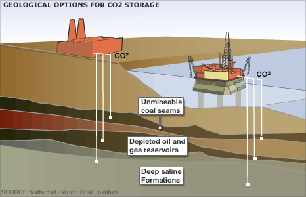
geological-carbonThe British government has given the go-ahead to a new generation of coal-fired power plants incorporating carbon-capture and storage technologies in a bid to reduce carbon dioxide emissions. Clean coal has been met with criticism and the policy seems just a little bit flaky:

Up to four new plants will be built if they are fitted with technology to trap and store CO2 emissions underground.

The technology is not yet proven and would only initially apply to 25% of power stations’ output.

Green groups welcomed the move but said any new stations would still release more carbon than they stored.

Uh huh. According to UK energy secretary Ed Miliband:

Once it is “independently judged as economically and technically proven” – which the government expects by 2020 – those stations would have five years to “retrofit” CCS to cover 100% of their output.

Kind of a glass quarter-full situation then. And it might not even work. But do check out the details.

[image and articles from the BBC and the Guardian]

Best way to clean up the environment? Make everyone richer.

800px-Earth_flag_PD

John Tierney at the New York Times has a couple of predictions for Earth Day:

1. There will be no green revolution in energy or anything else. No leader or law or treaty will radically change the energy sources for people and industries in the United States or other countries. No recession or depression will make a lasting change in consumers’ passions to use energy, make money and buy new technology — and that, believe it or not, is good news, because…

2. The richer everyone gets, the greener the planet will be in the long run.

Tierney acknowledges that that second prediction may be hard to believe with concerns about U.S. carbon emissions and increasing emissions from India and China as they get richer, but he backs it up with data:

By the 1990s, researchers realized that graphs of environmental impact didn’t produce a simple upward-sloping line as countries got richer. The line more often rose, flattened out and then reversed so that it sloped downward, forming the shape of a dome or an inverted U — what’s called a Kuznets curve. (See nytimes.com/tierneylab for an example.)

In dozens of studies, researchers identified Kuznets curves for a variety of environmental problems. There are exceptions to the trend, especially in countries with inept governments and poor systems of property rights, but in general, richer is eventually greener. As incomes go up, people often focus first on cleaning up their drinking water, and then later on air pollutants like sulfur dioxide.

As their wealth grows, people consume more energy, but they move to more efficient and cleaner sources — from wood to coal and oil, and then to natural gas and nuclear power, progressively emitting less carbon per unit of energy. This global decarbonization trend has been proceeding at a remarkably steady rate since 1850, according to Jesse Ausubel of Rockefeller University and Paul Waggoner of the Connecticut Agricultural Experiment Station.

“Once you have lots of high-rises filled with computers operating all the time, the energy delivered has to be very clean and compact,” said Mr. Ausubel, the director of the Program for the Human Environment at Rockefeller. “The long-term trend is toward natural gas and nuclear power, or conceivably solar power. If the energy system is left to its own devices, most of the carbon will be out of it by 2060 or 2070.”

Tierney says the U.S. and other Western countries seem to be near the top of the curve for carbon emissions and ready to start the downward slope. He points out that the amount of carbon emitted by the average American has been fairly flat for twenty years now, and per capita carbon emissions are declining in some other Western countries. Increasing forest land, also a by-product of increasing wealth and better agricultural technology, helps take more carbon out of the atmosphere in richer countries, too, whereas in poor countries, deforestation runs rampant as people seek fuel and farmland.

By this argument, tough restrictions on carbon dioxide emissions from developing countries could actually harm the environment by slowing their economic growth and delaying the point at which they top the curve and reach downward slope.

Tierney finishes with this:

While some American environmentalists hope that the combination of the economic crisis and a new president can start an era of energy austerity and green power, Mr. Ausubel says they’re hoping against history.

Over the past century, he says, nothing has drastically altered the long-term trends in the way Americans produce or use energy — not the Great Depression, not the world wars, not the energy crisis of the 1970s or the grand programs to produce alternative energy.

“Energy systems evolve with a particular logic, gradually, and they don’t suddenly morph into something different,” Mr. Ausubel says. That doesn’t make for a rousing speech on Earth Day. But in the long run, a Kuznets curve is more reliable than a revolution.

(Image: Unofficial Earth Day Flag, Wikimedia Commons.)

[tags]Earth Day, environment, pollution, economy, energy[/tags]

Rewriting Dune – arenaceous antidesertification architecture

I’ve mentioned before that everyone should follow Geoff Manaugh’s BLDGBLOG, and this post pretty much sums up why; Manaugh manages to find the weirdest and most wonderful ideas from the fringes of architecture and interprets them with the mind of a life-long science fiction fan.

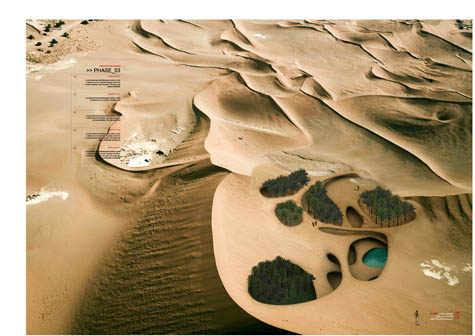
Sometimes, however, it doesn’t take him much interpretation or extrapolation to get straight into sensawunda territory, and Magnus Larsson’s “arenaceous antidesertification architecture” is a prime example. Take it away, Mr Manaugh:

Larsson’s project deservedly won first prize last fall at the Holcim Foundation’s Awards for Sustainable Construction held in Marrakech, Morocco. One of the most interesting aspects of the project, I think, is that this solidified dunescape is created through a particularly novel form of “sustainable construction” – that is, through a kind of infection of the earth.

Larsson has proposed using bacillus pasteurii, a “microorganism, readily available in marshes and wetlands, [that] solidifies loose sand into sandstone,” he explains.

[…]

But the idea of taking this research and applying it on a megascale – that is, to a 6,000km stretch of the Sahara Desert – boggles the mind. At the very least, the idea that this might be deployed for the wrong reasons, or by the wrong people, in some delirious hybrid of ice-nine, J.G. Ballard’s The Crystal World, and perhaps a Roger Moore-era James Bond film, deserves further thought.

Indeed it does… but take a look at the concept art for the project (of which there is more in a Flickr set). Even before you start thinking about potential misuse, you can’t help but be impressed by the sf-nal visual impact of the idea.

arenaceous antidesertification architecture concept

You’d be best off reading the whole of the BLDGBLOG post for the low-down on how this concept would work (and then Larsson’s paper itself, from which the above image is borrowed), but here’s an excerpted explanation from Larsson himself:

The piles would be pushed through the dune surface and a first layer of bacteria spread out, solidifying an initial surface within the dune. They would then be pulled up, creating almost any conceivable (structurally sound) surface along their way, with the loose sand acting as a jig before being excavated to create the necessary voids. If we allow ourselves to dream, we could even fantasise about ways in which the wind could do a lot of this work for us: solidifying parts of the surface to force the grains of sand to align in certain patterns, certain shapes, having the wind blow out our voids, creating a structure that would change and change again over the course of a decade, a century, a millenium.

Beautiful? Undoubtedly. Practical or plausible? I really have no idea… but I don’t think there’s any harm in admiring a magnificent idea for its own sake every once in a while. After all, that’s one of the pillars of science fiction, isn’t it?

The utter Ballardian weirdness of Dubai

Sheik Zayed Road, DubaiReading this may take you half an hour, but it’ll be half an hour well spent. Johann Hari of The Independent goes to Dubai and unearths a slice of desert dressed as utopia, full of half-finished buildings, jaded over-moneyed ex-pats and a colossal underclass of what are essentially indentured slaves. I knew the place was bent, but not this badly.

Time doesn’t seem to pass in the malls. Days blur with the same electric light, the same shined floors, the same brands I know from home. Here, Dubai is reduced to its component sounds: do-buy. In the most expensive malls I am almost alone, the shops empty and echoing. On the record, everybody tells me business is going fine. Off the record, they look panicky. There is a hat exhibition ahead of the Dubai races, selling elaborate headgear for £1,000 a pop. “Last year, we were packed. Now look,” a hat designer tells me. She swoops her arm over a vacant space.

I approach a blonde 17-year-old Dutch girl wandering around in hotpants, oblivious to the swarms of men gaping at her. “I love it here!” she says. “The heat, the malls, the beach!” Does it ever bother you that it’s a slave society? She puts her head down, just as Sohinal did. “I try not to see,” she says. Even at 17, she has learned not to look, and not to ask; that, she senses, is a transgression too far.

Between the malls, there is nothing but the connecting tissue of asphalt. Every road has at least four lanes; Dubai feels like a motorway punctuated by shopping centres. You only walk anywhere if you are suicidal. The residents of Dubai flit from mall to mall by car or taxis.

It gets weirder and bleaker as you read through, making you realise that until recently the public veneer of Dubai was very effective in keeping us from seeing what was really happening… that and the complicity of our own willingness to accept what we’re told, of course. To paraphrase Mark Twain, the truth’s always stranger than fiction, because fiction is required to make sense. [image by chorcel]