Tag Archives: environment

Consuming the future

nature_chainsVia New Scientist, scientists at the Ecological Society of America confirm my Agent Smithesque suspicions on the cause of our ongoing environmental crisis:

More specifically, all we’re doing is what all other creatures have ever done to survive, expanding into whatever territory is available and using up whatever resources are available, just like a bacterial culture growing in a Petri dish till all the nutrients are used up. What happens then, of course, is that the bugs then die in a sea of their own waste.

Making all this worse is the development of consumerism, which encourages even greater consumption of resources than would be the case if every new human being consumed as much as they have done historically, the NS article comments on the development of this trait:

According to Rees, the change took place after the second world war in the US, when factories previously producing weapons lay idle, and soldiers were returning with no jobs to go to.

American economists and the government of the day decided to revive economic activity by creating a culture in which people were encouraged to accumulate and show off material wealth, to the point where it defined their status in society and their self-image.

In today’s world, such rhetoric seems beyond belief. Yet the consumer spree carries on regardless, and few of us are aware that we’re still willing slaves to a completely artificial injunction to consume, and to define ourselves by what we consume.

British philosopher John Gray (not the American self-help guru of the same name) has argued something similar in his book Straw Dogs: Thoughts on Humans and other Animals, in which he lays out a thoroughly pessimistic critique of the notion of human exceptionalism, and his prediction of the imminent failure of environmentalist policies.

I don’t agree entirely with Gray on the inevitability of collapse and decay, but I certainly concur with James Martin‘s view that the 21st century will have to mark a change from focussing on limitless growth to sustainable growth (if such a thing is truly possible), as a precursor to a steady state economy.

The article raises another interesting point:

In an ideal world, it would be a counter-advertising campaign to make conspicuous consumption shameful.

“Advertising is an instrument for construction of people’s everyday reality, so we could use the same media to construct a cultural paradigm in which conspicuous consumption is despised,” he says. “We’ve got to make people ashamed to be seen as a ‘future eater’.”

I’m against moralistic ‘holier-than-thou’ criticisms of consumerism, but as “consumerism” as a concept has come about by the deliberate decisions of business people and marketers (and policymakers) seeking to promote ever greater economics growth and consumption, might it not be time to have a similar drive towards sustainability?

[image from Peter from Wellington on flickr]

Go green: stop breeding

baby and globeCOSMOS Magazine reports that the world’s wealthiest nations are experiencing something of a baby boom, standing in stark contrast to the general decline of birthrate in recent decades. In many respects this can be seen as a good thing, at least from an economic perspective; the “greying” of the population has produced a situation where the number of elderly people unable to work and in need of care and support has grown without a proportional increase in the numbers of young productive people able to keep the economy ticking over. [image by geraintwm]

But that classical economic viewpoint fails to consider other important factors, like the environmental impact of an increase in the number of children in developed nations. In a nutshell, large families are not environmentally sustainable in a country like Britain, where family planning researchers have begun to suggest that the best way for a young couple to “go green” is to restrict the number of children they have. Population is a global matter, certainly, but it’s estimated that a British baby will produce 160 times the greenhouse gas emissions of a baby born in Ethiopia. Or, to put it another way, each child born in the United States multiplies its parents’ carbon legacy by more than five times.

Statistics are all very well, but as any discussion of environmental responsibility shows, we struggle with making sacrifices for a nebulous and intangible greater global good – and personal experience suggests strongly that there are a sizeable number of people who get very offended by suggestions that they should restrict the number of children they choose to have. So, the two big questions are: should developed nations be instigating some sort of population control policy (while simultaneously assisting less developed nations with the education and medical support required to foster similar attitudes), and – if so – how should they incentivize such a controversial and personal decision?

First the good news: plants evolve quickly in response to climate change

plant in droughtNow the bad news: it’s not always a positive change, as serendipitously discovered by Arthur Weis of the University of California:

When a severe drought struck southern California, Weis realized that he could use the extra bucket of seeds for an experiment. In 2004 he and his colleagues collected more field mustard seeds from the same sites that Sim had visited seven years earlier. They thawed out some of the 1997 seeds and then reared both sets of plants under identical conditions. The newer plants grew to smaller sizes, produced fewer flowers, and, most dramatically, produced those flowers eight days earlier in the spring. The changing climate had, in other words, driven the field mustard plants to evolve over just a few years. “It was serendipity that we had the seeds lying around,” says Weis.

The article continues with a lengthy examination of the plasticity of lifeforms – their ability to change swiftly in response to environmental conditions. Recent research is putting the lie to the original Darwinian view of evolution as something that operates at a glacially slow pace, and strongly suggesting that climate change – regardless of cause – may be one of the most important factors in evolutionary change. Whether the increasing pace of climate change will be reflected by a stronger and faster response from natural selection remains to be seen. [image by Andyrob]

This pretty much underlines what I think a lot of us know deep down; whatever happens, the Earth and its biosphere will survive. Whether we get to remain a significant component of it is still an open question.

Icelandic cod on an evolutionary fast-track to extinction

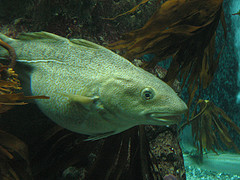
codfishHere’s a real Zeitgeist of a story for you: not only is it strong evidence in favour of the theory of evolution by selective pressure, but it also shows that external forces – including human intervention – can accelerate the process to a great degree.

The big downside, however, is that it may be a sign that one of the largest fisheries in the world is about to collapse like a house of cards: you see, there’s a gene in cod which governs the depth at which they prefer to live, and relentless trawling has exerted evolutionary pressure in favour of the mutant fish which swim deeper than the others. [image by Hello, I am Bruce]

Fisheries are known to exert selective pressure on fish. In some cases this has led to the evolution of smaller fish.

This was thought to be a slow process. “Previous workers have concluded that evolutionary changes are only observable on a longer timescale, of decades,” Árnason says. “The changes we observe are much more rapid.”

The A gene is being driven out simply because of where those fish choose to live, says Árnason. Such inadvertent, rapid selective pressure may drive some fisheries to crash.

“Man the hunter has become a mechanised techno-beast,” the team writes. “Modern fisheries are uncontrolled experiments in evolution.”

Worryingly, the researchers found that cod in the Icelandic fishery are becoming sexually mature while still smaller and younger. Something similar occurred in Newfoundland cod just before that fishery crashed. “We think this too is an evolutionary response to the selective pressure of fisheries,” says Árnason.

So, bad news… but bad news with some valuable knowledge in its back pocket. If extreme external conditions apply evolutionary pressure, where will we see this phenomenon crop up next? Perhaps, if the environmental uber-pessimists turn out to be right, we humans will end up at the pointy end of evolution’s goad; on a planet with limited food and water and numerous existential hazards, who knows what we might turn into over the course of a century or two?

‘Craveable’: Does the food industry play with our heads?

big-boy1Trying to write an optimistic science fiction story for a change has led to some fascinating research avenues. If we want to give our poor put-upon planet a bit of a break, wouldn’t it make sense to change the way we eat? Think of the fuel we could save, the waste we could cut back on…

Not so fast, though. Former U.S. Food & Drug Administration commissioner (under Clinton and W.) and pediatrician David Kessler says one of the reasons Americans overeat is because the food industry, not unlike tobacco before it, is messing with our minds.

At first glance, that sounds obvious, given the myriad of junk-food choices and the constant blare of advertisement. Kessler digs deeper, though, in his new book The End of Overeating:

“The food the industry is selling is much more powerful than we realized,” he said. “I used to think I ate to feel full. Now I know, we have the science that shows, we’re eating to stimulate ourselves. And so the question is what are we going to do about it?”

In good dramatic fashion, Kessler says it’s partly his fault: when he headed the FDA he won battles for better labeling of processed foods, but didn’t push much for labels in restaurants.

His own dumpster-diving research (note to Hollywood: this book needs to be a movie) led him to the conclusion that not only are seemingly healthy menu choices like grilled chicken or spinach dip larded with “fat on fat on salt on sugar on fat on fat,” but that they are more or less deliberately designed to goad you brain into craving more, even when your stomach has had more than enough. He estimates that 15% of the U.S. population is vulnerable to “conditioned overeating.”

(And everytime I visit another country I see more U.S.-based food chains — sorry about that, but I’m guessing this is not just an issue for my own country.)

Willpower, yes; government oversight, maybe, says Kessler. Far better to change the way we look at food – to break the emotional association with good times. Perceptions have changed for the better before this, he points out: consider shifting attitudes towards cigarettes, driving without a seat belt, or drunk driving.

By now some readers are thinking “That’s obvious,” or rolling their eyes at the prospect of more nanny-statism. (I did both.) Skepticism is healthy, too. For starters, I’d like to know more about the neuroscience of those “reward circuits.” Here’s a taste, though:

Yale University neuroscientist Dana Small had hypereaters smell chocolate and taste a chocolate milkshake inside a brain-scanning MRI machine. Rather than getting used to the aroma, as is normal, hypereaters found the smell more tantalizing with time. And drinking the milkshake didn’t satisfy. The reward-anticipating region of their brains stayed switched on, so that another brain area couldn’t say, “Enough!”

You can hear some NPR interviews with Kessler here, there, and everywhere.

[Image: Iconic US diner mascot Big Boy by Patrick Powers]