
Tag Archives: Fiction

Teens don’t read and can hardly write, right?

Inbox overload!Wrong… unless those 40,000 words they text out over a month don’t count [via LifeHacker; image by nate steiner].

Sure, a lot of those texts will be rote replies and simple questions, but the point stands: teenagers communicate heavily using a form of the written word. When I was a teenager in the nineties I used to write a lot of letters, but I’d be very surprised if I approached a tenth of that wordcount, which equates to the lower limit for a novel (or at least it used to). Text has a lower bandwidth than face-to-face speech, but SMS messages have the advantage of asynchronicity over a regular phone call, and as gnomic as the compressed words and pseudo-1337 of text messages may be to us older folk, they have the same capability for hidden meaning and word-play as “proper” writing.

Where am I going with this? I’m not sure, to be honest… but I’m increasingly convinced that blaming technologised teen lifestyles for their perceived disinterest in reading is a fiction born of contempt and generational differences. The “cellphone novel” is a popular format in Japan – has anyone really tried pushing it here in the West? Or will we need to wait for that generation to grow its own stars and mavens organically without the help of old-media gatekeepers?

Americaland: writing the US from beyond its borders

America!People can be very quick to make jokes about the lack of knowledge some Americans have about the countries beyond their borders, but the opposite can also be true. Damien Walter recalls a discussion he had with Neil Gaiman at last year’s Clarion writer’s workshop about “Americaland” – the bundle of cultural shorthands and cliches that go to make up the fictional USA where British (and other) writers tend to set their stories:

Americaland is real place for British writers, it is built from thousands of fragments of American TV, films, music, comics and other cultural artefacts. It’s a place filled with 1950’s dinners and long desolate highways among other things. And its just as imaginary as a Britain filled with red telephone boxes and bowler hatted business men.

(One draw of Americaland is the British tendency towards naffness…IE…any story that seems fascinating and dark in Americaland becomes utterly naff if you transplant it to the UK. Batman in Gotham = Dark Knight. Batman in Birmingham = mentalist in tights. If you are British and want to write Batman, or any other American archetype, then welcome to Americaland.)

[Batman in Birmingham… I’d buy that comic, personally. DC should give the franchise to Grant Morrison for a few years… “Mentalist in Tights” = Best Tagline Ever.]

Americaland is as much a fantasy world as Middle Earth or Dune. Some of the most fascinating fantasy worlds are the ones that overlap our reality so closely that the reader can almost accept them as real. Perhaps that’s why Americaland, with all its inaccuracies and cliches, can be such a compelling place to set stories in. Whenever I turn my hand to any story of the horrific or dark fantasy variety, I find Americaland creeping in from the edges. However hard I try to root these stories in the Britain I know, American locations and characters crop up again and again. When I turned to my imagination for material this weekend, it gave me a man and woman meeting in a diner and going on a road trip. It’s a story that can only take place in Americaland. So do I accept where my imagination is taking me, for all its flaws, or rail against it and force myself to write in British settings?

It’s a good question – should you only write what you know? And if not, how would you recommend a non-native get a feel for the real USA without the expense of a pair of plane tickets and a few months of travelling? [image by dno1967]

And to our American readers: what are the most egregious Americaland cliches you see in the writing of non-American authors, and how should they be corrected?

Tales from the slush

Mmmm, tasty slush...Short fiction writers would be well advised to follow the Apex Book Company blog, as I think I’ve mentioned before; they have lots of guest posts from writers, editors and other niches in the fiction food-chain, containing plenty of sound advice. Like this post from submissions editor Maggie Jamison, for example, which offers a little hope and solace for those of you who fear the anonymity of the slush pile:
Believe it or not, a submissions editor can remember your name, particularly if you wrote something she liked, even if she passed on it. If you pay attention to rejection comments (if she gives any), and keep working to hone your understanding of her market, chances are your next attempt will be closer to what she wants.

And here’s the funny thing (though maybe it’s just me): we want you to succeed. Of all the other submissions editors I’ve spoken to, the vast majority would much rather send an acceptance letter than the typical form rejection. Heck, even a personal “This was so, so, SO close!” rejection is more fun than the form. I think most magazines want to be the one that nabs the first few publications of a great up-and-comer, and I’ve always enjoyed the vicarious excitement when a manuscript from my slush pile is accepted and bought.

I know that’s the attitude Futurismic‘s very own hard-workin’ Chris East takes to the slush pile… if we didn’t want to publish good stories, we wouldn’t offer $200 per story and throw submissions open to all and sundry! [image by misscrabette]

Maggie makes some sound points about rewrites and re-submissions, too:

Unless I’ve specifically asked you to tweak the story and send it back, DO NOT resubmit the same story. The only other way it might be acceptable is if you rewrite the story so completely that I can’t tell I’ve read it before. But then, it wouldn’t be the same story, would it?

As a submissions editor, I do try (when I have time) to give suggestions for what might make a rejected story just a little bit better. I do this so the author knows and can utilize this information to avoid the same issue in her next story submission, not so the author can tweak her story and send it right back to me. If I want to see a rewrite or a reworking, I will be very, very clear.

Of course, all this advice follows on from the basic rule of making sure you read the submission guidelines carefully for the venue you’re sending your story to. As Chris has pointed out here before, a great many of the stories we reject aren’t bad per se, they’re just not the sort of stories we publish. Researching your market is a great way to lessen the chance of the dreaded “thanks, but no thanks” response. 🙂

Silvia Moreno-Garcia explains the origins of “Biting the Snake’s Tail”

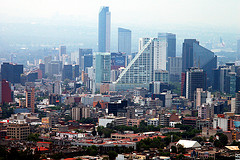
Mexico City skylineSo, did you read Silvia Moreno-Garcia’s latest Futurismic story, “Biting the Snake’s Tail”, published here yesterday? Well, you should – go do it now.

One of the great joys of author blogs, for me at least, is getting an insight into how stories came to be – to find out what inspired them, how they progressed from initial idea to finished work. Silvia has written a post that opens a door on “Biting the Snake’s Tail”, which takes place in a near-future iteration of Mexico City:

It was two years in the making. I wrote the first half of it after dreaming two parts of it: the detective walking through the rainy streets with the dog and the murder. In the original, the murder took place at a public bath house and the victim was a gay man.

When I was a kid and there was no water (yep, this was a problem in Mexico City even years ago) for the day, we sometimes went to the public bath house in Santa Julia. This meant paying a few pesos and you got a bit of soap, some shampoo and access to a shower area. I remember we took our own towels, but towels might have been supplied at a cost. Last year, when I was in Mexico City, water issues were pretty bad. About 5 million people (a quarter of the city) was suffering from a drought and predictions for 2010 were that even the ritzy neighbourhoods would be affected. Think a third of the city without water this year, taps running dry for many days at times.

Having been lucky enough to visit Mexico City, I know it’s the sort of place where stories wait for you around every street corner. Ludicrous wealth and grinding poverty live cheek by jowl, and history howls hungrily from beneath layered and crumbling facades of modernity… much like any big city, I suppose, but they don’t come much bigger than El D. F., and that history is marbled with conflict and the struggle to survive for as long as records have been kept. [image by alex-s]

For a privileged Euro like myself, Mexico City was a real eye-opener; I’ve been fortunate enough to have travelled a fair amount in my life, but few places have affected me quite so deeply. Travel is fatal to prejudice, as Mark Twain once said… I wonder if visiting new places in fiction can have the same effect? I certainly hope so – after all, as energy costs continue to increase, it’s going to be the only form of long-distance travel available to the vast majority of us… and there’s more than enough prejudice to go round.

NEW FICTION: BITING THE SNAKE’S TAIL by Silvia Moreno-Garcia

Our second story of the new decade is yet another return visit from a Futurismic fiction alumnus. We loved Silvia Moreno-Garcia‘s “Maquech” enough to publish it back in 2008, and “Biting The Snake’s Tail” takes us back to an exotic and ecologically crumbling Mexico City… but this time it’s in a noir-ish near-future police story, where what you don’t see is even more important than what you do. Enjoy!

Biting The Snake’s Tail

by Silvia Moreno-Garcia

Cops don’t go into the alcazabas. They’ll do raids every few months and confiscate mod-drugs for the sake of the TV cameras, but they don’t care what happens in the alcazaba’s colorless alleys. The gang leaders have established their own code of conduct, so what happens in the alcazaba is the business of the people who live there and not of the outsiders circling and enduring these cities within a city.

That’s why it was so bizarre to see all those officers in their blue uniforms running around La Catrina. I bet they were also pretty surprised to see me there in full gear with Arkasha at my side.

Gonzalo hadn’t told me what was going on. All he said was I had to get to La Catrina fast. Therefore, I was wearing the exo and the helmet, just in case things were really nasty. Arkasha was an added form of insurance. It’s funny how many people will run at the sight of a large dog, but not of a gun. Continue reading NEW FICTION: BITING THE SNAKE’S TAIL by Silvia Moreno-Garcia