Tag Archives: futurism

Revealed: Pentagon predicts wars of the future

viperfull_2The proud journos at TPMMuckraker have managed to acquire the titles of various Pentagon Office of Net Assessment reports through a Freedom of Information request. Here’s what’s been on their minds:

The Great Siberian War Of 2030

The Revival Of Chinese Nationalism: Challenges To American Ideals

The Future Of Undersea Warfare

Chinese And Russian Asymmetrical Strategies For Space Dominance (2010-2030)

That last one is relevant to the recent news of a military (but possibly not weapons-carrying, what with the Outer Space Treaty [thanks commenter Kian]) Chinese space station.

The whole list is here.

As the actual content of the reports is still classified we can amuse ourselves by wondering what Biometaphor For The Body Politic [March 2006] refers to. It sounds like a description of someone explaining the Facts of Life with handpuppets.

[via Danger Room][image also from Danger Room]

Why pundits always get it wrong

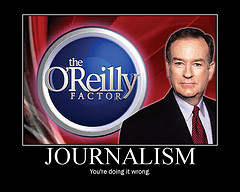
Bill O'Reilly motivational poster spoofHave you ever wondered why the talking heads on television are so often utterly wrong in their predictions about the future?

According to a research psychologist from Stanford University, it’s because the people the media tends to hire as pundits are the sort of people who are psychologically predisposed to making predictions based more on their own beliefs than any rational assessment of the situation:

At first, Tetlock’s ongoing study of 82,361 predictions by 284 pundits (most but not all of them American) came up empty. He initially looked at whether accuracy was related to having a Ph.D., being an economist or political scientist rather than a blowhard journalist, having policy experience or access to classified information, or being a realist or neocon, liberal or conservative. The answers were no on all counts. The best predictor, in a backward sort of way, was fame: the more feted by the media, the worse a pundit’s accuracy. And therein lay Tetlock’s first clue. The media’s preferred pundits are forceful, confident and decisive, not tentative and balanced. They are, in short, hedgehogs, not foxes.

That bestiary comes from the political philosopher Isaiah Berlin, who in 1953 argued that hedgehogs “know one big thing.” They apply that one thing (for instance, that ethnicity and language are primal; ergo, any country that contains many ethnic groups will break up) everywhere, express supreme confidence in their forecasts, dismiss opposing views and are drawn to top-down arguments deduced from that Big Idea. Foxes, in contrast, “know many things,” as Berlin put it. They consider competing views, make bottom-up inductive arguments from an array of facts and doubt the power of Big Ideas.

Intriguing, no? But while foxes are arguably better than hedgehogs, here’s the sobering conclusion:

If there are three possibilities (say, that China will experience more, less or the same amount of civil unrest), throwing darts at targets representing each one produces a forecast more accurate than most pundits’. Simply extrapolating from recent data on, say, economic output does even better.

Unfortunately, extrapolated data doesn’t make for such good television… or blog posts, for that matter. Will the decentralisation of current affairs newscasting make this situation better or worse? [image by silas216]

I wonder if we could classify science fiction writers using the same dualism?

Solar power from space: here in ten years?

One of the most visually striking science fictional solutions to our hunger for energy has to be SBSP – solar power beamed from space. Nothing says ‘awesome’ quite so much as a lance of coherent energy zapping through the atmosphere and into a collection station before powering your toaster or charging your pod-car…. but how soon might it turn up?

According to the not-so-imaginatively named start-up company called Space Energy, Inc, it could be soon. Space Energy says “it plans to develop SBSP satellites to generate and transmit electricity to receivers on the Earth’s surface […] The hitch: this concept is based on as yet unproven technology.”

For ‘unproven’ there, you might want to swap in ‘sketchy’:

… the actual test results conducted for a Discovery channel documentary proved a total failure. The former NASA executive and physicist who organized the experiment, a John Mankins, admitted in a press conference that the $1 Million budget spent of the experiment resulted in less than 1/1000th of 1% of the power transmitted being received on the other island.

Ouch. I wonder if SE, Inc are sincere but a little deluded, or whether they’re another snake-oil energy company? There’s been a few of those cropping up recently, and I can’t help but suspect there’ll be more to come… especially when the price of oil starts rising again.

Still, maybe two decades will do it for space-based solar – apparently the Japanese are on the case:

Researchers at the Japan Aerospace Exploration Agency (JAXA) have begun to develop the hardware for a SBSP satellite they hope to launch by 2030. They will begin testing this month of a microwave power transmission system designed to beam the power from the satellites to Earth.

All very well, but will no one think of the birds?

Doctorow on the decline and fall of novels

man reading a novelThe ever-ubiquitous Cory Doctorow crops up over at Internet Evolution, talking about “media-morphosis” – the ways in which the internet is mangling and mutating all the other forms of media. The whole thing is worth a read, but I thought I’d pick out a bit of Doctorow’s thinking about the future of the novel, as it fits quite neatly with some of the recent ebook posts here at Futurismic. [image by John Althouse Cohen]

Doctorow points out that books are suffering on two sides – firstly from the rise of the big-box retailers, which have restricted the titles available, and secondly from the way we’re being conditioned by the web (and other media imitating the web) to read in short, easy-to-swallow chunks – and then paints a worst-case scenario:

If big-budget movies might turn into opera, then long-form narrative books might turn into poetry. There’s a hell of a lot of published poetry — more than ever — mostly consumed by other poets and a small band of extremely dedicated followers of the form. A few poets make a big living at it, a few more make a marginal living at it, but for most poets, income is aspirational, not reality-based (this is pretty close to the situation in short fiction already, and not far off from the world of novel writing in many genres).

But a future in which novels turn into hand-crafted fetish items for a small group of literati is one in which the relevance of the novel dwindles away to a dribbly nothing.

I think most of us here would see that as a rather sad omega point for one of our favourite media, especially given the incredible artistic possibility it has to offer; Doctorow suggests that one route to salvation for the novel would be to build the sort of evangelical business that distributes books to places that they otherwise might not reach.

But what if his worst-case is actually the fact of the matter? Is it not possible that the novel will increasingly become an anachronism, the sort of thing considered historically interesting but culturally irrelevant by 21st Century humankind? Maybe we just need to face up to the idea that reading books for fun is a pastime whose days in the sun are over, no matter how personally attached to it we may be.