Tag Archives: futurism

Would you sign up for direct-to-brain broadband?

In a “twenty-questions” style interview with author Michael Grant over at The Guardian, I was struck by his answer to the final question:

What piece of technology would you most like to own?

I want a Google chip implanted in my brain. Wire up my cerebrum. I’m perfectly serious. I want all access, all the time.

Now, despite his protestations of seriousness, I rather suspect he’s exaggerating for effect. But even so, I found myself wondering whether I’d go for such a connection myself, if the opportunity arose. Let’s assume for a moment (and not too hypothetically) that such an always-on link could be achieved without surgical intervention – high-powered wearable computing, wireless broadband link, some sort of cyberpunk data-shades assemblage for interface, all that jazz. Is it still as transgressive and extreme an idea if you could just take it all off when ever you chose to? After all, I already spend upwards of ten hours a day connected to the internet*; the technological leap to being able to do so without having to be here at my desk seems like a small skip of convenience from where I’m sitting right now.

Now, imagine that Grant’s implants actually existed – how differently would a person with such capabilities interact with the world, and with other people? Would they have something of the autist or savant about them, or would instantaneous access to the knowledge and conversation of the web enhance their abilities to socialise? What work would they do (or want to do), and what jobs would they be denied?

Sure, these are all established questions that arise from reading cyberpunk literature – but to be kicked into that mode of thinking by a throwaway line in an interview with a YA author? It’s a weird wired world, and no mistake.

[ * – Yes, I know it shows. Be nice. ]
Singularity school with Vernor Vinge

Puzzled by posthumanism? Looking for an entry-level introduction to this thing that people call the Singularity? Well, sometimes it’s best to go straight to the source – sf novelist and computer scientist Vernor Vinge coined the concept of the Technological Singularity in 1993, so who better to explain the basics, as in this brisk interview at H+ Magazine:

Some folks will say there have been singularities before — for instance, the printing press. but before Gutenberg, you could have explained to somebody what a printing press would be and you could have explained the consequences. Even though those consequences might not have been believed, the listener would have understood what you were saying. But you could not explain a printing press to a goldfish or a flat worm. And having the post-Singularity explained to us now is qualitatively different from explaining past breakthroughs in the same way. So all these extreme events like the invention of fire, the invention of the printing press, and the evolution of cities and agriculture are not the right analogy. The technological Singularity is more akin to the rise of humankind within the animal kingdom, or perhaps to the rise of multi-cellular life.

It’s tricky trying to explain something which, by definition, is inexplicable – which is probably why the Technological Singularity is as hard to pitch at the average layman as at an industry expert. I’m still not sure I “believe” in it as anything more than a convenient metaphor for a world that changes fast enough to alienate people within their natural lifespans, but on that level alone it’s hard for me to think about the passing of the next thirty years – which would see my lifespan little less than doubled – without realising I’m going to feel like a stranger in a strange land on an hourly basis. Hell, it already happens at least once a day.

So, what do you lot make of the Singularity – inevitable geek rapture? Metaphor for an accelerating culture? Or just the sound of comp-sci lips flapping in the breeze at sf conventions?

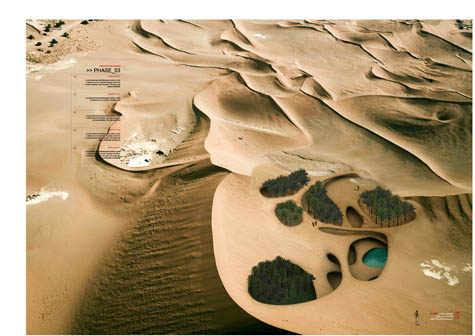
Rewriting Dune – arenaceous antidesertification architecture

I’ve mentioned before that everyone should follow Geoff Manaugh’s BLDGBLOG, and this post pretty much sums up why; Manaugh manages to find the weirdest and most wonderful ideas from the fringes of architecture and interprets them with the mind of a life-long science fiction fan.

Sometimes, however, it doesn’t take him much interpretation or extrapolation to get straight into sensawunda territory, and Magnus Larsson’s “arenaceous antidesertification architecture” is a prime example. Take it away, Mr Manaugh:

Larsson’s project deservedly won first prize last fall at the Holcim Foundation’s Awards for Sustainable Construction held in Marrakech, Morocco. One of the most interesting aspects of the project, I think, is that this solidified dunescape is created through a particularly novel form of “sustainable construction” – that is, through a kind of infection of the earth.

Larsson has proposed using bacillus pasteurii, a “microorganism, readily available in marshes and wetlands, [that] solidifies loose sand into sandstone,” he explains.

[…]

But the idea of taking this research and applying it on a megascale – that is, to a 6,000km stretch of the Sahara Desert – boggles the mind. At the very least, the idea that this might be deployed for the wrong reasons, or by the wrong people, in some delirious hybrid of ice-nine, J.G. Ballard’s The Crystal World, and perhaps a Roger Moore-era James Bond film, deserves further thought.

Indeed it does… but take a look at the concept art for the project (of which there is more in a Flickr set). Even before you start thinking about potential misuse, you can’t help but be impressed by the sf-nal visual impact of the idea.

arenaceous antidesertification architecture concept

You’d be best off reading the whole of the BLDGBLOG post for the low-down on how this concept would work (and then Larsson’s paper itself, from which the above image is borrowed), but here’s an excerpted explanation from Larsson himself:

The piles would be pushed through the dune surface and a first layer of bacteria spread out, solidifying an initial surface within the dune. They would then be pulled up, creating almost any conceivable (structurally sound) surface along their way, with the loose sand acting as a jig before being excavated to create the necessary voids. If we allow ourselves to dream, we could even fantasise about ways in which the wind could do a lot of this work for us: solidifying parts of the surface to force the grains of sand to align in certain patterns, certain shapes, having the wind blow out our voids, creating a structure that would change and change again over the course of a decade, a century, a millenium.

Beautiful? Undoubtedly. Practical or plausible? I really have no idea… but I don’t think there’s any harm in admiring a magnificent idea for its own sake every once in a while. After all, that’s one of the pillars of science fiction, isn’t it?

Why I’m looking forward to 2012

Mac Tonnies - Loving the AlienIf you thought we were all done with millennial panics and numerically significant dates for another thousand years or so, think again. Mac Tonnies looks a short way ahead to December 2012, the much-touted end of the Fifth Sun of the Mayan calendar, and wonders whether we’re doomed as a species to perpetually rebuild such temporal milestones. Continue reading Why I’m looking forward to 2012

Resilience economics – Jamais Cascio’s 2020 vision

skyscraper construction siteJamais Cascio has been doing what futurists do best – speculating on the near-term changes that need to be made to haul our asses out of the economic hole they’re in and, hopefully, ensure we don’t end up stuck there again.

Of course, the web is full of people doing the same thing, making pretty much every website (this one included, to be fair) a shower of competing ideas and ideologies (of varying degrees of sanity). What’s interesting – and perhaps more reasonable – about Cascio’s approach is that he isn’t adhering to either of the standard polar opposites of socialism and capitalism; he’s attempting to synthesise the two in this report from an imaginary future a few decades away:

Traditional capitalism was, arguably, driven by the desire to increase wealth, even at the expense of other values. Traditional socialism, conversely, theoretically wanted to increase equality, even if that meant less wealth. But both 19th/20th century economic models had insufficient focus on increasing resilience, and would often actively undermine it. The economic rules we started to assemble in the early 2010s seek to change that.

[snip]

Decentralized diversity (what we sometimes call the “polyculture” model) means setting the rules so that no one institution or approach to solving a problem/meeting a need ever becomes overwhelmingly dominant. This comes at a cost to efficiency, but efficiency only works when there are no bumps in the road. Redundancy works out better in times of chaos and uncertainty — backups and alternatives and slack in the system able to counter momentary failures.

Some food for thought there, no? It’s informed by the networked and distributed technologies which surround us, but lacks the idealistic tang of utopian thinking… and compromise seems like a good idea from where I’m sitting, at least.

And while we’re talking about major upheavals to the way we do stuff nowadays, how about open source healthcare?

… in healthcare, state intervention artificially skews the model of service toward the most expensive kind of treatment. For example, the patent system encourages an R&D effort focused mainly on tweaking existing drugs just enough to claim that they’re “new,” and justify getting a new patent on them (the so-called “me too” drugs). Most medical research is carried out in prestigious med schools, clinics and research hospitals whose boards of directors are also senior managers or directors of drug companies. And the average GP’s knowledge of new drugs comes from the Pfizer or Merck rep who drops by now and then.

[snip]

In an open-source healthcare system, someone might go to vocational school for accreditation as the equivalent of a Chinese “barefoot doctor.” He could set fractures and deal with other basic traumas, and diagnose the more obvious infectious diseases. He might listen to your cough, do a sputum culture and maybe a chest x-ray, and give you a round of zithro for your pneumonia. But you can’t purchase such services by themselves without paying the full cost of a college and med school education plus residency.

That’s a bit more extreme (or at least more detailed and close-focussed) than Cascio’s vision, but they both depend on a degree of decentralisation, with local systems picking up the slack where national institutions have failed. Given the increasing urbanisation of the world’s population, maybe devolving some governmental systems to independent local nodes would provide the flexibility we need to deal with these times of rapid change. [image by mugley]