Tag Archives: genetics

Culture is carried by DNA?

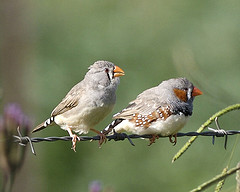
pair of Australian zebra finchesIt sometimes feels like you can’t go two weeks without some new aspect of human life or behaviour being declared as being related to our DNA. The latest attempted conquest of genetic determinism? Why, our very culture itself!

You see, male zebra finches usually learn their courtship song patterns from their fathers, but it turns out they can generate the same songs spontaneously after a few generations without influence:

“It’s the classic ‘chicken and the egg’ puzzle,” Mitra said. “Learning may explain how the son copies its father’s song, but it doesn’t explain the origin of the father’s song.”

Mitra’s team wanted to find out what would happen if an isolated bird raised his own colony. As expected, birds raised in soundproof boxes grew up to sing cacophonous songs.

But then scientists let the isolated birds give voice lessons to a new round of hatchlings. They found that the young males imitated the songs — but they tweaked them slightly, bringing the structure closer to that of songs sung in the wild. When these birds grew up and became tutors, their pupils’ song continue to conform, with tweaks.

After three to four generations, the teachers were producing strapping young finches that belted out normal-sounding songs.

Uhm. Well, if you’re thinking that seems a little tenuous, you’re not alone:

Mitra admits that the analogies between bird culture and human culture are tenuous. “But there are resemblances. Culture is just learned behaviors. The motivating scenario is, if you isolate human babies from culture, put them on an island and come back after a few generations, what would their culture be like? What sort of language would they have? What sort of politics would evolve?”

That experiment probably won’t take place in the near future. In the meantime, Fitch says we can learn valuable lessons about human culture from songbirds, both at theoretical and mechanistic levels.

“Social learning is shared between the two, and songbirds are a well-understood and experimentally tractable system,” he said. “These biologically-grounded studies will lead us beyond the tired ‘nature versus nurture’ or ‘biology versus culture’ dichotomies which dominate the social sciences today.”

With the caveat that I’m not a geneticist or behavioural scientist, I don’t really see how birdsong and human politics are supposed to be different expressions of the same thing; the former is a biological imperative, while the latter is an emergent phenomenon. As Brian Eno once said, “culture is everything we don’t have to do”; a zebra finch that doesn’t sing sweetly won’t pass on its DNA, making its songcraft a matter of reproductive necessity, but I don’t think you can declare the same thing about, say, a great human painter or poet or politician.

That said, I’m all for getting beyond the nature/nurture dichotomy – knowing how culture emerges from biology is one of the most tempting grails of knowledge I can imagine. But in the same way that everything from alcoholism to sexuality seems to be blithely written off as being primarily a function of our genetic code, declaring such a nebulous and complex phenomenon as human culture to be passed along by DNA on the basis of some songbird studies seems… well, it seems pretty daft, really.

If there’s someone in the audience who can set me straight on this subject, I’d be very glad for them to speak up and tell me where my reasoning is wrong, but this story seems to me like just another instalment in our ongoing fetish with genetics as the key to all unsolved mysteries. [image by Lip Kee]
Are “designer baby” fears actually prolonging children’s suffering?

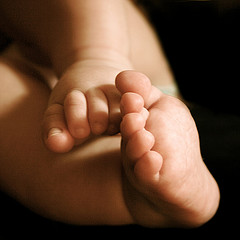
baby feetMedia hysteria about “designer babies” maintains ethical pressure on IVF genetic screening techniques and keeps them from becoming more widely used. Michael Le Page at New Scientist suggests IVF-PGD should in fact be mandatory, comparing a refusal to use the technique to the actions of parents who refuse medical treatment for their child on religious grounds:
We now have the ability to ensure that children are born free of any one of hundreds of serious genetic disorders, from cystic fibrosis to early-onset cancers. But children continue to be born with these diseases.

All would-be parents should be offered screening to alert them to any genetic disorders they risk passing on to their children. Those at risk should then be offered IVF with pre-implantation genetic diagnosis (IVF-PGD) to ensure any children are healthy.

Why isn’t it happening? Because most people still regard attempts to influence which genes our children inherit as taboo.

He goes on to point out that IVF-PGD can’t be used for ‘designing’ a child, and takes the view that if every life is a gamble, screening for inheritable diseases is a way of stacking the deck in your favour… and in the child’s.

Of course, that view is contrary to the “pro-life” philosophy, but even someone more moderate than that might see Le Page’s approach as callous. And there’s the argument that it’s immoral to attempt to eradicate disability entirely; remember the deaf couples who use genetic screening to select in favour of a child with deafness? [image by lepiaf.geo]

What do you think – should we use science to engineer away our physical defects before they happen, or to make life as comfortable as possible for those afflicted with them?

Gattaca becomes reality – all babies to be DNA sequenced at birth by 2020?

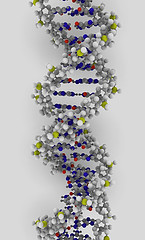
digital rendering of DNAA genetics outfit named Illumina is preparing to launch an affordable genetic mapping service in the next couple of years. Its first few customers can expect to pay between US$10,000 and US$20,000 for a complete mapping of every gene in their DNA, but their chief executive has told The Times that by 2020 the equipment should be so affordable that all newborns will have their genomes sequenced at birth:

“The limitations are sociological; when and where people think it can be applied, the concerns people have about misinformation and the background ethics questions.

“I think those are actually going to be the limits that push it out to a ten-year timeframe,” he added.

Of course, he’s bound to be positive about the prospects; CEO of the company isn’t exactly a disinterested position. But I think that’s a pretty plausible timeframe, if only so far as the capability is concerned.

And there will be resistance to the idea, even if the Gattaca comparison is rather overstated. Given the UK government’s current obsession with storing the minutia of its citizen’s lives, I’d be worried about letting them have my entire genetic sequence – though not because of what they would use it for so much as that I couldn’t trust them not to leave it in a briefcase on a rush-hour train

Even that makes light of a potentially sticky ethical quagmire, though; we won’t get to see everything that’s hidden in Pandora’s box until we actually open the lid. Let’s just hope we’ve gotten over our little global obsession with copyright and intellectual property by the time the street-corner sequencer shacks open for business, eh? [story via FuturePundit; image by ynse]

Genes, genomes, and skiffy

beesKen MacLeod has a monograph up on genomics, sociology and science-fiction at the genomics forum:

Social scientists are less likely than natural scientists to star as villains or heroes in SF. Their work, however, has deeply influenced the genre.

At first or second or third hand – directly, through popularizations, and as refracted through mass media – anthropology, economics, sociology, and political theory have all raised questions to which SF writers have imagined answers.

As well as highlighting the importance of sociology and economics to the development of science fiction MacLeod suggests a reading list of suitable novels that are relevant to his topic. He also compliments us literary SF fans:

Written SF (whose core readership and reviewers are more scientifically informed than the general public) usually has to hew to stricter standards of scientific plausibility…

Damn staight.

[via Ken MacLeod][image from Todd Huffman on flickr]

Geneticists scolded for giving genes silly names

grouchoSome fruit-fly genes have names like these:

Groucho Marx: A fruit fly that produces an excess of facial bristles.

Cheap Date: A fruit fly that expresses high sensitivity to alcohol.

Ken and Barbie: Fruit flies that fail to develop external genitalia.

I’m Not Dead Yet: INDY for short, these are fruit flies who live longer than usual. [NPR explains where this came from, like you don’t know if you’re reading this blog]

Harmless enough, you’d think, but:

Since it’s increasingly likely some fruit fly genes will show up in humans, Dr. [Murray] Feingold [a Massachusetts clinician who treats people with genetic diseases] warns it will not be possible for doctors to hide a scientific name like “I’m Not Dead Yet.”…

And for a doctor, these names become embarrassing “when that gene becomes responsible for some kind of medical problem and I have to tell that patient, ‘Well, I’m sorry things don’t look so good because you have [the] I’m Not Dead Yet gene.'”

So it’s not just PC run amok, but a curious case study in the democratization of information. Your take?

[The immortal Julius Marx: Wikimedia Commons]