Excerpts from “Asphalt Veins – The Freeway States” Published in NEWStream and syndicated to all ReutAssoc membersites (retrieved December 21 2012 @ 13:34).


It was no great surprise when the highways seceded. Continue reading The Free Freeways
Excerpts from “Asphalt Veins – The Freeway States” Published in NEWStream and syndicated to all ReutAssoc membersites (retrieved December 21 2012 @ 13:34).
It was no great surprise when the highways seceded. Continue reading The Free Freeways
As useful as it is to have easy access to digital maps of the world, they throw up some odd anomalies from time to time… like this one from Lancashire, here in the UK. Google’s maps of the area show a small village called Argleton, not far from Ormskirk. The thing is, there’s no such village.
The jury is still out on the cause of this cartographic aberration: the copyfight lobby suspects it’s a deliberate mistake planted in the mapping data by an organisation keen to catch out those who reuse it without permission (much in the way that the Royal Mail salts its postcode databases with fake addresses so it can detect unlicensed use), but Occam’s Razor suggests it’s more likely a mistyped version of the nearby village of Aughton, or some other sort of data glitch that sneaked its way into the data. These things happen, after all, especially when you pay low hourly rates to large numbers of data entry monkeys… I know, I’ve been one.
But think for a moment – as digital maps become the norm (and given the price the Ordnance Survey charge for theirs, it’s not going to take very long for that to happen on this side of the pond), will they become considered to be authoritative, even though their accuracy may not merit that authority? After all, people trust their sat-navs to such a ridiculous degree that they’ll drive down roads that pure common sense would suggest aren’t safe or worth travelling… it’s like an extension of the unfounded trust that some folk have of everything they see on television. If Google says it’s there, then there it is, right?
Adventuring a little further into the realms of participatory geography, the ability to overlay your own data on top of a basic map could allow groups and collectives to remap and rename places as they chose. Don’t like the political or historical resonances of your local street names? Then choose new ones. Want to differentiate the parts of town that you haunt from the rest of the metropolis? Draw your borders, share your maps, reclaim your city. Once augmented reality becomes ubiquitous (which surely isn’t going to take very long), it’s pretty much game over for conventional consensus geography… and the political repercussions of that are going to be interesting to watch.
So, did you see the Wired spoof piece about the iHobo augmented reality application? Yeah, yeah, I know it’s a joke, they make that pretty clear. But it’s a clever joke – and not just because it says a number of things about technology, class and culture.

What iHobo does is highlight not only the imminent mundanity of augmented reality – a technology whose path to near-ubiquity in the developed world is defined only by time and falling prices – but also the fact that we’ve always had augmented reality. It’s not a thing you buy, it’s a thing you do.
Reality is perception – when I go to, say, Berlin, whose Berlin do I see? Do I see the Berlin of the German Tourist Board or the Lonely Planet writers? Do I see the Berlin of a modern experimental architect, or the Berlin of Albert Speer? Of the gallery-owning cognoscenti or the punk squatter kids? They’re all different cities, yet they share the same geographical space.
In addition to time and space, there’s another dimension you can move in – call it culture, call it perspective, call it viewpoint, call it contextual relevance, call it popularity. It’s all of those things, and none. It’s something we build as groups and as individuals, a shared semiotic system of value and meaning – and soon we’ll be able to travel inside other people’s systems at the swipe of a finger across a touchscreen.
Of course, there’s a very good chance I’m stating the obvious here*, but this ties in so closely to a bunch of the weirder theories of reality I had when I was younger that I can’t help but geek out about it. Sorry.
[ * Seriously, sometimes it’s a real struggle finding stuff that I think won’t just bounce right off of you jaded lot. But then I console myself with the thought that I’m lucky to have a very smart and well-read audience by comparison to a lot of similar sites. So don’t go changin’. 🙂 ]
 Here’s an odd twist on crowdsourcing; the publicly-accessible cameras along the Texas-Mexico border have attracted amateur border guards from a number of the southern states… and beyond. In fact, it seems to be quite the international pastime:
So far, more than 100,000 web users have signed up online to become virtual border patrol deputies, according to Don Reay, executive director of the Texas Border Sheriffs’ Coalition, which represents 20 counties where illegal crossings and drugs and weapons smuggling are rife.
“We had folks send an email saying, in good Australian fashion, ‘Hey mate, we’ve been watching your border for you from the pub in Australia’,” he said.
Not everyone is quite so impressed, however, especially considering the system’s cost measured against its successes:
Opponents have dismissed the project as “the perfect Google border” and say the cameras do little to deter criminal activity. “Border security deserves trained professionals, not pub-goers in Perth,” said Eliot Shapleigh, a state senator from El Paso, Texas, who claims that the programme has resulted in only a handful of arrests. “It’s wholly ineffective for the governor’s stated goal of security, it panders to extremists for political purposes and it’s not an effective use of $2m for just three apprehensions.”
One has to wonder whether all the people who’ve signed up to watch the border are sincerely interested in reporting transgressions rather than turning a blind eye to them; the barriers to entry are pretty low, after all, and not everyone wants to take America’s side these days. [image by Daquella manera]
But what interests me most about this story is that it seems to highlight one of my current obsessions, namely the fragmentation of nation-states into parts that borders on a map just can’t represent. If an Australian is voluntarily watching a piece of land at the edge of Texas (which, a long time back, was part of Mexico) to make sure that no Mexicans (or Guatemalans or Hondurans or anyone else) cross that fence-line, could he not be considered a temporary US citizen? Or is he merely a form of contractor, or neither?
Think about it – to enforce a geographical boundary, the US is using tools that contribute to the ongoing erasure of geography; meanwhile, non-citizens on the other side of the globe do work that a citizen would need to be security-screened for… and do it for free, or for kudos. What does being a citizen actually mean, beyond defining who you pay your taxes to? Where does citizenship actually take place – on the ground, in our own minds, or in the network of mutual assumptions that we call society?
Isn’t it possible that one day that one way to cross the conceptual border of the US and become a citizen thereof would be to have spent a considerable amount of time and effort ensuring that other people didn’t cross the geographical border?
[26/03/09 – Note: it has been brought to my attention that the term ‘wetback’ is a lot more fundamentally racist than I – unused to some of the subtleties of US slang – initially thought; had I thought it referred to anything more than person who attempts to cross the Rio Grande, I wouldn’t have used it, and I’d like to apologise for any offence caused.]
The ICC’s Live Piracy Map does exactly what its name suggests – it collates reports of modern piracy (the ocean-going sort, not kids using peer-to-peer networks), and plots them out as a Google Maps layer:
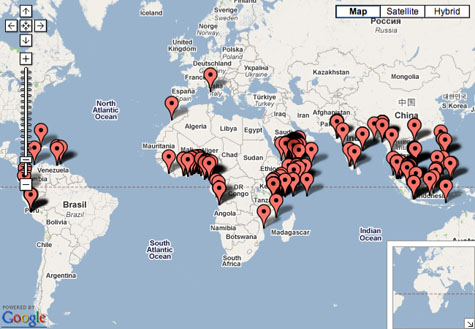
What’s interesting to me (as someone who works in maritime history) is how some of the hotspots are comparatively new, but others are almost as old as ocean-going commerce itself – a reminder that geography remains unconquered by technological progress, at least as far as supply chains of physical goods are concerned. [story and screenshot via the indispensable BLDGBLOG]
It also suggests that Sven’s armed cruise ship story wasn’t quite as implausible as some seemed to feel…