Tag Archives: hacking

How dangerous could a hacked robot really be?

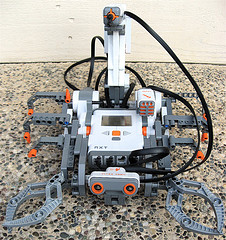
Robot scorpionThat’s the question SlashDot posed as they relinked to a research study at Washington University’s the University of Washington Computer Science & Engineering department entitled “A Spotlight on Security and Privacy Risks with Future Household Robots: Attacks and Lessons”, which reports on the potential for currently available household robots being hacked and exploited by malicious (or simply pranksome) third parties. [image by jurvetson]

Q. What robots did you study?

The RoboSapien V2, the Rovio, and the Spykee. Our versions were purchased in or before October 2008.

Q. Are you saying that I shouldn’t purchase one of these robots?

No. We are saying that there are security vulnerabilities relating to the specific versions of the robots that we studied. Any purchase decision will necessarily be made based on many factors, only one of which might be the vulnerabilities we identified. You may conclude that despite the vulnerabilities, one of these robots is right for you. In addition, we studied only three specific versions of the RoboSapien V2, the Rovio, and the Spykee. We have no reasons to believe that comparable robots from these or other manufacturers are more or less secure than the ones we studied.

Obviously the idea of your RoboSapien running amok in your absence is an admittedly minor worry – you’re unlikely to suffer more than chipped skirting boards or table legs. But looking just a little further ahead, the Washington crew are making a lot of sense; household bots are likely to become more prevalent pretty quickly, in direct proportion with their ability to do genuinely useful (or destructive) stuff. Security is rarely a high concern in consumer electronics, and the relentless ubiquity of spam is clear proof that you can’t realistically expect the average user to take adequate precautions either… so what seems like a bit of a gag now will probably be headline stories within a decade.

And it’s not just the household where the robot population is increasing – the damned things are cropping up everywhere, in all sorts of shapes and sizes and with all sorts of capabilities. Take, for example, the swarm of robotic bees that Harvard researchers are developing:

Harvard researchers recently got a $10 million grant to create a colony of flying robotic bees, or RoboBees to among other things, spur innovation in ultra-low-power computing and electronic “smart” sensors; and refine coordination algorithms to manage multiple, independent machines.

So, how dangerous could a hacked robot really be? Well, do I have any volunteers to enter that swarm of angry and compromised robotic bees?

Didn’t think so. 😉

Screw WorldCon; I wish I’d been at DefCon

So, the great and the good of science fiction and fantasy literature are all off to Montreal for this year’s WorldCon, and I’m not bitter and twisted in the slightest… after all, I can keep up to date on the gossip and action from innumerable sources, not least of which is the remarkably fully-featured ConReporter blog. Today’s Tomorrows columnist Brenda Cooper has promised us a con report on her return, too.

But as I think I’ve mentioned before, fandom really needs to up its game as far as convention badges are concerned, because the geeks and hackers at DefCon get badges that look like this:

DefCon 2009 delegate badge

C’mon, admit it: that whips the hell out of a laminated card on a lanyard. It also has hardware built into it that allows it to network with all the other cards from the same series (and plenty of other funky techno-gimcrackery, too).

And while I’d quite enjoy a long weekend of sitting around in a moderately posh hotel and nattering about (or even to) my favourite authors and critics, there’s a lot to learn at DefCon as well. Someone demonstrated an entirely mechanical hack of a supposedly unpickable electromechanical lock [via BoingBoing], and a gang of ATM skimmer-scammers unwittingly bit off way more than they could chew by planting a bogus ATM at the convention venue [via SlashDot].

Who knows – maybe someone managed to work out what the Conficker worm is actually for, and why it appears to have been abandoned to self-replicating autonomy by its creators [also via SlashDot]?

More seriously, though, I really wish I was going to Montreal for the weekend; one of the joys of fandom as a community is the sense of being part of a network of people who are passionate about the same stuff as you, but the downside is that you rarely get to see all those friends and colleagues in the flesh.

If you’re going to WorldCon, be sure to have yourself a damn good time… and raise a beer or two for me, OK?

How to dismantle a nuclear bomb (before it dismantles you)

old Russian nuclear bombNo, it’s not a U2 reference; in the wake of the proposed nuclear reduction initiatives between the US and Russia, those helpful folk at the BBC have an article on how nuclear weapons are decommissioned – only the procedure they witnessed was a simulation. [image by mikelopoulos]
The dismantlement experiment is a joint exercise between the UK and Norway – the first of its kind – and was held a few miles from Oslo.

The five-day exercise has been keenly anticipated internationally as a way of building trust between nuclear weapons states and non-nuclear weapons states.

It is designed to see if one country can verify the disarmament of another country’s nuclear weapon, but without any sensitive information about national security and weapon design being compromised.

This is one of the things that has always baffled me about these sorts of agreements: everyone saying “oh yes, we should be mutually disarming!” but then tacitly acknowledging that “actually, we’d best be keeping the technology secret, because we don’t really trust you not to build more – and if you do we’ll want to have better ones”. So much for building trust, eh?

Still, the descriptions of the procedure are kind of interesting – not so much from a technical standpoint (you don’t get a list of the wrench sizes you’ll need) but as a physical manifestation of nation-state psychology:

From the start inspectors watch, photograph, seal and tag key items. They cover entry and exit points to the disarmament chamber, sweeping all those going in and out to ensure no radioactive material is smuggled away.

“It is a very choreographed process, almost like a ballet,” says Mr Persbo. “Timings are very precise.”

The amount of fissile material in a nuclear bomb is itself classified, so a number of techniques have to be employed by the inspectors to ensure nothing is diverted when they are not able to measure it in detail themselves.

Each country’s scientists have separately designed and built their own prototype devices known as “information barriers”, which can confirm that an agreed amount of radioactive material is present in any container.

If nothing else, you’ve got the switcheroo-loophole plot mechanics for a fissile re-run of The Italian Job right there. That should make for a cheery movie… but if you want some real nuclear angst to set you up for the weekend, you can read this (PDF) report from the International Commission on Nuclear Non-proliferation and Disarmament that looks at the possibility of the old and flaky nuclear command and control infrastructures of the superpowers being hacked by terrorists in order to kick off a modern-day Ragnarok. I can hear Dan Brown firing up his word processor as we speak… [via SlashDot]

Is there any truly secure personal identifier?

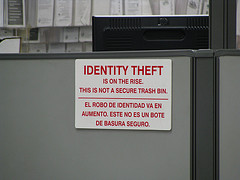
identity theft warning signIf there were any criminal elements unaware of the potential for brute-force guessing of United States Social Security numbers, we can be sure they know about it now, as the news is everywhere. Thankfully, it’s still not particularly easy to do and has a low success rate:

An SSN consists of nine digits, the first five of which are assigned by established criteria based in part on the zip code in which someone was born. Now Alessandro Acquisti and Ralph Gross of Carnegie Mellon University in Pittsburgh have shown that it is possible to predict the remaining four digits from someone’s birth date.

For 8.5 per cent people born between 1989 and 2003, the researchers were able to identify the complete SSN within less than 1000 attempts.

Obviously a rethink is required, as an SSN can be used to apply for credit cards – but what to replace it with? In this specific instance, preventing automated online credit card applications would be a wise move, incorporating the added bonus of making high-interest credit less easy to obtain on a whim. [image by TheTruthAbout]

But the SSN issue is symptomatic of the growing problem of identity theft. Are there any ID systems that can’t be hacked, spoofed, brute-forced or cloned? If not – and I rather suspect not – what do we do in situations where it’s necessary to conclusively confirm a person’s identity, especially in situations where the person isn’t present?

Perhaps some sort of localised bureau network would be of use, with every town having an office that could act as an identity clearing house for a multitude of different high-risk transactions, requiring the applicant or transactee to attend in person to confirm that they are who they claim to be. Sure, it’d add an extra layer of hassle to things like applying for credit cards, but that’s a small price to pay for a lower likelihood of having someone else apply for one in your name.

But then any national bureaucratic system will have the sort of baroque operational architecture that invites colonisation by corruption and good old fashioned human error… perhaps it would end up as a step sideways, or even backwards. Sounds like a problem for Bruce Schneier!

Perhaps it’s time to accept that in any large system where user convenience is increased, the risk of identity theft increases in proportion. But what will it take for us to give up quick credit and one-click ordering?

Oil rigs are vulnerable to hacking

oil rigIt shouldn’t come as a huge surprise – after all, anything that uses networked computing is at risk without the proper precautions – but independent researchers have declared oil rigs to be extremely vulnerable to hacking attempts.

While oil companies have made huge improvements in offshore safety and environmental protection, their efforts to secure important data have been poor, the SINTEF team says.

The group says that the current “integrated operations” model, which uses onshore workers to control processes carried out on the platform via networked PCs, leaves communications open to attack.

According to Science Daily, the team interviewed “key personnel in the petroleum sector” to get a sense of the data protection measures currently in place. The interviewees confirmed “that the number of safety incidents on production systems (platforms) has risen during past few years.”

Researchers said that hackers have already made their presence felt on oil platforms.

The worst-case scenario, of course, is that a hacker will break in and take over control of the whole platform,” says SINTEF scientist, Martin Gilje Jaatun. “Luckily, this has not happened yet, but we have heard of a number of incidents that could have turned into something quite dramatic. For example, virus attacks have led to process electronic equipment becoming unstable.

Frankly I’m surprised there haven’t been any major incidents so far, but it’s safe to assume that the inevitable resurgence of oil prices (not to mention the increasingly politicised nature of the fossil fuel industry) will make unmanned rigs into highly appealing target for hackers interested in protest or profit. [image by ccgd]

In fact, the profit motive is probably the stronger of the two… profit, or the prospect of free fuel. Any terrorist group or pirate nation looking for a ready source of the black gold would find it easy enough to hire some disaffected code-kiddie, then pay (or threaten) them enough to get them to bypass the security on an unmanned rig and then fiddle the telemetry for long enough to allow a physical invasion of the platform. Hey presto – a big base in offshore waters with all the oil you could ask for, and a target that even a major government is going to think twice about simply bombing to smithereens